


Page 201 - Physics Form 5 KSSM_Neat
P. 201
Light-dependent resistor in a light-controlled switch                                      CHAPTER 5


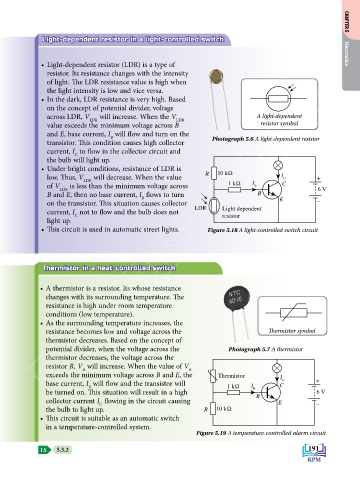
             •  Light-dependent resistor (LDR) is a type of                                              Electronics
               resistor. Its resistance changes with the intensity
               of light. The LDR resistance value is high when
              KEMENTERIAN PENDIDIKAN MALAYSIA
               the light intensity is low and vice versa.
             •  In the dark, LDR resistance is very high. Based
               on the concept of potential divider, voltage
               across LDR, V LDR  will increase. When the V LDR               A light-dependent
               value exceeds the minimum voltage across B                      resistor symbol
               and E, base current, I  will flow and turn on the
                                  B
               transistor. This condition causes high collector   Photograph 5.6 A light-dependent resistor
               current, I  to flow in the collector circuit and
                       C
               the bulb will light up.
             •  Under bright conditions, resistance of LDR is
               low. Thus, V LDR  will decrease. When the value   R  10 kΩ            I C        +
               of V LDR  is less than the minimum voltage across      1 kΩ   I B      C
               B and E, then no base current, I  flows to turn                B                 6 V
                                            B
               on the transistor. This situation causes collector                    E          –
               current, I  not to flow and the bulb does not   LDR  Light dependent
                       C
               light up.                                            resistor
             •  This circuit is used in automatic street lights.  Figure 5.18 A light-controlled switch circuit


              Thermistor in a heat-controlled switch

             •  A thermistor is a resistor. Its whose resistance
               changes with its surrounding temperature. The
               resistance is high under room temperature
               conditions (low temperature).
             •  As the surrounding temperature increases, the
               resistance becomes low and voltage across the                      Thermistor symbol
               thermistor decreases. Based on the concept of
               potential divider, when the voltage across the         Photograph 5.7 A thermistor
               thermistor decreases, the voltage across the
               resistor R, V  will increase. When the value of V
                          R
                                                          R
               exceeds the minimum voltage across B and E, the    Thermistor         I
               base current, I  will flow and the transistor will    1 kΩ   I        C C        +
                            B
               be turned on. This situation will result in a high            B                  6 V
               collector current I  flowing in the circuit causing            B     E           –
                               C
               the bulb to light up.                          R   10 kΩ
             •  This circuit is suitable as an automatic switch
               in a temperature-controlled system.
                                                            Figure 5.19 A temperature-controlled alarm circuit


             LS     5.3.2                                                                     191

