


Page 212 - Physics Form 5 KSSM_Neat
P. 212
Half-life
           When a sample of radioactive material decays, the number of parent nuclei which has not
           decayed decreases with time while the number of daughter nuclei increases. Let us do the
           following activities to get an idea about half-life.

              Activity        6.2                                                       ISS  ICS
            KEMENTERIAN PENDIDIKAN MALAYSIA
                                                                                 SCAN ME
            Aim:  Watch the animated video to get an idea about the half-life    SCAN ME
                  and discuss the decay series of a radioactive source             Video of half-life
            Instructions:
            1.  Carry out this activity in pairs.
                                                                               http://bit.ly/2CPwomw
            2.  Scan the QR code to watch the video on half-life and browse
               the Internet for more information on half-life.
            3.  Based on the video and the information obtained from the website, discuss:
               (a)  What is half-life?
               (b)  What is radioactive decay series?
               (c)  State  the  types of radiation  emitted,  the  elements  produced  and  the  time  taken  for the
                  uranium-238 decay series.
               (d)  Explain the importance of the uranium-238 decay series in determining the age of rocks and
                  the age of the Earth.
            4.  Prepare a short multimedia presentation and present it in class.


                The half-life, T 1 is the time taken for a sample of radioactive nuclei to decay to half of its
                             2
           initial number. After one half-life, the number of nuclei that are not decayed will be half of its
           initial value.
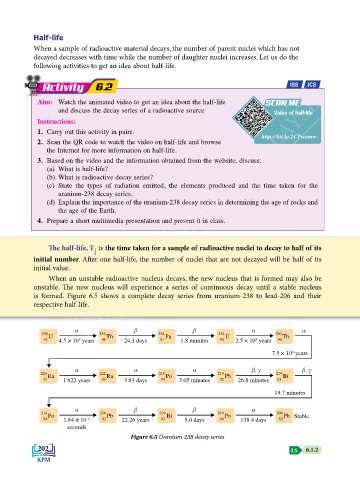
                When an unstable radioactive nucleus decays, the new nucleus that is formed may also be
           unstable. The new nucleus will experience a series of continuous decay until a stable nucleus
           is formed. Figure 6.5 shows a complete decay series from uranium-238 to lead-206 and their
           respective half-life.


                        α                β                 β                 α              α
              238              234               234               234              230
                                 Th
                                                   Pa
                                                                                      Th
                92   U  4.5 × 10  years     90         24.1 days     91         1.8 minutes     92   U  2.5 × 10  years     90
                                                                              5
                         9


                                                                                   7.5 × 10  years
                                                                                         4
                        α                α                 α                 β, γ           β, γ
             226               222               218              214               214
                                                                    Pb
               Ra
                                                   Po
                                 Ra
                88         1 622 years     86         3.83 days     84         3.05 minutes     82         26.8 minutes     83     Bi

                                                                                   19.7 minutes
                        α                β                 β                 α
             214  Po           210  Pb           210  Bi          210  Po           206  Pb
                84         1.64 × 10 –4     82         22.26 years     83         5.0 days     84         138.4 days     82         Stable
                     seconds
                                        Figure 6.5 Uranium-238 decay series
            202                                                                         LS   6.1.2

