


Page 210 - Physics Form 5 KSSM_Neat
P. 210
6.1   Radioactive Decay                                        Info GALLERY

           Radioactive  decay  is  a  process  in  which  an  unstable  nucleus   A radioactive decay is random
           becomes more stable by emitting radioactive radiation. This   and spontaneous because it is not
           process is random and spontaneous. There are three types of   influenced by temperature, pressure
           radioactive radiation, namely alpha particle (a), beta particle (b)   and other physical factors.
            +KEMENTERIAN PENDIDIKAN MALAYSIA
           and gamma ray (g).


                  +
                  +
                                                                              LET’S RECALL
                                                                              LET’S RECALL
                                                                                     Radioactivity
            Alpha particle (a)   Beta particle (b)    Gamma ray (g)                   http://bit.
                                                                                      ly/3ghCObR
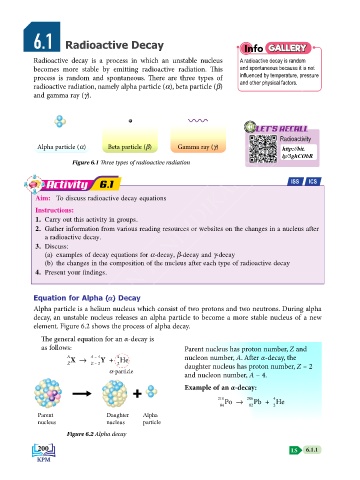
                       Figure 6.1 Three types of radioactive radiation

               Activity        6.1                                                      ISS   ICS


            Aim:  To discuss radioactive decay equations
            Instructions:
            1.  Carry out this activity in groups.
            2.  Gather information from various reading resources or websites on the changes in a nucleus after
              a radioactive decay.
            3.  Discuss:
              (a)  examples of decay equations for a-decay, b-decay and g-decay
              (b)  the changes in the composition of the nucleus after each type of radioactive decay
            4.  Present your findings.


           Equation for Alpha (a) Decay
           Alpha particle is a helium nucleus which consist of two protons and two neutrons. During alpha
           decay, an unstable nucleus releases an alpha particle to become a more stable nucleus of a new
           element. Figure 6.2 shows the process of alpha decay.

             The general equation for an α-decay is
             as follows:                                Parent nucleus has proton number, Z and
                     A   X  ˜   A – 4   Y  +  He        nucleon number, A. After α-decay, the
                                    4

                     Z      Z – 2   2                   daughter nucleus has proton number, Z – 2
                                  a-particle
                                                        and nucleon number, A – 4.
              + +  +
               +  +               ++ +                  Example of an α-decay:
               + +  +  +        + + + + +  +  +
            + +  + + + +          + +         +                   210      206     4
              +  +                +                                84 Po  ˜   82 Pb  +  He
                                                                                   2
            Parent               Daughter   Alpha
            nucleus              nucleus    particle
                     Figure 6.2 Alpha decay
            200                                                                         LS   6.1.1

