


Page 12 - DnD_5e_Players_Handbook_(BnW_OCR)
P. 12
B u i l d i n g   B r u e n o r ,  St e p   5     T i e r s   o f   P l a y
             Bob writes down the starting equipment from  the
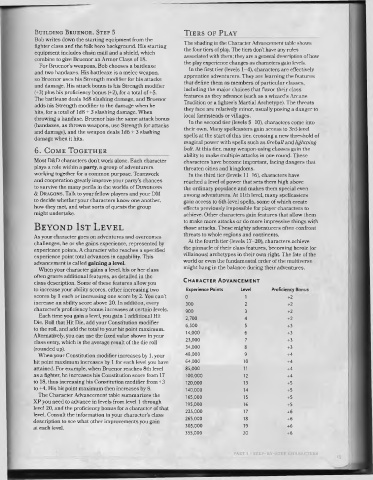
                                                               The shading in the Character Advancement table shows
             fighter class and the folk hero background. His starting
                                                               the four tiers of play. The tiers don’t have any rules
             equipment includes chain mail and a shield, which
                                                               associated with them; they are a general description of how
             com bine to give Bruenor an Arm or Class of 18.
                                                               the play experience changes as characters gain levels.
              For Bruenor’s w eapons, Bob chooses a battleaxe
                                                                In the first tier (levels  1-4), characters are effectively
             and two handaxes. His battleaxe is a melee weapon,
                                                               apprentice adventurers. They are learning the features
             so Bruenor uses his Strength modifier for his attacks
                                                               that define them as m em bers of particular classes,
             and damage. His attack bonus is his Strength modifier
                                                               including the major choices that flavor their class
             (+3) plus his proficiency bonus (+2), for a total of +5.
                                                               features as they advance (such as a wizard’s Arcane
             The battleaxe deals  1d8 slashing damage, and Bruenor
                                                               Tradition or a fighter’s Martial Archetype). The threats
             adds his Strength modifier to the damage when he
                                                               they face are relatively minor, usually posing a danger to
             hits, for a total of 1d8 + 3 slashing damage. W hen
                                                               local farmsteads or villages.
             throwing a handaxe, Bruenor has the same attack bonus
                                                                In the second tier (levels 5-10), characters com e into
             (handaxes, as thrown weapons, use Strength for attacks
                                                               their own. Many spellcasters gain access to 3rd-level
             and damage), and the weapon deals  1d6 + 3 slashing
                                                               spells at the start of this tier, crossing a new threshold of
             damage when it hits.
                                                               magical power with spells such as fireball and lightning
                                                               bolt. At this tier, many weapon-using classes gain the
             6.  C  o m e   T o g e t h e r
                                                               ability to make multiple attacks in one round. These
            Most D & D  characters don’t work alone. Each character   characters have becom e important, facing dangers that
            plays a role within a party, a group of adventurers   threaten cities and kingdoms.
            working together for a com m on purpose. Teamwork   In the third tier (levels  11-16), characters have
            and cooperation greatly improve your party’s chances   reached a level of power that sets them high above
            to survive the many perils in the worlds o f D u n g e o n s    the ordinary populace and makes them special even
            &  D r a g o n s .  Talk to your fellow players and your DM   am ong adventurers. At  11th level, many spellcasters
            to decide whether your characters know one another,   gain access to 6th-level spells, som e of which create
            how they met, and what sorts of quests the group   effects previously im possible for player characters to
            might undertake.                                  achieve. Other characters gain features that allow them
                                                              to make m ore attacks or do m ore impressive things with
            B e y o n d   1st L e v e l                       those attacks. These mighty adventurers often confront
                                                              threats to whole regions and continents.
            As your character goes on adventures and overcom es
                                                                At the fourth tier (levels 17-20), characters achieve
            challenges, he or she gains experience, represented by
                                                              the pinnacle of their class features, becom ing heroic (or
            experience points. A character w ho reaches a specified
                                                              villainous) archetypes in their own right. The fate of the
            experience point total advances in capability. This
                                                              world or even the fundamental order of the multiverse
            advancement is called gaining a level.
                                                              might hang in the balance during their adventures.
              W hen your character gains a level, his or her class
            often grants additional features, as detailed in the
                                                              C h a r a c t e r   A d v a n c e m e n t
            class description. Som e of these features allow you
            to increase your ability scores, either increasing two   Experience Points  Level  Proficiency
            scores by 1  each or increasing one score by 2. You can’t   0          1             +2
            increase an ability score above 20. In addition, every   300           2             +2
            character’s proficiency bonus increases at certain levels.
                                                               900                 3             +2
              Each time you gain a level, you gain  1  additional Hit
                                                               2,700               4             +2
            Die. Roll that Hit Die, add your Constitution modifier
                                                               6,500               5             +3
            to the roll, and add the total to your hit point maximum.
                                                               14,000              6             +3
            Alternatively, you can use the fixed value shown in your
                                                               23,000              7             +3
            class entry, which is the average result of the die roll
                                                               34,000              8             +3
            (rounded up).
              W hen your Constitution modifier increases by 1, your   48,000       9             +4
            hit point maximum increases by 1  for each level you have   64,000     10            +4
            attained. For example, when Bruenor reaches 8th level   85,000         11            +4
            as a fighter, he increases his Constitution score from 17   100,000    12            +4
            to  18, thus increasing his Constitution modifier from +3   120,000    13            +5
            to +4. His hit point maximum then increases by 8.
                                                               140,000             14            +5
              The Character Advancement table sum m arizes the
                                                               165,000             15            +5
            X P  you need to advance in levels from  level  1  through
                                                               195,000             16            +5
            level 20, and the proficiency bonus for a character of that
                                                               225,000             17            +6
            level. Consult the information in your character’s class
                                                               265,000            18             +6
            description to see what other improvements you gain
                                                               305,000            19             +6
            at each level.
                                                               355,000            20             +6

