


Page 79 - JURNAL PENYELIDIKAN AKADEMIK
P. 79
J u r n a l   P e n y e l i d i k a n   A k a d e m i k   I P G M   J i l i d   5 / 2 0 2 0  | 72


               described  above.  The  assessment  of  CT  RBT  training  could  be  formalized.  As
               suggested by Brennan and Reinseck (2012), assessment can be in the form of project
               portfolio analysis and artifact-based interviews.

                       Portfolio  analysis  can  focus  on  the  products  from  the  use  of  Scratch  and
               Microsoft    Makecode       tools.   Dr   Scratch    is   an    online    analytical   tool
               (http://www.drscratch.org/)  that  evaluates  Scratch  projects  from  different
               computational areas. Scratch project can be uploaded to this website or just use the
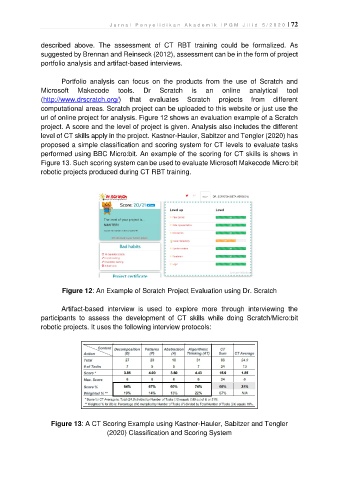
               url of online project for analysis. Figure 12 shows an evaluation example of a Scratch
               project. A score and the level of project is given. Analysis also includes the different
               level of CT skills apply in the project. Kastner-Hauler, Sabitzer and Tengler (2020) has
               proposed a simple classification and scoring system for CT levels to evaluate tasks
               performed using BBC Micro:bit. An example of the scoring for CT skills is shows in
               Figure 13. Such scoring system can be used to evaluate Microsoft Makecode Micro:bit
               robotic projects produced during CT RBT training.


                       Figure 12: An Example of Scratch Project Evaluation using Dr. Scratch

                       Artifact-based  interview  is  used  to  explore  more  through  interviewing  the
               participants  to  assess  the  development  of  CT  skills  while  doing  Scratch/Micro:bit
               robotic projects. It uses the following interview protocols:


                   Figure 13: A CT Scoring Example using Kastner-Hauler, Sabitzer and Tengler
                                       (2020) Classification and Scoring System

