


Page 104 - Critical Care Nursing Demystified
P. 104
Chapter 3  CARE OF THE PATIENT WITH CRITICAL CARDIAC AND VASCULAR NEEDS        89


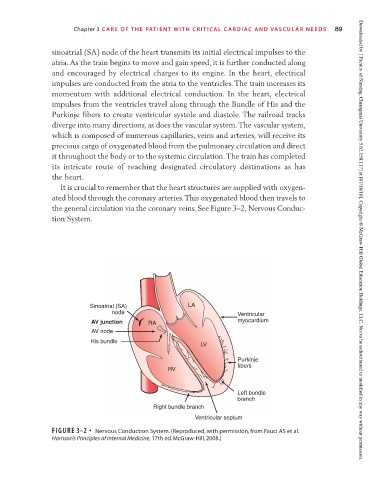
                               sinoatrial (SA) node of the heart transmits its initial electrical impulses to the
                               atria. As the train begins to move and gain speed, it is further conducted along
                               and encouraged by electrical charges to its engine. In the heart, electrical
                               impulses are conducted from the atria to the ventricles. The train increases its
                               momentum with additional electrical conduction. In the heart, electrical
                               impulses from the  ventricles travel along through the Bundle of His and the
                               Purkinje fibers to create ventricular systole and diastole. The railroad tracks
                               diverge into many directions, as does the vascular system. The vascular system,
                               which is composed of numerous capillaries, veins and arteries, will receive its
                               precious cargo of oxygenated blood from the pulmonary circulation and direct
                               it throughout the body or to the systemic circulation. The train has completed
                               its intricate route of reaching designated circulatory destinations as has
                               the heart.
                                 It is crucial to remember that the heart structures are supplied with oxygen-
                               ated blood through the coronary arteries. This oxygenated blood then travels to
                               the general circulation via the coronary veins. See Figure 3–2, Nervous Conduc-
                               tion System.                                                                         Downloaded by [ Faculty of Nursing, Chiangmai University 5.62.158.117] at [07/18/16]. Copyright © McGraw-Hill Global Education Holdings, LLC. Not to be redistributed or modified in any way without permission.


                                         Sinoatrial (SA)             LA
                                               node                               Ventricular
                                          AV junction    RA                       myocardium
                                          AV node
                                         His bundle
                                                                        LV
                                                                                  Purkinje
                                                                                  fibers
                                                               RV


                                                                                  Left bundle
                                                                                  branch
                                                           Right bundle branch
                                                                       Ventricular septum
                               FIGURE 3–2  •   Nervous Conduction System. (Reproduced, with permission, from Fauci AS et al.
                               Harrison’s Principles of Internal Medicine, 17th ed. McGraw-Hill, 2008.)

