


Page 105 - Critical Care Nursing Demystified
P. 105
90        CRITICAL CARE NURSING  DeMYSTIFIED


                     Assessment Skills


                             1    The development of cardiac problems within the individual is very trau-
                            matic and anxiety provoking. Information pertaining to the cardiovascular
                              system will enable the critical care nurse to provide the delivery of more thor-
                            ough and comprehensive nursing care to the patient.
                               Again, nurse proficiency is required in the mental, emotional, and physical
                            assessment of the individual suffering from cardiovascular issues. Strength in
                            assessment skills and techniques will guide patient care, stabilize the patient’s
                            condition, and prevent additional cardiovascular deterioration.


                            History and Interview
                            This portion of assessment should be conducted in a nonthreatening and non-
                            intimidating manner. The patient’s presenting symptoms and complaints need
                            to be explored using an organized framework. If the patient is experiencing
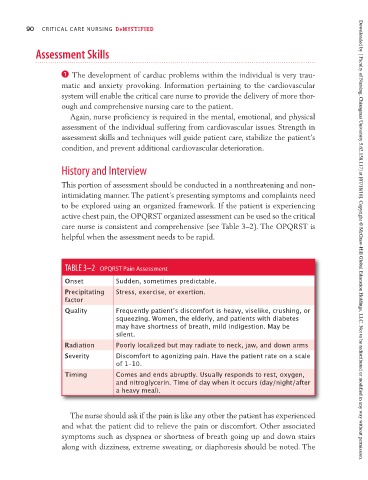
                            active chest pain, the OPQRST organized assessment can be used so the critical
                            care nurse is consistent and comprehensive (see Table 3–2). The OPQRST is
                            helpful when the assessment needs to be rapid.                                      Downloaded by [ Faculty of Nursing, Chiangmai University 5.62.158.117] at [07/18/16]. Copyright © McGraw-Hill Global Education Holdings, LLC. Not to be redistributed or modified in any way without permission.


                             TABLE 3–2  OPQRST Pain Assessment
                             Onset          Sudden, sometimes predictable.
                             Precipitating   Stress, exercise, or exertion.
                             factor
                             Quality        Frequently patientʼs discomfort is heavy, viselike, crushing, or
                                            squeezing. Women, the elderly, and patients with diabetes
                                            may have shortness of breath, mild indigestion. May be
                                            silent.
                             Radiation      Poorly localized but may radiate to neck, jaw, and down arms
                             Severity       Discomfort to agonizing pain. Have the patient rate on a scale
                                            of 1–10.
                             Timing         Comes and ends abruptly. Usually responds to rest, oxygen,
                                            and nitroglycerin. Time of day when it occurs (day/night/after
                                            a heavy meal).


                               The nurse should ask if the pain is like any other the patient has experienced
                            and what the patient did to relieve the pain or discomfort. Other associated
                            symptoms such as dyspnea or shortness of breath going up and down stairs
                            along with dizziness, extreme sweating, or diaphoresis should be noted. The

