


Page 431 - Critical Care Nursing Demystified
P. 431
416        CRITICAL CARE NURSING  DeMYSTIFIED


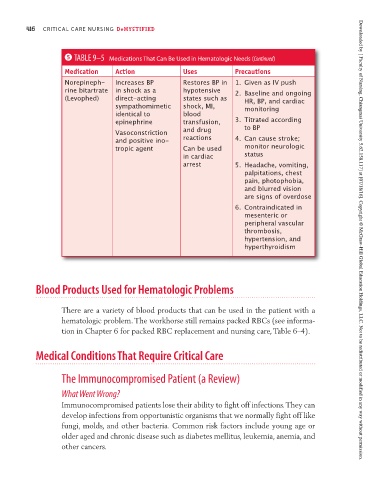
                              5   TABLE 9–5  Medications That Can Be Used in Hematologic Needs (Continued)

                             Medication    Action             Uses           Precautions
                             Norepineph-   Increases BP       Restores BP in  1.  Given as IV push
                             rine bitartrate  in shock as a   hypotensive    2.  Baseline and ongoing
                             (Levophed)    direct-acting      states such as   HR, BP, and cardiac
                                           sympathomimetic    shock, MI,       monitoring
                                           identical to       blood
                                           epinephrine        transfusion,   3.  Titrated according
                                           Vasoconstriction   and drug         to BP
                                           and positive ino-  reactions      4.  Can cause stroke;
                                           tropic agent       Can be used      monitor neurologic
                                                              in cardiac       status
                                                              arrest         5.  Headache, vomiting,
                                                                               palpitations, chest
                                                                               pain, photophobia,
                                                                               and blurred vision
                                                                               are signs of overdose
                                                                             6.  Contraindicated in
                                                                               mesenteric or
                                                                               peripheral vascular
                                                                               thrombosis,
                                                                               hypertension, and                Downloaded by [ Faculty of Nursing, Chiangmai University 5.62.158.117] at [07/18/16]. Copyright © McGraw-Hill Global Education Holdings, LLC. Not to be redistributed or modified in any way without permission.
                                                                               hyperthyroidism


                     Blood Products Used for Hematologic Problems


                            There are a variety of blood products that can be used in the patient with a
                            hematologic problem. The workhorse still remains packed RBCs (see informa-
                            tion in Chapter 6 for packed RBC replacement and nursing care, Table 6–4).


                     Medical Conditions That Require Critical Care


                            The Immunocompromised Patient (a Review)

                            What Went Wrong?
                            Immunocompromised patients lose their ability to fight off infections. They can
                            develop infections from opportunistic organisms that we normally fight off like
                            fungi, molds, and other bacteria. Common risk factors include young age or
                            older aged and chronic disease such as diabetes mellitus, leukemia, anemia, and
                            other cancers.

