


Page 100 - Color_Atlas_of_Physiology_5th_Ed._-_A._Despopoulos_2003
P. 100
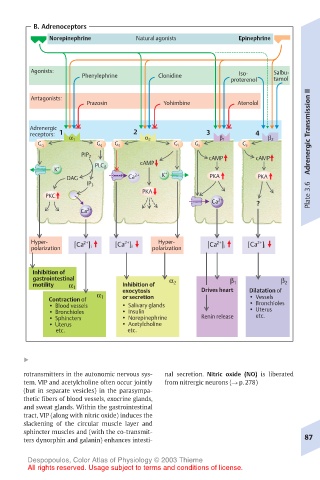
B. Adrenoceptors
            Norepinephrine      Natural agonists       Epinephrine


        Agonists:                                              Salbu-
                    Phenylephrine    Clonidine         Iso-
                                                     proterenol  tamol
                                                                       II
        Antagonists:
                     Prazosin         Yohimbine       Atenolol

        Adrenergic
        receptors:  1          2               3           4           Adrenergic Transmission
                 α 1              α 2             β 1        β 2
          G q          G q  G o         G i  G s        G s
                   PIP 2                        cAMP       cAMP
                                 cAMP
             K +      PLC β           +
                DAG           Ca 2+  K          PKA        PKA
                     IP 3
                                 PKA
           PKC                                                         Plate 3.6
                                                 Ca 2+     ?
                   Ca 2+

        Hyper-      2+       2+      Hyper-       2+       2+
        polarization  [Ca ] i  [Ca ] i  polarization  [Ca ] i  [Ca ] i


        Inhibition of
        gastrointestinal
        motility  α 1        Inhibition of  α 2      β 1        β 2
                             exocytosis       Drives heart  Dilatation of
            Contraction of  α 1  or secretion            •  Vessels
            •  Blood vessels  •  Salivary glands         •  Bronchioles
            •  Bronchioles  •  Insulin                   •  Uterus
            •  Sphincters   •  Norepinephrine  Renin release       etc.
            •  Uterus       •  Acetylcholine
                  etc.           etc.

      !
      rotransmitters in the autonomic nervous sys-  nal secretion. Nitric oxide (NO) is liberated
      tem. VIP and acetylcholine often occur jointly  from nitrergic neurons (! p. 278)
      (but in separate vesicles) in the parasympa-
      thetic fibers of blood vessels, exocrine glands,
      and sweat glands. Within the gastrointestinal
      tract, VIP (along with nitric oxide) induces the
      slackening of the circular muscle layer and
      sphincter muscles and (with the co-transmit-
      ters dynorphin and galanin) enhances intesti-                   87

       Despopoulos, Color Atlas of Physiology © 2003 Thieme
       All rights reserved. Usage subject to terms and conditions of license.

