


Page 129 - Color_Atlas_of_Physiology_5th_Ed._-_A._Despopoulos_2003
P. 129
Pressure–Volume Curve, Respiratory  determine the peak expiratory and inspiratory
       Work                            pressures (! A, red and green curves). Only a
                                       very small pressure can be generated from a
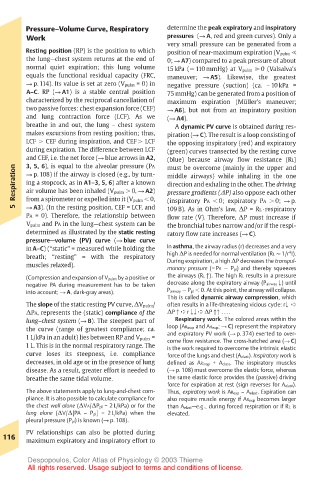
       Resting position (RP) is the position to which  position of near-maximum expiration (V pulm #
       the lung—chest system returns at the end of  0; ! A7) compared to a peak pressure of about
       normal quiet expiration; this lung volume  15 kPa (! 110 mmHg) at V pulm $ 0 (Valsalva’s
       equals the functional residual capacity (FRC,  maneuver; ! A5). Likewise, the greatest
       ! p. 114). Its value is set at zero (V pulm = 0) in  negative pressure (suction) (ca. – 10 kPa =
       A–C. RP (! A1) is a stable central position  75 mmHg) can be generated from a position of
       characterized by the reciprocal cancellation of  maximum expiration (Müller’s maneuver;
       two passive forces: chest expansion force (CEF)  ! A6), but not from an inspiratory position
       and lung contraction force (LCF). As we  (! A4).
       breathe in and out, the lung – chest system  A dynamic PV curve is obtained during res-
       makes excursions from resting position; thus,  piration (! C). The result is a loop consisting of
       LCF ! CEF during inspiration, and CEF ! LCF  the opposing inspiratory (red) and expiratory
       during expiration. The difference between LCF  (green) curves transected by the resting curve
       and CEF, i.e. the net force (! blue arrows in A2,  (blue) because airway flow resistance (RL)
       3, 5, 6), is equal to the alveolar pressure (PA
    Respiration  ing a stopcock, as in A1–3, 5, 6) after a known  middle airways) while inhaling in the one
                                       must be overcome (mainly in the upper and
       ! p. 108) if the airway is closed (e.g., by turn-
                                       direction and exhaling in the other. The driving
       air volume has been inhaled (V pulm ! 0, ! A2)
                                       pressure gradients (∆P) also oppose each other
       ! A3). (In the resting position, CEF = LCF, and
    5  from a spirometer or expelled into it (V pulm " 0,  (inspiratory PA " 0; expiratory PA ! 0; ! p.
                                       109 B). As in Ohm’s law, ∆P = RL ! respiratory
                                              .
       PA = 0). Therefore, the relationship between  flow rate (V). Therefore, ∆P must increase if
       V pulm and PA in the lung—chest system can be  the bronchial tubes narrow and/or if the respi-
       determined as illustrated by the static resting  ratory flow rate increases (! C).
       pressure—volume (PV) curve (! blue curve
       in A–C) (“static” = measured while holding the  In asthma, the airway radius (r) decreases and a very
                                                                  4
       breath; “resting” = with the respiratory  high ∆P is needed for normal ventilation (RL ! 1/r !).
                                       During exspiration, a high ∆P decreases the transpul-
       muscles relaxed).               monary pressure (= PA % P pl) and thereby squeezes
       (Compression and expansion of V pulm by a positive or  the airways (R L"). The high RL results in a pressure
       negative PA during measurement has to be taken  decrease along the expiratory airway (P airway#) until
       into account; ! A, dark-gray areas).  P airway % P pl " 0. At this point, the airway will collapse.
                                       This is called dynamic airway compression, which
       The slope of the static resting PV curve, ∆V pulm/  often results in a life-threatening vicious cycle: r# !
       ∆PA, represents the (static) compliance of the  ∆P"! r##! ∆P""....
       lung–chest system (! B). The steepest part of  Respiratory work. The colored areas within the
       the curve (range of greatest compliance; ca.  loop (AR insp and AR exp; ! C) represent the inspiratory
                                       and expiratory PV work (! p. 374) exerted to over-
       1 L/kPa in an adult) lies between RP and V pulm =  come flow resistance. The cross-hatched area (! C)
       1 L. This is in the normal respiratory range. The  is the work required to overcome the intrinsic elastic
       curve loses its steepness, i.e. compliance  force of the lungs and chest (A elast). Inspiratory work is
       decreases, in old age or in the presence of lung  defined as AR insp + A elast. The inspiratory muscles
       disease. As a result, greater effort is needed to  (! p. 108) must overcome the elastic force, whereas
       breathe the same tidal volume.  the same elastic force provides the (passive) driving
                                       force for expiration at rest (sign reverses for A elast).
       The above statements apply to lung-and-chest com-  Thus, expiratory work is AR exp – A elast. Expiration can
       pliance. It is also possible to calculate compliance for  also require muscle energy if AR exp becomes larger
       the chest wall alone (∆VA/∆P pl = 2 L/kPa) or for the  than A elast—e.g., during forced respiration or if RL is
       lung alone (∆V/∆[PA – P pl] = 2 L/kPa) when the  elevated.
       pleural pressure (P pl) is known (! p. 108).
       PV relationships can also be plotted during
  116
       maximum expiratory and inspiratory effort to
       Despopoulos, Color Atlas of Physiology © 2003 Thieme
       All rights reserved. Usage subject to terms and conditions of license.

