


Page 133 - Color_Atlas_of_Physiology_5th_Ed._-_A._Despopoulos_2003
P. 133
Pulmonary Gas Exchange          about 8 kPa (60 mmHg) for O 2 and about
                                       0.8 kPa (6 mmHg) for CO 2, although regional
       Alveolar ventilation. Only the alveolar part  variation occurs (! p. 122). PA O 2 will rise when
       (VA) of the tidal volume (VT) reaches the al-  PA CO 2 falls (e.g., due to hyperventilation) and
       veoli. The rest goes to dead space (VD). It fol-  vice versa (! alveolar gas equation, p. 136).
       lows that VA = VT – VD (L) (! p. 114). Multiply-  O 2 diffuses about 1–2µm from alveolus to
       ing these volumes by the respiratory rate (f in  bloodstream (diffusion distance). Under nor-
         – 1
       min ) results in the respective ventilation, i.e.,  mal resting conditions, the blood in the pul-
          .
       .
              .
                                .
                              .
                           .
                    .
       V A, V E (or V T), and V D. Thus, V A = V E–V D (L !  monary capillary is in contact with the alve-
         – 1
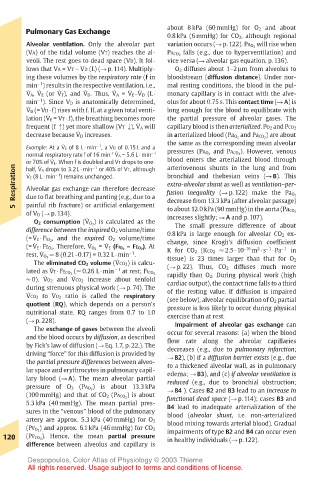
       min ). Since V D is anatomically determined,  olus for about 0.75 s. This contact time (! A) is
       .
       V D (= VD ! f) rises with f. If, at a given total venti-  long enough for the blood to equilibrate with
            .
       lation (V E = VT ! f), the breathing becomes more  the partial pressure of alveolar gases. The
                                .
       frequent (f ") yet more shallow (VT #), V A will  capillary blood is then arterialized. PO 2 and PCO 2
                  .
       decrease because V D increases.  in arterialized blood (Pa O 2 and Pa CO 2 ) are about
               .                       the same as the corresponding mean alveolar
       Example: At a V E of 8 L ! min , a VD of 0.15 L and a
                       – 1
                           .
                          -1
       normal respiratory rate f of 16 min V A = 5.6 L ! min – 1  pressures (PA O 2 and PA CO 2 ). However, venous
             .
       or 70% of V E. When f is doubled and VT drops to one-  blood enters the arterialized blood through
          .
                                       arteriovenous shunts in the lung and from
    Respiration  V E (8 L ! min ) remains unchanged.  bronchial and thebesian veins (! B). This
                       or 40% of VT, although
                      – 1
       half, V A drops to 3.2 L ! min
       .
             – 1
                                       extra-alveolar shunt as well as ventilation–per-
       Alveolar gas exchange can therefore decrease
                                       fusion inequality (! p. 122) make the Pa O 2
       painful rib fracture) or artificial enlargement
    5  due to flat breathing and panting (e.g., due to a  decrease from 13.3 kPa (after alveolar passage)
       of V D (! p. 134).  .           to about 12.0 kPa (90 mmHg) in the aorta (Pa CO 2
                                       increases slightly; ! A and p. 107).
         O 2 consumption (V O 2 ) is calculated as the  The small pressure difference of about
       difference between the inspired O 2 volume/time  0.8 kPa is large enough for alveolar CO 2 ex-
         .
       (= V E ! FI O 2 , and the expired O 2 volume/time  change, since Krogh’s diffusion coefficient
                         .
         .
                     .
       (= V E ! FE O 2 . Therefore, V O 2 = V E (FI O 2 – FE O 2 ). At  K for CO 2 (KCO 2 ! 2.5 ! 10 –16 m ! s – 1 ! Pa – 1  in
                                                           2
          .
       rest, V O 2 ! 8 (0.21–0.17) = 0.32 L ! min .
                              – 1
                           .
         The eliminated CO 2 volume (VCO 2) is calcu-  tissue) is 23 times larger than that for O 2
            .
       lated as VT ! FE CO 2 (! 0.26 L ! min  – 1  at rest; FI CO 2  (! p. 22). Thus, CO 2 diffuses much more
           .
                                       rapidly than O 2. During physical work (high
                 .
       ! 0). VO 2 and VCO 2 increase about tenfold  cardiac output), the contact time falls to a third
       during strenuous physical work (! p. 74). The  of the resting value. If diffusion is impaired
       .
             .
       VCO 2 to VO 2 ratio is called the respiratory  (see below), alveolar equilibration of O 2 partial
       quotient (RQ), which depends on a person’s  pressure is less likely to occur during physical
       nutritional state. RQ ranges from 0.7 to 1.0  exercise than at rest.
       (! p. 228).                      Impairment of alveolar gas exchange can
         The exchange of gases between the alveoli
       and the blood occurs by diffusion, as described  occur for several reasons: (a) when the blood
                                       flow rate along the alveolar capillaries
       by Fick’s law of diffusion (! Eq. 1.7, p. 22,). The  decreases (e.g., due to pulmonary infarction;
       driving “force” for this diffusion is provided by  ! B2), (b) if a diffusion barrier exists (e.g., due
       the partial pressure differences between alveo-
       lar space and erythrocytes in pulmonary capil-  to a thickened alveolar wall, as in pulmonary
                                       edema; ! B3), and (c) if alveolar ventilation is
       lary blood (! A). The mean alveolar partial  reduced (e.g., due to bronchial obstruction;
       pressure of O 2 (PA O 2 ) is about 13.3 kPa  ! B4 ). Cases B2 and B3 lead to an increase in
       (100 mmHg) and that of CO 2 (PA CO 2 ) is about  functional dead space (! p. 114); cases B3 and
       5.3 kPa (40 mmHg). The mean partial pres-  B4 lead to inadequate arterialization of the
       sures in the “venous” blood of the pulmonary
                                       blood (alveolar shunt, i.e. non-arterialized
       artery are approx. 5.3 kPa (40 mmHg) for O 2
                                       blood mixing towards arterial blood). Gradual
       (PV O 2 ) and approx. 6.1 kPa (46 mmHg) for CO 2  impairments of type B2 and B4 can occur even
  120  (PV CO 2 ). Hence, the mean partial pressure  in healthy individuals (! p. 122).
       difference between alveolus and capillary is
       Despopoulos, Color Atlas of Physiology © 2003 Thieme
       All rights reserved. Usage subject to terms and conditions of license.

