


Page 130 - Color_Atlas_of_Physiology_5th_Ed._-_A._Despopoulos_2003
P. 130
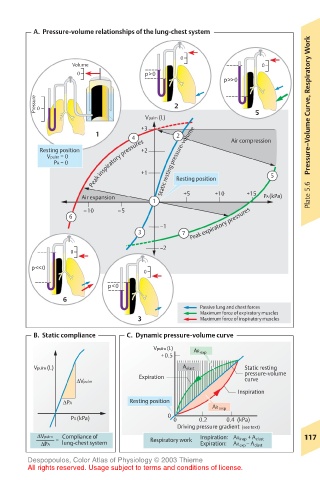
A.  Pressure-volume relationships of the lung-chest system


                                          0
                 Volume                                     0
                  0               p>0
                                                   p>>0
         Pressure  0                    2                              Pressure–Volume Curve, Respiratory Work

                                  Vpulm (L)               5
                                 +3
                       1       4         2           Air compression
          Resting position       +2
                Vpulm = 0
                      PA = 0  Peak inspiratory pressures +1 Static resting pressure-volume  5
                                         Resting position
                   Air expansion          +5     +10     +15  PA (kPa)  Plate 5.6
                                   1
                    –10     –5
                 6
                                     –1     Peak expiratory pressures
                                3         7
                                     –2
                 0
        p<<0
                                 0
                         p<0
               6
                                              Passive lung and chest forces
                                              Maximum force of expiratory muscles
                                3             Maximum force of inspiratory muscles
         B.  Static compliance  C.  Dynamic pressure-volume curve
                                    Vpulm (L)
                                     +0.5    AR  exp
         Vpulm (L)                        A elast       Static resting
                                Expiration              pressure-volume
                  ∆Vpulm                                curve
                                                       Inspiration
               ∆PA            Resting position
                                                 AR  insp
                 PA (kPa)              0  0   0.2   0.4 (kPa)
                                         Driving pressure gradient  (see text)
         ∆Vpulm  Compliance of                                       117
              =                    Respiratory work  Inspiration: AR insp  + A elast
          ∆PA  lung-chest system              Expiration:  AR exp – A elast
       Despopoulos, Color Atlas of Physiology © 2003 Thieme
       All rights reserved. Usage subject to terms and conditions of license.

