


Page 137 - Color_Atlas_of_Physiology_5th_Ed._-_A._Despopoulos_2003
P. 137
CO 2 Transport in Blood         in reactions 5.4 and 5.5 prevents the rapid es-
                                       tablishment of equilibrium, large quantities of
                                                           –
       Carbon dioxide (CO 2) is the end-product of  CO 2 can be incorporated in HCO 3 and Hb car-
       energy metabolism (! p. 228). CO 2 produced  bamate. Deoxygenated hemoglobin (Hb) can
       by cells of the body undergoes physical dissolu-  take up more H +  ions than oxygenated
       tion and diffuses into adjacent blood capillar-  hemoglobin (Oxy-Hb) because Hb is a weaker
       ies. A small portion of CO 2 in the blood remains  acid (! A). This promotes CO 2 uptake in the
       dissolved, while the rest is chemically bound in  peripheral circulation (Haldane effect) because
                –
       form of HCO 3  and carbamate residues of  of the simultaneous liberation of O 2 from ery-
       hemoglobin (! A , lower panel, blue arrows;  throcytes, i.e. deoxygenation of Oxy-Hb to Hb.
       ! arteriovenous CO 2 difference given in the  In the pulmonary capillaries, these reac-
       table). Circulating CO 2-loaded blood reaches  tions proceed in the opposite direction (! A,
       the pulmonary capillaries via the right heart.  top panel, red and black arrows). Since the P CO 2
       CO 2 entering the pulmonary capillaries is re-  in alveoli is lower than in venous blood, CO 2
       leased from the compounds (! A, red arrows),  diffuses into the alveoli, and reactions 5.4 and
       diffuses into the alveoli, and is expired into the  5.5 proceed to the left. CO 2 is released from
                                                              +
                                          –
       atmosphere (! A and p. 106).    HCO 3 and Hb carbamate whereby H ions (re-
                                       leased from Hb) are bound in both reactions
    Respiration  dehydratase) catalyzes the reaction  (! A7, A8), and the direction of HCO 3 /Cl ex-
         The enzyme carbonic anhydrase (carbonate
                                                                 –
                                                              –
            –
               +
                  CO 2 + H 2O
         HCO 3 + H
                                       change reverses (! A9). Reoxygenation of Hb
                                       to Oxy-Hb in the lung promotes this process by
       in erythrocytes (! A5, 7). Because it acceler-
                                                        +
    5  ates the establishment of equilibrium, the  increasing the supply of H ions (Haldane ef-
       short contact time (! 1 s) between red blood
                                       fect).
       cells and alveolus or peripheral tissue is suffi-
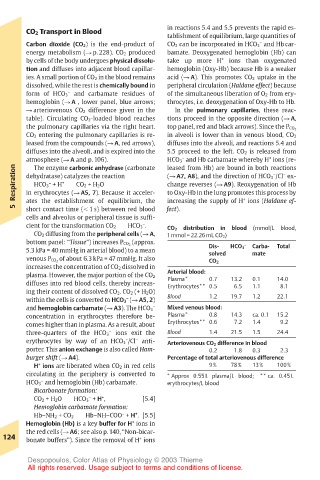
       cient for the transformation CO 2  HCO 3 . –  distribution  in  blood  (mmol/L  blood,
                                       CO 2
         CO 2 diffusing from the peripheral cells (! A,  1 mmol = 22.26 mL CO 2)
       bottom panel: “Tissue”) increases P CO 2 (approx.  Dis-  –  Carba-  Total
       5.3 kPa = 40 mmHg in arterial blood) to a mean  solved  HCO 3  mate
       venous P CO 2 of about 6.3 kPa = 47 mmHg. It also  CO 2
       increases the concentration of CO 2 dissolved in
                                       Arterial blood:
       plasma. However, the major portion of the CO 2  Plasma*  0.7  13.2  0.1  14.0
       diffuses into red blood cells, thereby increas-  Erythrocytes** 0.5  6.5  1.1  8.1
       ing their content of dissolved CO 2. CO 2 (+ H 2O)
       within the cells is converted to HCO 3 (! A5, 2)  Blood  1.2  19.7  1.2  22.1
                             –
                                   –   Mixed venous blood:
       and hemoglobin carbamate (! A3). The HCO 3
       concentration in erythrocytes therefore be-  Plasma*  0.8  14.3  ca. 0.1  15.2
       comes higher than in plasma. As a result, about  Erythrocytes** 0.6  7.2  1.4  9.2
                          –            Blood    1.4  21.5  1.5  24.4
       three-quarters of the HCO 3  ions exit the
                             –
                                –
       erythrocytes by way of an HCO 3 /Cl anti-  Arteriovenous CO 2 difference in blood
       porter. This anion exchange is also called Ham-  0.2  1.8  0.3  2.3
       burger shift (! A4).            Percentage of total arteriovenous difference
         H ions are liberated when CO 2 in red cells  9%  78%  13%  100%
          +
       circulating in the periphery is converted to  * Approx 0.55 L plasma/L blood;  ** ca. 0.45 L
          –
       HCO 3 and hemoglobin (Hb) carbamate.  erythrocytes/L blood
         Bicarbonate formation:
                     –
         CO 2 + H 2O  HCO 3 + H , +  [5.4]
         Hemoglobin carbamate formation:
                            –
                               +
         Hb–NH 2 + CO 2  Hb–NH–COO + H . [5.5]
                               +
       Hemoglobin (Hb) is a key buffer for H ions in
       the red cells (! A6; see also p. 140, “Non-bicar-
  124  bonate buffers”). Since the removal of H ions
                                +
       Despopoulos, Color Atlas of Physiology © 2003 Thieme
       All rights reserved. Usage subject to terms and conditions of license.

