


Page 315 - Color_Atlas_of_Physiology_5th_Ed._-_A._Despopoulos_2003
P. 315
Estrogens                       the cervical mucus, making it more conducive
                                       to sperm penetration and survival, especially
       Estrogens are steroid hormones with 18 car-  around the time of ovulation.
       bon atoms. Estrogens are primarily synthe-  ! Fertilization. In the female body, estrogens
       sized from the 17-ketosteroid androstene-  prepare the sperm to penetrate and fertilize
       dione, but testosterone can also be a precursor  the ovum (capacitation) and regulate the
       (! p. 295 A). The ovaries, (granulosa and theca  speed at which the ovum travels in the fal-
       cells), placenta (! p. 304), adrenal cortex, and  lopian tube.
       in Leydig’s cells (interstitial cells) of the testes  ! Extragonadal effects of estrogen. During
       (! p. 306) are the physiological sites of estro-  puberty, estrogens stimulate breast develop-
    Hormones and Reproduction  (E). The potencies of estrone (E l) and estriol (E 3)  and axillary hair. Since estrogens increase the
       gen synthesis.. In some target cells for testo-
                                       ment, induces changes in the vagina and in the
       sterone, it must first be converted to estradiol
                                       distribution of subcutaneous fat, and (together
                                       with androgens) stimulate the growth of pubic
       to become active.
         Estradiol (E 2) is the most potent estrogen
                                       coagulability of the blood, the administration
                                       of estrogens (e.g., in contraceptives) increases
       are relatively low in comparison (E 2 : E 1 : E 3 =
                                       the risk of thrombosis and leads renal salt and
       10 : 5 : 1). Most estrogens (and testosterone)
                                       water retention. Estrogens slow longitudinal
       circulating in the blood are bound to sex hor-
                                       bone growth, accelerate epiphyseal closure (in
       mone-binding globulin (SHBG). Estriol (E 3) is
       the chief degradation product of estradiol (E 2).
                                       tivity. Estrogen deficiencies in menopause
         Oral administration of estradiol has vir-
       tually no effect because almost all of the hor-
                                       consequently lead to the loss of bone mass
    11  mone is removed from the bloodstream during  men and women) and increase osteoblast ac-
                                       (osteoporosis). Estrogens induce a decrease in
       its first pass through the liver. Therefore, other  LDL and a rise in VLDL and HDL concentrations
       estrogens (with a different chemical structure)  (! p. 254ff.), which is why arteriosclerosis is
       must be used for effective oral estrogen ther-  less common in premenopausal women than
       apy.                            in men. Estrogen also makes the skin thinner
         Actions. Although estrogens play a role in  and softer, reduces the sebaceous glands, and
       the development of female sex characteristics,  increases fat deposits in subcutaneous tissue.
       they are not nearly as important as the andro-  Lastly, estrogen influences a number of central
       gens for male sexual development (! p. 306).  nervous functions, e.g., sexual response, social
       The preparatory action of estrogen is often re-  behavior, and mood.
       quired for optimal progesterone effects (e.g., in
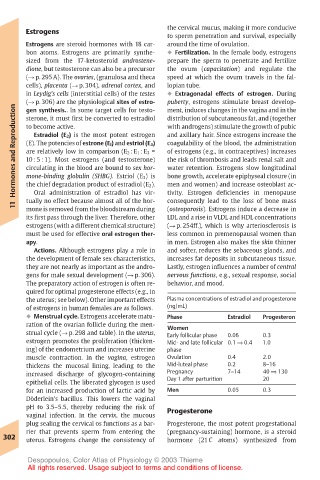
       the uterus; see below). Other important effects  Plasma concentrations of estradiol and progesterone
       of estrogens in human females are as follows.  (ng/mL)
       ! Menstrual cycle. Estrogens accelerate matu-  Phase  Estradiol  Progesteron
       ration of the ovarian follicle during the men-  Women
       strual cycle (! p. 298 and table). In the uterus,  Early follicular phase  0.06  0.3
       estrogen promotes the proliferation (thicken-  Mid- and late follicular 0.1 ! 0.4  1.0
       ing) of the endometrium and increases uterine  phase
       muscle contraction. In the vagina, estrogen  Ovulation  0.4  2.0
       thickens the mucosal lining, leading to the  Mid-luteal phase  0.2  8–16
       increased discharge of glycogen-containing  Pregnancy  7–14  40 ! 130
       epithelial cells. The liberated glycogen is used  Day 1 after parturition  20
       for an increased production of lactic acid by  Men  0.05  0.3
       Döderlein’s bacillus. This lowers the vaginal
       pH to 3.5–5.5, thereby reducing the risk of  Progesterone
       vaginal infection. In the cervix, the mucous
       plug sealing the cervical os functions as a bar-  Progesterone, the most potent progestational
       rier that prevents sperm from entering the  (pregnancy-sustaining) hormone, is a steroid
  302  uterus. Estrogens change the consistency of  hormone (21 C atoms) synthesized from
       Despopoulos, Color Atlas of Physiology © 2003 Thieme
       All rights reserved. Usage subject to terms and conditions of license.

