


Page 350 - Color_Atlas_of_Physiology_5th_Ed._-_A._Despopoulos_2003
P. 350
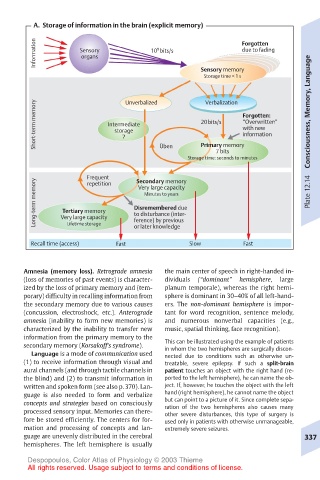
A.  Storage of information in the brain (explicit memory)
         Information  Sensory      10 bits/s           Forgotten
                                                       due to fading
                                    9
                   organs
                                              Sensory memory
                                               Storage time < 1 s


                                               Verbalization
                             Unverbalized
         Short-term memory  Intermediate      20bits/s  Forgotten:     Consciousness, Memory, Language
                                                        “Overwritten”
                                                        with new
                           storage
                                                        information
                             ?
                                              Primary memory
                                     Üben
                                                  7 bits
                                           Storage time: seconds to minutes
                     Frequent   Secondary memory
         Long-term memory  Very large capacity  Disremembered due      Plate 12.14
                     repetition
                                Very large capacity
                                 Minutes to years
               Tertiary memory
                               to disturbance (inter-
                               ference) by previous
                Lifetime storage
        Recall time (access)  Fast  or later knowledge  Slow  Fast

      Amnesia (memory loss). Retrograde amnesia  the main center of speech in right-handed in-
      (loss of memories of past events) is character-  dividuals  (“dominant”  hemisphere,  large
      ized by the loss of primary memory and (tem-  planum temporale), whereas the right hemi-
      porary) difficulty in recalling information from  sphere is dominant in 30–40% of all left-hand-
      the secondary memory due to various causes  ers. The non-dominant hemisphere is impor-
      (concussion, electroshock, etc.). Anterograde  tant for word recognition, sentence melody,
      amnesia (inability to form new memories) is  and numerous nonverbal capacities (e.g.,
      characterized by the inability to transfer new  music, spatial thinking, face recognition).
      information from the primary memory to the  This can be illustrated using the example of patients
      secondary memory (Korsakoff’s syndrome).  in whom the two hemispheres are surgically discon-
        Language is a mode of communication used  nected due to conditions such as otherwise un-
      (1) to receive information through visual and  treatable, severe epilepsy. If such a split-brain
      aural channels (and through tactile channels in  patient touches an object with the right hand (re-
      the blind) and (2) to transmit information in  ported to the left hemisphere), he can name the ob-
      written and spoken form (see also p. 370). Lan-  ject. If, however, he touches the object with the left
      guage is also needed to form and verbalize  hand (right hemisphere), he cannot name the object
      concepts and strategies based on consciously  but can point to a picture of it. Since complete sepa-
                                      ration of the two hemispheres also causes many
      processed sensory input. Memories can there-  other severe disturbances, this type of surgery is
      fore be stored efficiently. The centers for for-  used only in patients with otherwise unmanageable,
      mation and processing of concepts and lan-  extremely severe seizures.
      guage are unevenly distributed in the cerebral                  337
      hemispheres. The left hemisphere is usually
       Despopoulos, Color Atlas of Physiology © 2003 Thieme
       All rights reserved. Usage subject to terms and conditions of license.

