


Page 355 - Color_Atlas_of_Physiology_5th_Ed._-_A._Despopoulos_2003
P. 355
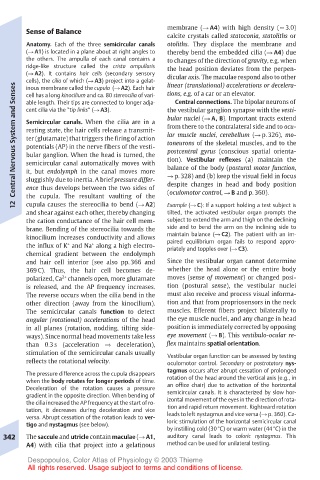
Sense of Balance                membrane (! A4) with high density (! 3.0)
                                       calcite crystals called statoconia, statoliths or
       Anatomy. Each of the three semicircular canals  otoliths. They displace the membrane and
       (! A1) is located in a plane about at right angles to  thereby bend the embedded cilia (! A4) due
       the others. The ampulla of each canal contains a  to changes of the direction of gravity, e.g. when
       ridge-like structure called the crista ampullaris  the head position deviates from the perpen-
       (! A2). It contains hair cells (secondary sensory  dicular axis. The maculae respond also to other
       cells), the cilia of which (! A3) project into a gelat-  linear (translational) accelerations or decelera-
    Central Nervous System and Senses  resting state, the hair cells release a transmit-  the vestibular ganglion synapse with the vesti-
       inous membrane called the cupula (! A2). Each hair
                                       tions, e.g. of a car or an elevator.
       cell has a long kinocilium and ca. 80 stereocilia of vari-
                                        Central connections. The bipolar neurons of
       able length. Their tips are connected to longer adja-
       cent cilia via the ”tip links” (! A3).
                                       bular nuclei (! A, B). Important tracts extend
       Semicircular canals. When the cilia are in a
                                       from there to the contralateral side and to ocu-
                                       lar muscle nuclei, cerebellum (! p. 326), mo-
       ter (glutamate) that triggers the firing of action
                                       toneurons of the skeletal muscles, and to the
       potentials (AP) in the nerve fibers of the vesti-
                                       postcentral gyrus (conscious spatial orienta-
       bular ganglion. When the head is turned, the
                                       tion). Vestibular reflexes (a) maintain the
       semicircular canal automatically moves with
                                       balance of the body (postural motor function,
       it, but endolymph in the canal moves more
                                       ! p. 328) and (b) keep the visual field in focus
       ence thus develops between the two sides of
                                       (oculomotor control, ! B and p. 360).
       the cupula. The resultant vaulting of the
       cupula causes the stereocilia to bend (! A2)
    12  sluggishly due to inertia. A brief pressure differ-  despite changes in head and body position
                                       Example (! C): If a support holding a test subject is
       and shear against each other, thereby changing  tilted, the activated vestibular organ prompts the
       the cation conductance of the hair cell mem-  subject to extend the arm and thigh on the declining
       brane. Bending of the stereocilia towards the  side and to bend the arm on the inclining side to
       kinocilium increases conductivity and allows  maintain balance (! C2). The patient with an im-
                                       paired equilibrium organ fails to respond appro-
       the influx of K and Na along a high electro-  priately and topples over (! C3).
                      +
                +
       chemical gradient between the endolymph
       and hair cell interior (see also pp. 366 and  Since the vestibular organ cannot determine
       369 C). Thus, the hair cell becomes de-  whether the head alone or the entire body
               2+
       polarized, Ca channels open, more glutamate  moves (sense of movement) or changed posi-
       is released, and the AP frequency increases.  tion (postural sense), the vestibular nuclei
       The reverse occurs when the cilia bend in the  must also receive and process visual informa-
       other direction (away from the kinocilium).  tion and that from propriosensors in the neck
       The semicircular canals function to detect  muscles. Efferent fibers project bilaterally to
       angular (rotational) accelerations of the head  the eye muscle nuclei, and any change in head
       in all planes (rotation, nodding, tilting side-  position is immediately corrected by opposing
       ways). Since normal head movements take less  eye movement (! B). This vestibulo-ocular re-
       than 0.3 s (acceleration ! deceleration),  flex maintains spatial orientation.
       stimulation of the semicircular canals usually  Vestibular organ function can be assessed by testing
       reflects the rotational velocity.  oculomotor control. Secondary or postrotatory nys-
       The pressure difference across the cupula disappears  tagmus occurs after abrupt cessation of prolonged
       when the body rotates for longer periods of time.  rotation of the head around the vertical axis (e.g., in
       Deceleration of the rotation causes a pressure  an office chair) due to activation of the horizontal
                                       semicircular canals. It is characterized by slow hor-
       gradient in the opposite direction. When bending of  izontal movement of the eyes in the direction of rota-
       the cilia increased the AP frequency at the start of ro-
       tation, it decreases during deceleration and vice  tion and rapid return movement. Rightward rotation
       versa. Abrupt cessation of the rotation leads to ver-  leads to left nystagmus and vice versa (! p. 360). Ca-
       tigo and nystagmus (see below).  loric stimulation of the horizontal semicircular canal
                                       by instilling cold (30 !C) or warm water (44 !C) in the
  342  The saccule and utricle contain maculae (! A1,  auditory canal leads to caloric nystagmus. This
       A4) with cilia that project into a gelatinous  method can be used for unilateral testing.
       Despopoulos, Color Atlas of Physiology © 2003 Thieme
       All rights reserved. Usage subject to terms and conditions of license.

