


Page 371 - Color_Atlas_of_Physiology_5th_Ed._-_A._Despopoulos_2003
P. 371
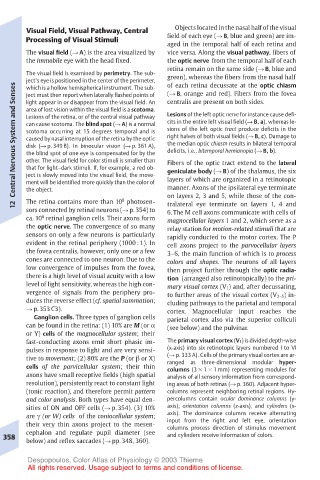
Visual Field, Visual Pathway, Central  Objects located in the nasal half of the visual
       Processing of Visual Stimuli    field of each eye (! B, blue and green) are im-
                                       aged in the temporal half of each retina and
       The visual field (! A) is the area visualized by  vice versa. Along the visual pathway, fibers of
       the immobile eye with the head fixed.  the optic nerve from the temporal half of each
                                       retina remain on the same side (! B, blue and
       The visual field is examined by perimetry. The sub-
       ject’s eye is positioned in the center of the perimeter,  green), whereas the fibers from the nasal half
    Central Nervous System and Senses  Lesions of the retina, or of the central visual pathway  Lesions of the left optic nerve for instance cause defi-
                                       of each retina decussate at the optic chiasm
       which is a hollow hemispherical instrument. The sub-
                                       (! B, orange and red). Fibers from the fovea
       ject must then report when laterally flashed points of
                                       centralis are present on both sides.
       light appear in or disappear from the visual field. An
       area of lost vision within the visual field is a scotoma.
                                       cits in the entire left visual field (! B, a), whereas le-
       can cause scotoma. The blind spot (! A) is a normal
                                       sions of the left optic tract produce deficits in the
       scotoma occurring at 15 degrees temporal and is
                                       right halves of both visual fields (! B, c). Damage to
       caused by nasal interruption of the retina by the optic
                                       the median optic chiasm results in bilateral temporal
       disk (! p. 349 B). In binocular vision (! p. 361 A),
                                       deficits, i.e., bitemporal hemianopia (! B, b).
       the blind spot of one eye is compensated for by the
       other. The visual field for color stimuli is smaller than
                                       Fibers of the optic tract extend to the lateral
       that for light–dark stimuli. If, for example, a red ob-
                                       geniculate body (! B) of the thalamus, the six
       ject is slowly moved into the visual field, the move-
                                       manner. Axons of the ipsilateral eye terminate
       the object.
                                       on layers 2, 3 and 5, while those of the con-
       The retina contains more than 10 photosen-
                            8
    12  ment will be identified more quickly than the color of  layers of which are organized in a retinotopic
                                       tralateral eye terminate on layers 1, 4 and
       sors connected by retinal neurons (! p. 354) to  6. The M cell axons communicate with cells of
       ca. 10 retinal ganglion cells. Their axons form  magnocellular layers 1 and 2, which serve as a
          6
       the optic nerve. The convergence of so many  relay station for motion-related stimuli that are
       sensors on only a few neurons is particularly  rapidly conducted to the motor cortex. The P
       evident in the retinal periphery (1000 : 1). In  cell axons project to the parvocellular layers
       the fovea centralis, however, only one or a few  3–6, the main function of which is to process
       cones are connected to one neuron. Due to the  colors and shapes. The neurons of all layers
       low convergence of impulses from the fovea,  then project further through the optic radia-
       there is a high level of visual acuity with a low  tion (arranged also retinotopically) to the pri-
       level of light sensitivity, whereas the high con-  mary visual cortex (V 1) and, after decussating,
       vergence of signals from the periphery pro-  to further areas of the visual cortex (V 2–5) in-
       duces the reverse effect (cf. spatial summation;  cluding pathways to the parietal and temporal
       ! p. 353 C3).                   cortex. Magnocellular input reaches the
         Ganglion cells. Three types of ganglion cells  parietal cortex also via the superior colliculi
       can be found in the retina: (1) 10% are M (or α  (see below) and the pulvinar.
       or Y) cells of the magnocellular system; their
       fast-conducting axons emit short phasic im-  The primary visual cortex (V 1) is divided depth-wise
       pulses in response to light and are very sensi-  (x-axis) into six retinotopic layers numbered I to VI
                                       (! p. 333 A). Cells of the primary visual cortex are ar-
       tive to movement; (2) 80% are the P (or " or X)  ranged  as  three-dimensional  modular  hyper-
       cells of the parvicellular system; their thin  columns (3 ! 1 ! 1 mm) representing modules for
       axons have small receptive fields (high spatial  analysis of all sensory information from correspond-
       resolution), persistently react to constant light  ing areas of both retinas (! p. 360). Adjacent hyper-
       (tonic reaction), and therefore permit pattern  columns represent neighboring retinal regions. Hy-
       and color analysis. Both types have equal den-  percolumns contain ocular dominance columns (y-
       sities of ON and OFF cells (! p. 354). (3) 10%  axis), orientation columns (z-axis), and cylinders (x-
       are γ (or W) cells of the coniocellular system;  axis). The dominance columns receive alternating
                                       input from the right and left eye, orientation
       their very thin axons project to the mesen-  columns process direction of stimulus movement
       cephalon and regulate pupil diameter (see  and cylinders receive information of colors.
  358
       below) and reflex saccades (! pp. 348, 360).
       Despopoulos, Color Atlas of Physiology © 2003 Thieme
       All rights reserved. Usage subject to terms and conditions of license.

