


Page 392 - Color_Atlas_of_Physiology_5th_Ed._-_A._Despopoulos_2003
P. 392
H 2 O influx  +40     Actual
                                Changes in oncotic pressure of plasma proteins  mmHg  No
                                   +30
                                               deviation
                                   +20
                                               from
                     mL/100mL plasma  +10      van’t Hoff ’s law
                       60  40  20
                                     20  40  60
                                     mL/100mL plasma
                               –10                                     and Units
                                       H 2 O loss
                               –20
                                                                       Dimensions

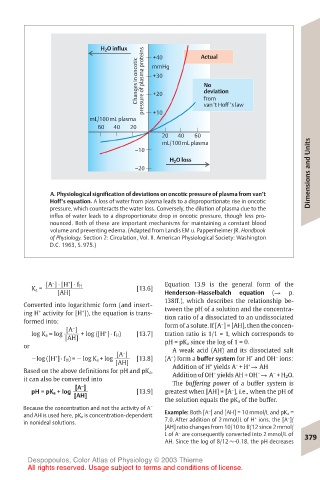
            A. Physiological signification of deviations on oncotic pressure of plasma from van’t
            Hoff’s equation. A loss of water from plasma leads to a disproportionate rise in oncotic
            pressure, which counteracts the water loss. Conversely, the dilution of plasma due to the
            influx of water leads to a disproportionate drop in oncotic pressure, though less pro-
            nounced. Both of these are important mechanisms for maintaining a constant blood
            volume and preventing edema. (Adapted from Landis EM u. Pappenheimer JR. Handbook
            of Physiology. Section 2: Circulation, Vol. II. American Physiological Society: Washington
            D.C. 1963, S. 975.)


             –  +                     Equation 13.9 is the general form of the
        K a =  [A ] · [H ] · f H  [13.6]
              [AH]                    Henderson–Hasselbalch  equation  (!  p.
                                      138ff.), which describes the relationship be-
      Converted into logarithmic form (and insert-  tween the pH of a solution and the concentra-
      ing H activity for [H ]), the equation is trans-  tion ratio of a dissociated to an undissociated
                   +
          +
      formed into:                                 –
                 –
                [A ]                  form of a solute. If [A ] = [AH], then the concen-
                         +
        log K a = log  + log ([H ] · f H)  [13.7]  tration ratio is 1/1 = 1, which corresponds to
                [AH]                  pH = pK a since the log of 1 = 0.
      or                                A weak acid (AH) and its dissociated salt
                           [A ]
                             –
                                                               –
             +
                                       –
                                                         +
        $log ([H ] · f H) = $ log K a + log  [13.8]  (A ) form a buffer system for H and OH ions:
                           [AH]                 +     –  +
      Based on the above definitions for pH and pK a,  Addition of H yields A + H ! AH  –
                                                           –
                                        Addition of OH yields AH + OH ! A + H 2O.
                                                 –
      it can also be converted into     The buffering power of a buffer system is
                   –
                  [A ]
                                                     –
        pH = pK a + log         [13.9]  greatest when [AH] = [A ], i.e., when the pH of
                  [AH]
                                      the solution equals the pK a of the buffer.
      Because the concentration and not the activity of A –  –
      and AH is used here, pK a is concentration-dependent  Example: Both [A ] and [AH] = 10 mmol/L and pK a =
                                                          +
                                                                  –
      in nonideal solutions.          7.0. After addition of 2 mmol/L of H ions, the [A ]/
                                      [AH] ratio changes from 10/10 to 8/12 since 2 mmol/
                                      L of A are consequently converted into 2 mmol/L of  379
                                         –
                                      AH. Since the log of 8/12 !-0.18, the pH decreases
       Despopoulos, Color Atlas of Physiology © 2003 Thieme
       All rights reserved. Usage subject to terms and conditions of license.

