


Page 402 - Color_Atlas_of_Physiology_5th_Ed._-_A._Despopoulos_2003
P. 402
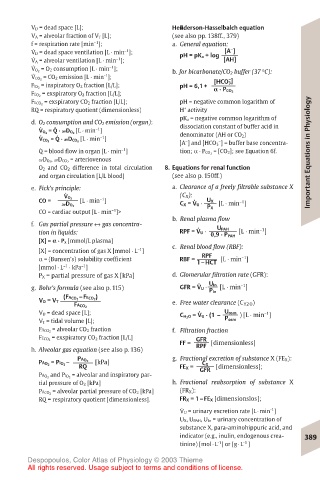
V D = dead space [L];           Henderson-Hasselbalch equation
                                         7.
        V A = alveolar fraction of V T [L];  (see also pp. 138ff., 379)
                      –1
        f = respiration rate [min ];    a. General equation:
        .
                                                     –
                             –1
        V D = dead space ventilation [L · min ];  pH = pK a + log  [A ]
        .
                           –1
        V A = alveolar ventilation [L · min ];     [AH]
        .
        V O 2 = O 2 consumption [L · min ];  b. for bicarbonate/CO 2 buffer (37 C):
                          –1
                                                            o
        .
        V CO 2 = CO 2 emission [L · min ];       [HCO 3 ]
                        -1
                                                    –
        FI O 2 = inspiratory O 2 fraction [L/L];  pH = 6,1 +
        FE O 2 = exspiratory O 2 fraction [L/L];  α · P CO 2
        FE CO 2 = exspiratory CO 2 fraction [L/L];  pH = negative common logarithm of
        RQ = respiratory quotient (dimensionless)  H activity
                                          +
                                         pK a = negative common logarithm of
        d. O 2 consumption and CO 2 emission (organ):  dissociation constant of buffer acid in
          .
             .
                       –1
          V O 2 = Q · avD O 2 [L · min ]  denominator (AH or CO 2)
          .
              .
                        –1
          V CO 2 = Q · avD CO 2 [L · min ]  –     –
          .                              [A ] and [HCO 3 ] = buffer base concentra-
                            –1
          Q = blood flow in organ [L · min ]  tion; α · P CO 2 = [CO 2]; see Equation 6f.  Important Equations in Physiology
          avD O 2 , avD CO 2 = arteriovenous
          O 2 and CO 2 difference in total circulation  8. Equations for renal function
          and organ circulation [L/L blood]  (see also p. 150ff.)
        e. Fick’s principle:            a. Clearance of a freely filtrable substance X
                .
          CO =  V O 2  [L · min ]        (C X): .  U X  –1
                       –1
               avD O 2                   C X = V U ·  P X  [L · min ]
                          –1
          CO = cardiac output [L · min ]>
                                        b. Renal plasma flow
        f. Gas partial pressure " gas concentra-  .
                                                           –1
          tion in liquids:               RPF = V U ·  U PAH  [L · min ]
                                                0,9 · P PAH
          [X] = α · P x [mmol/L plasma]
                                        c. Renal blood flow (RBF):
                                –1
          [X] = concentration of gas X [mmol · L ]
                                              RPF
                                                       –1
          α = (Bunsen’s) solubility coefficient  RBF =  1–HCT  [L · min ]
          [mmol · L –1  · kPa ]
                   –1
          P X = partial pressure of gas X [kPa]  d. Glomerular filtration rate (GFR):
                                              .
                                                       –1
        g. Bohr’s formula (see also p. 115)  GFR = V U ·  U In  [L · min ]
                                                P In
               (FA CO 2 –FE CO 2 )
          V D = V T                     e. Free water clearance (C H2 O)
                  FA CO 2
                                              .
          V D = dead space [L];          C H 2 O = V U · (1 –  U osm  ) [L · min ]
                                                            –1
          V T = tidal volume [L];                   P osm
          FA CO 2 = alveolar CO 2 fraction  f. Filtration fraction
          FE CO 2 = exspiratory CO 2 fraction [L/L]  GFR
                                         FF =    [dimensionless]
        h. Alveolar gas equation (see also p. 136)  RPF
                                        g. Fractional excretion of substance X (FE X):
          PA O 2 = PI O 2 –  PA O 2  [kPa]    C X
                   RQ                    FE X =  GFR  [dimensionless];
          PA O 2 and PI O 2 = alveolar and inspiratory par-
          tial pressure of O 2 [kPa]    h. Fractional reabsorption of substance X
          PA CO 2 = alveolar partial pressure of CO 2 [kPa]  (FR X):
          RQ = respiratory quotient [dimensionless].  FR X = 1–FE X [dimensionslos];
                                          .
                                          V U = urinary excretion rate [L · min ]
                                                              -1
                                         U X, U PAH, U In = urinary concentration of
                                         substance X, para-aminohippuric acid, and
                                         indicator (e.g., inulin, endogenous crea-  389
                                         tinine) [mol · L ] or [g · L ]
                                                  -1
                                                        -1
       Despopoulos, Color Atlas of Physiology © 2003 Thieme
       All rights reserved. Usage subject to terms and conditions of license.

