


Page 397 - Color_Atlas_of_Physiology_5th_Ed._-_A._Despopoulos_2003
P. 397
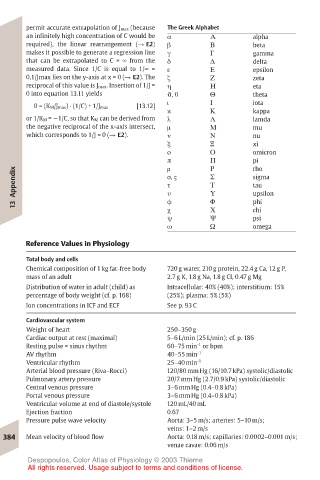
permit accurate extrapolation of J max (because  The Greek Alphabet
       an infinitely high concentration of C would be  α  Α  alpha
       required), the linear rearrangement (! E2)  (  Β   beta
       makes it possible to generate a regression line  γ  Γ  gamma
       that can be extrapolated to C = ' from the  δ  ∆   delta
       measured data. Since 1/C is equal to 1/' =  ε  Ε   epsilon
       0,1/Jmax lies on the y-axis at x = 0 (! E2). The  .  /  zeta
       reciprocal of this value is J max. Insertion of 1/J =  η  Η  eta
       0 into equation 13.11 yields    ), θ     Θ         theta
                                       ι        Ι         iota
         0 = (K M/J max) · (1/C) + 1/J max  [13.12]
                                       κ        Κ         kappa
       or 1/K M = $1/C, so that K M can be derived from  λ  Λ  lamda
       the negative reciprocal of the x-axis intersect,  µ  Μ  mu
       which corresponds to 1/J = 0 (! E2).  ν  Ν         nu
                                       =        >         xi
                                       ?        @         omicron
                                       π        Π         pi
                                                Ρ
                                                          rho
                                       *
    Appendix                           σ, ς     Σ Τ       sigma
                                                          tau
                                       τ
                                                Υ
                                                          phi
                                       φ
    13                                 υ        Φ         upsilon
                                       K        L         chi
                                       ψ        Ψ         psi
                                       ω        Ω         omega
       Reference Values in Physiology
       Total body and cells
       Chemical composition of 1 kg fat-free body  720 g water, 210 g protein, 22.4 g Ca, 12 g P,
       mass of an adult                2.7 g K, 1.8 g Na, 1.8 g Cl, 0.47 g Mg
       Distribution of water in adult (child) as  Intracellular: 40% (40%); interstitium: 15%
       percentage of body weight (cf. p. 168)  (25%); plasma: 5% (5%)
       Ion concentrations in ICF and ECF  See p. 93 C
       Cardiovascular system
       Weight of heart                 250–350 g
       Cardiac output at rest (maximal)  5–6 L/min (25 L/min); cf. p. 186
       Resting pulse = sinus rhythm    60–75 min or bpm
                                             -1
       AV rhythm                       40–55 min -1
       Ventricular rhythm              25–40 min -1
       Arterial blood pressure (Riva–Rocci)  120/80 mm Hg (16/10.7 kPa) systolic/diastolic
       Pulmonary artery pressure       20/7 mm Hg (2.7/0.9 kPa) systolic/diastolic
       Central venous pressure         3–6 mm Hg (0.4–0.8 kPa)
       Portal venous pressure          3–6 mm Hg (0.4–0.8 kPa)
       Ventricular volume at end of diastole/systole  120 mL/40 mL
       Ejection fraction               0.67
       Pressure pulse wave velocity    Aorta: 3–5 m/s; arteries: 5–10 m/s;
                                       veins: 1–2 m/s
  384  Mean velocity of blood flow     Aorta: 0.18 m/s; capillaries: 0.0002–0.001 m/s;
                                       venae cavae: 0.06 m/s
       Despopoulos, Color Atlas of Physiology © 2003 Thieme
       All rights reserved. Usage subject to terms and conditions of license.

