


Page 75 - Color_Atlas_of_Physiology_5th_Ed._-_A._Despopoulos_2003
P. 75
Contraction of Striated Muscle   ATP (! p. 72) is essential for filament sliding
                                       and, hence, for muscle contraction. Due to
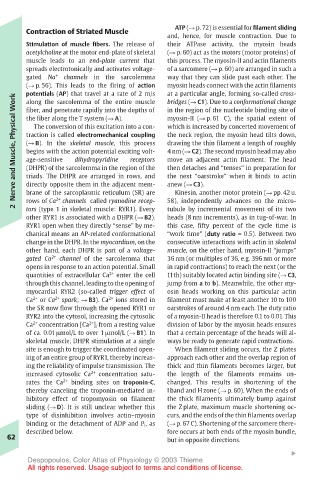
       Stimulation of muscle fibers. The release of  their ATPase activity, the myosin heads
       acetylcholine at the motor end-plate of skeletal  (! p. 60) act as the motors (motor proteins) of
       muscle leads to an end-plate current that  this process. The myosin-II and actin filaments
       spreads electrotonically and activates voltage-  of a sarcomere (! p. 60) are arranged in such a
       gated  Na +  channels  in  the  sarcolemma  way that they can slide past each other. The
       (! p. 56). This leads to the firing of action  myosin heads connect with the actin filaments
       potentials (AP) that travel at a rate of 2 m/s  at a particular angle, forming so-called cross-
    Nerve and Muscle, Physical Work  (! B). In the skeletal muscle, this process  which is increased by concerted movement of
                                       bridges (! C1). Due to a conformational change
       along the sarcolemma of the entire muscle
                                       in the region of the nucleotide binding site of
       fiber, and penetrate rapidly into the depths of
                                       myosin-II (! p. 61 C), the spatial extent of
       the fiber along the T system (! A).
         The conversion of this excitation into a con-
       traction is called electromechanical coupling
                                       the neck region, the myosin head tilts down,
                                       drawing the thin filament a length of roughly
       begins with the action potential exciting volt-
                                       4 nm (! C2). The second myosin head may also
                              receptors
                  dihydropyridine
                                       move an adjacent actin filament. The head
       age-sensitive
       (DHPR) of the sarcolemma in the region of the
                                       then detaches and “tenses” in preparation for
                                       the next “oarstroke” when it binds to actin
       triads. The DHPR are arranged in rows, and
                                        Kinesin, another motor protein (! pp. 42 u.
       brane of the sarcoplasmic reticulum (SR) are
               channels called ryanodine recep-
              2+
                                       58), independently advances on the micro-
       rows of Ca
    2  directly opposite them in the adjacent mem-  anew (! C3).
                                       tubule by incremental movement of its two
       tors (type 1 in skeletal muscle: RYR1). Every
       other RYR1 is associated with a DHPR (! B2).  heads (8 nm increments), as in tug-of-war. In
       RYR1 open when they directly “sense” by me-  this case, fifty percent of the cycle time is
       chanical means an AP-related conformational  “work time” (duty ratio = 0.5). Between two
       change in the DHPR. In the myocardium, on the  consecutive interactions with actin in skeletal
       other hand, each DHPR is part of a voltage-  muscle, on the other hand, myosin-II “jumps”
       gated Ca 2+  channel of the sarcolemma that  36 nm (or multiples of 36, e.g. 396 nm or more
       opens in response to an action potential. Small  in rapid contractions) to reach the next (or the
       quantities of extracellular Ca 2+  enter the cell  11th) suitably located actin binding site (! C3,
       through this channel, leading to the opening of  jump from a to b). Meanwhile, the other my-
       myocardial RYR2 (so-called trigger effect of  osin heads working on this particular actin
       Ca 2+  or Ca 2+  spark; ! B3). Ca 2+  ions stored in  filament must make at least another 10 to 100
       the SR now flow through the opened RYR1 or  oarstrokes of around 4 nm each. The duty ratio
       RYR2 into the cytosol, increasing the cytosolic  of a myosin-II head is therefore 0.1 to 0.01. This
                     2+
       Ca 2+  concentration [Ca ] i from a resting value  division of labor by the myosin heads ensures
       of ca. 0.01µmol/L to over 1 µmol/L (! B1). In  that a certain percentage of the heads will al-
       skeletal muscle, DHPR stimulation at a single  ways be ready to generate rapid contractions.
       site is enough to trigger the coordinated open-  When filament sliding occurs, the Z plates
       ing of an entire group of RYR1, thereby increas-  approach each other and the overlap region of
       ing the reliability of impulse transmission. The  thick and thin filaments becomes larger, but
       increased cytosolic Ca 2+  concentration satu-  the length of the filaments remains un-
       rates the Ca 2+  binding sites on troponin-C,  changed. This results in shortening of the
       thereby canceling the troponin-mediated in-  I band and H zone (! p. 60). When the ends of
       hibitory effect of tropomyosin on filament  the thick filaments ultimately bump against
       sliding (! D). It is still unclear whether this  the Z plate, maximum muscle shortening oc-
       type of disinhibition involves actin–myosin  curs, and the ends of the thin filaments overlap
       binding or the detachment of ADP and P i, as  (! p. 67 C). Shortening of the sarcomere there-
       described below.                fore occurs at both ends of the myosin bundle,
   62                                  but in opposite directions.
                                                                   !
       Despopoulos, Color Atlas of Physiology © 2003 Thieme
       All rights reserved. Usage subject to terms and conditions of license.

