


Page 73 - Color_Atlas_of_Physiology_5th_Ed._-_A._Despopoulos_2003
P. 73
Contractile Apparatus of Striated  changes in the head–neck segment allow the
       Muscle                          myosin head to “tilt” when interacting with
                                       actin (sliding filaments; ! p. 62).
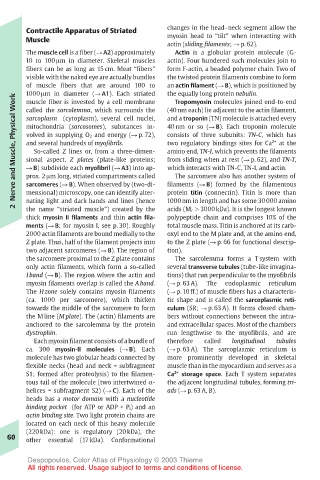
       The muscle cell is a fiber (! A2) approximately  Actin is a globular protein molecule (G-
       10 to 100 µm in diameter. Skeletal muscles  actin). Four hundered such molecules join to
       fibers can be as long as 15 cm. Meat “fibers”  form F-actin, a beaded polymer chain. Two of
       visible with the naked eye are actually bundles  the twisted protein filaments combine to form
       of muscle fibers that are around 100 to  an actin filament (! B), which is positioned by
       1000 µm in diameter (! A1). Each striated  the equally long protein nebulin.
    Nerve and Muscle, Physical Work  mitochondria (sarcosomes), substances in-  40 nm or so (! B). Each troponin molecule
                                        Tropomyosin molecules joined end-to-end
       muscle fiber is invested by a cell membrane
       called the sarcolemma, which surrounds the
                                       (40 nm each) lie adjacent to the actin filament,
                                       and a troponin (TN) molecule is attached every
       sarcoplasm (cytoplasm), several cell nuclei,
                                       consists of three subunits: TN-C, which has
       volved in supplying O 2 and energy (! p. 72),
       and several hundreds of myofibrils.
                                       two regulatory bindings sites for Ca
                                                                at the
                                                              2+
                                       amino end, TN-I, which prevents the filaments
         So-called Z lines or, from a three-dimen-
       sional aspect, Z plates (plate-like proteins;
                                       from sliding when at rest (! p. 62), and TN-T,
       ! B) subdivide each myofibril (! A3) into ap-
                                       which interacts with TN-C, TN-I, and actin.
       prox. 2µm long, striated compartments called
                                        The sarcomere also has another system of
       sarcomeres (! B). When observed by (two-di-
                                       protein titin (connectin). Titin is more than
       nating light and dark bands and lines (hence
                                       1000 nm in length and has some 30 000 amino
    2  mensional) microscopy, one can identify alter-  filaments (! B) formed by the filamentous
                                       acids (M r ! 3000 kDa). It is the longest known
       the name “striated muscle”) created by the
       thick myosin II filaments and thin actin fila-  polypeptide chain and comprises 10% of the
       ments (! B; for myosin I, see p. 30). Roughly  total muscle mass. Titin is anchored at its carb-
       2000 actin filaments are bound medially to the  oxyl end to the M plate and, at the amino end,
       Z plate. Thus, half of the filament projects into  to the Z plate (! p. 66 for functional descrip-
       two adjacent sarcomeres (! B). The region of  tion).
       the sarcomere proximal to the Z plate contains  The sarcolemma forms a T system with
       only actin filaments, which form a so-called  several transverse tubules (tube-like invagina-
       I band (! B). The region where the actin and  tions) that run perpendicular to the myofibrils
       myosin filaments overlap is called the A band.  (! p. 63 A).  The  endoplasmic  reticulum
       The H zone solely contains myosin filaments  (! p. 10 ff.) of muscle fibers has a characteris-
       (ca. 1000 per sarcomere), which thicken  tic shape and is called the sarcoplasmic reti-
       towards the middle of the sarcomere to form  culum (SR; ! p. 63 A). It forms closed cham-
       the M line (M plate). The (actin) filaments are  bers without connections between the intra-
       anchored to the sarcolemma by the protein  and extracellular spaces. Most of the chambers
       dystrophin.                     run lengthwise to the myofibrils, and are
         Each myosin filament consists of a bundle of  therefore  called  longitudinal  tubules
       ca. 300 myosin-II molecules (! B). Each  (! p. 63 A). The sarcoplasmic reticulum is
       molecule has two globular heads connected by  more prominently developed in skeletal
       flexible necks (head and neck = subfragment  muscle than in the myocardium and serves as a
       S1; formed after proteolysis) to the filamen-  Ca 2+  storage space. Each T system separates
       tous tail of the molecule (two intertwined α-  the adjacent longitudinal tubules, forming tri-
       helices = subfragment S2) (! C). Each of the  ads (! p. 63 A, B).
       heads has a motor domain with a nucleotide
       binding pocket (for ATP or ADP + P i) and an
       actin binding site. Two light protein chains are
       located on each neck of this heavy molecule
       (220 kDa): one is regulatory (20 kDa), the
   60  other  essential  (17 kDa).  Conformational
       Despopoulos, Color Atlas of Physiology © 2003 Thieme
       All rights reserved. Usage subject to terms and conditions of license.

