


Page 72 - Color_Atlas_of_Physiology_5th_Ed._-_A._Despopoulos_2003
P. 72
30  20  ms
                                               (see 2.15E)
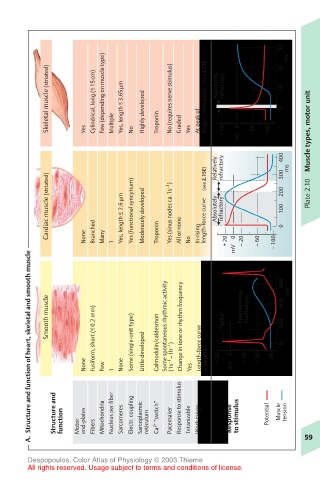
            Skeletal muscle (striated)  < Cylindrical, long ( –   15cm) Few (depending on muscle type)  < Yes, length  –   3.65µm  Highly developed  No (requires nerve stimulus)  length-force curve  Absolutely  refractory  10  0


                                              At peak of
                                     Troponin
                           Multiple
                                          Graded
                    Yes
                                                   + 50
                                            Yes
                               No
                                                       mV  0  – 50  –100  400  ms  Muscle types, motor unit
                                                   refractory
                                                  Relatively
            Cardiac muscle (striated)  < Yes, length  –   2.6 µm  Yes (functional syncytium)  Moderately developed  Yes (sinus nodes ca.1s –1 )  length-force curve  (see 2.15E)  Absolutely  refractory  300  200  100  0  Plate 2.10


                                          All or none
                      Branched
                                     Troponin
                                              In rising
                        Many
                    None
                                            No
                           1
                                                      mV + 20  0  – 20  – 60  – 100
        A.  Structure and function of heart, skeletal and smooth muscle
            Smooth muscle  < Fusiform, short ( –   0.2 mm)  Some spontaneous rhythmic activity  Change in tone or rhythm frequency  “Spike”  Spontaneous  fluctuation  600  400  200  ms


                    None  Few  1  None  Some (single-unit type)  Little developed  Calmodulin/caldesmon  (1s –1 –1h –1 )  Yes  Length-force curve  is variable  + 20  0  mV  – 20  – 40  – 60  0


             Structure and  function  end-plates  Mitochondria  Nucleus per fiber  Sarcomeres  Electr. coupling  Sarcoplasmic  reticulum  Ca 2+  “switch”  Pacemaker  Response to stimulus  Tetanizable  Work range  Response  to stimulus  Potential  Muscle  tension


                      Fibers
                   Motor
                                                                      59

       Despopoulos, Color Atlas of Physiology © 2003 Thieme
       All rights reserved. Usage subject to terms and conditions of license.

