


Page 1000 - Hall et al (2015) Principles of Critical Care-McGraw-Hill
P. 1000
CHAPTER 79: Tetanus  731


                    DIAGNOSIS AND LABORATORY TESTING                        TABLE 79-2    Drugs Used in Medical Management of Tetanus

                    The diagnosis of tetanus is based on clinical manifestations rather than   Medication  Indication  Dose (Usual)
                    laboratory tests. In areas where tetanus is endemic diagnosis is relatively   HTIG a  Generalized tetanus  500-3000 IU intramuscular
                    easy, but in developed countries where the disease is less prevalent diag-
                    nosis can be delayed. The spatula test is a simple test that can be helpful   Metronidazole  Toxin production   500 mg IV/PO q6h
                    in diagnosis. In the presence of tetanus, the posterior pharyngeal wall   (given in all cases)
                    will contract due to a reflex contraction of the masseters when touched   Midazolam  Spasms, sedation, and   0.3-30.0 mg/h IV (mean =9.0 mg/h), titrate
                    by a spatula. In a study by Apte and Kanad used the test on 400 patients     cardiovascular instability to effect
                    with suspected tetanus and was found to have sensitivity of 94% and   Magnesium   Spasms and cardiovas- 40 mg/kg IV load over 30 minutes, then 1-3 g IV/h
                    a specificity of 100% for diagnosing tetanus.  Although the clinical   sulfate  cular instability
                                                     25
                    presentation for tetanus is usually characteristic, there is a differential   Titrate to serum concentrations of 2-4 mmol/L
                    diagnosis that includes malignant hyperthermia, atropine poisoning or   Cisatracurium  Neuromuscular block-  1-2 μg/kg/min IV, titrate to effect
                    an adverse effect of metoclopramide, strychnine poisoning, and acute   ade for severe muscle
                    hypercalcemia. In some cases, the diagnosis is difficult due to an atypi-  spasms
                    cal presentation. For instance, dysphagia may be the major symptom.   Dantrolene  Rigidity and spasms  0.5-1.0 mg/kg IV q4-6h
                    The major clinical features on which the diagnosis of tetanus is based
                    are listed in Table 79-1 along with the features of other conditions with   Clonidine  Cardiovascular instability 300 μg q8h via nasogastric tube
                    which it can be confused.                             a Human tetanus immune globulin.
                     Tissue cultures are positive in less than 50% of patients.  Since the
                                                               15
                    organism is noninvasive, blood cultures are of little value except in diag-  care often begins with an assessment of airway patency and the ability
                    nosing secondary infection. The severity of disease is inversely related   of the patient to ventilate, later shifts focus to stabilizing the circulation
                    to the duration of the incubation period, which can be defined as the   impacted by autonomic instability, and throughout requires vigilance to
                    time of injury to the first appearance of spasms. This can be useful to   prevent complications of what is commonly a prolonged critical illness.
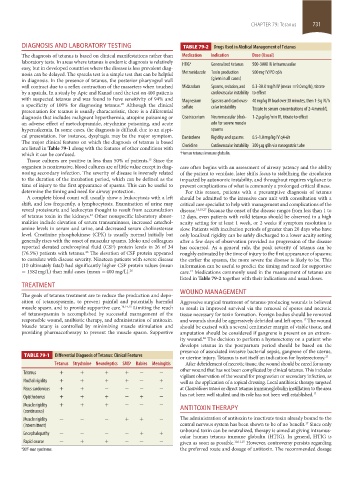
                    determine the timing and need for airway protection.   For this reason, patients with a presumptive diagnosis of tetanus
                     A complete blood count will usually show a leukocytosis with a left   should be admitted to the intensive care unit with consultation with a
                    shift, and less frequently, a lymphocytosis. Examination of urine may   critical care specialist to help with management and complications of the
                    reveal proteinuria and leukocytes thought to result from accumulation   disease. 14,15,27  Because the onset of the disease ranges from less than 1 to
                    of tetanus toxin in the kidneys.  Other nonspecific laboratory abnor-  12 days, even patients with mild tetanus should be observed in a high
                                           23
                    malities include elevation of serum transaminases, increased catechol-  acuity setting for at least 1 week, or 2 weeks if symptom resolution is
                    amine levels in serum and urine, and decreased serum cholinesterase   slow. Patients with incubation periods of greater than 20 days who have
                    level. Creatinine phosphokinase (CPK) is usually normal initially but   only localized rigidity can be safely discharged to a lower acuity setting
                    generally rises with the onset of muscular spasms. Idoko and colleagues   after a few days of observation provided no progression of the disease
                    reported elevated cerebrospinal fluid (CSF) protein levels in 26 of 34   has occurred. As a general rule, the peak severity of tetanus can be
                    (76.5%) patients with tetanus.  The elevation of CSF protein appeared   roughly estimated by the time of injury to the first appearance of spasms;
                                         26
                    to correlate with disease severity. Nineteen patients with severe disease   the earlier the spasms, the more severe the disease is likely to be. This
                    (10 ultimately fatal) had significantly higher CSF protein values (mean   information can be useful to predict the timing and need for supportive
                    = 1582 mg/L) than mild cases (mean = 400 mg/L). 26    care.  Medications commonly used in the management of tetanus are
                                                                             17
                                                                          listed in Table 79-2 together with their indications and usual doses.
                    TREATMENT
                                                                          WOUND MANAGEMENT
                    The goals of tetanus treatment are to reduce the production and depo-
                    sition of tetanospasmin, to prevent painful and potentially harmful   Aggressive surgical treatment of tetanus-producing wounds is believed
                    muscle spasm, and to provide supportive care. 10,14,15  Limiting the reach   to result in improved survival via the removal of spores and necrotic
                    of tetanospasmin is accomplished by successful management of the   tissue necessary for toxin formation. Foreign bodies should be removed
                    responsible wound, antibiotic therapy, and administration of antitoxin.   and wounds should be aggressively debrided and left open.  The wound
                                                                                                                    17
                    Muscle tetany is controlled by minimizing muscle stimulation and   should be excised with a several centimeter margin of viable tissue, and
                    providing pharmacotherapy to prevent the muscle spasm. Supportive   amputation should be considered if gangrene is present on an extrem-
                                                                          ity wound.  The decision to perform a hysterectomy on a patient who
                                                                                 28
                                                                          develops tetanus in the postpartum period should be based on the
                                                                          presence of associated invasive bacterial sepsis, gangrene of the uterus,
                      TABLE 79-1    Differential Diagnosis of Tetanus: Clinical Features  or uterine injury. Tetanus is not itself an indication for hysterectomy. 23
                               Tetanus Strychnine Neuroleptics SMS a  Rabies Meningitis  After debridement of necrotic tissue, the wound should be cared for as any
                                                                          other wound that has not been complicated by clinical tetanus. This includes
                    Trismus     +      +        +      +    −      −      vigilant observation of the wound for progression or secondary infection, as
                    Nuchal rigidity  +  +       +      +    −      +      well as the application of a topical dressing. Local antibiotic therapy targeted
                    Risus sardonicus  +  +      −      −    −      −      at Clostridium tetani or direct tetanus immunoglobulin instillation to the area
                                                                          has not been well studied and its role has not been well established. 17
                    Opisthotonus  +    +        +      −    +      −
                    Muscle rigidity   +  +      +      −    −      −      ANTITOXIN THERAPY
                    (continuous)
                    Muscle rigidity   −  −      −      +    +      −      The administration of antitoxin to inactivate toxin already bound to the
                                                                                                                    17
                    (intermittent)                                        central nervous system has been shown to be of no benefit.  Since only
                                                                          unbound toxin can be neutralized, therapy is aimed at giving intramus-
                    Encephalopathy  −  −        −      −    +      +
                                                                          cular human tetanus immune  globulin  (HTIG).  In general, HTIG  is
                    Rapid course  −    +        +      −    −      −      given as soon as possible. 10,11,15  However, controversy persists regarding
                    a Stiff-man syndrome.                                 the preferred route and dosage of antitoxin. The recommended dosage


            section05_c74-81.indd   731                                                                                1/23/2015   12:37:40 PM

