


Page 1003 - Hall et al (2015) Principles of Critical Care-McGraw-Hill
P. 1003
734     PART 5: Infectious Disorders


                                                                         VHFs are identified in North America, mostly in travelers. Dengue
                     • Clues to LF are insidious onset, sore throat, chest pain, cervico-  fever (DF) is often diagnosed in travelers, but severe DF is not  common.
                                                                                                                         3-7
                    facial edema, high maternal mortality and fetal loss during preg-  Yellow fever (YF) is occasionally reported in travelers even though most of
                    nancy, and irreversible deafness.                  those at risk of exposure are immunized.  Lassa fever (LF) and filovirus
                                                                                                    8,9
                     • Clues to filovirus (Marburg and Ebola) infections are a rash   HF have been reported in travelers. 10-15  Such travel-associated infections
                    around the fifth day, severe bleeding, jaundice, person-to-person   may increase in the future due to increased high-risk “adventure” travel to
                    transmission in community outbreaks and nosocomial settings,   remote areas of the world where VHF viruses are prevalent.
                    and a very high mortality rate.                      Acquisition of VHF in the United States occurs. Dengue is present
                     • A delayed-onset rash is characteristic of dengue, filoviruses, and LF.  on US territory. 16,17  Significant rates of Seoul hantavirus infection are
                                                                       reported in rats trapped in US cities and at-risk human populations
                     • Jaundice and liver failure are typical of YF, CCHF, RVF, and filo-  have evidence of prior infection. 18-20  Lab accidents and person-to-person
                                https://kat.cr/user/tahir99/
                    virus HF.                                          transmission of VHF viruses have occurred in Western countries. 21,22
                     • Bleeding is often severe with CCHF, filoviruses, South American   Rift Valley fever could be introduced into Europe or the United States.
                                                                                                                          23
                    VHFs, and Hantaan virus–associated HFRS, but only rarely so in   Bioterrorism is a significant threat with VHF pathogens listed on the
                    dengue and LF.                                     group A bioterrorism agent list.  The manifestations of VHFs depend
                                                                                               24
                     • Neurological complications are seen in South American HF, KFD,   on the specific pathogens, but with significant overlap (Table 80-2).
                    Alkhurma HF, and a small minority of RVF virus infection.  Physicians should consider the diagnosis of VHF in the appropriate set-
                     • Acute kidney injury is typical in HFRS and YF, and also seen in HCPS.  ting and recognize the severity of illness, the need to implement specific
                     • Ribavirin is proven effective in Lassa fever and HFRS, and may be   measures to prevent spread, and the potential benefits of ribavirin.
                    effective in South American HF and CCHF.               ■  FLAVIVIRIDAE

                                                                       VHF-causing  Flaviviridae  include  dengue  and  YF,  which  are  highly
                                                                       prevalent over wide geographic areas, and three geographically restricted
                 INTRODUCTION
                                                                       infections:  Omsk  hemorrhagic  fever,  Kyasanur  forest  disease,  and
                 Viral hemorrhagic fever (VHF) starts with a nonspecific febrile pro-  Alkhurma HF.
                 drome associated with protean manifestations, followed by widespread
                 endovascular insult, viral immunosuppression, multiorgan damage,   Dengue Fever and Dengue Hemorrhagic Fever
                 hemorrhagic complications, and shock. The mortality rate depends on   The Pathogen and the Life Cycle  Dengue virus (DENV) is an enveloped positive-
                 the pathogen, the inoculum size, and host factors.    strand RNA flavivirus. Its genome encodes three structural proteins
                   VHF viruses belong to four families of enveloped, single-stranded   and seven nonstructural proteins.  There are four serotypes (DENV-1,
                                                                                                25
                 RNA viruses: Flaviviridae, Arenaviridae, Filoviridae, and Bunyaviridae   DENV-2, DENV-3, and DENV-4) and multiple genotypes.
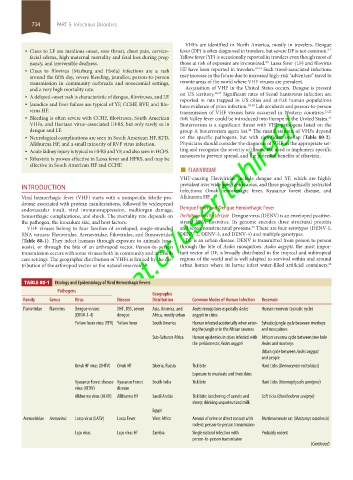
                 (Table 80-1). They infect humans through exposure to animals (zoo-  DF is an urban disease. DENV is transmitted from person to person
                 nosis), or through the bite of an arthropod vector. Person-to-person   through the bite of Aedes mosquitoes.  Aedes aegypti, the most impor-
                 transmission occurs with some viruses both in community and in health   tant vector of DF, is broadly distributed in the tropical and subtropical
                 care settings. The geographic distribution of VHFs is limited by the dis-  regions of the world and is well adapted to survival within and around
                 tribution of the arthropod vector or the natural reservoir. 1,2  urban homes where its larvae infest water-filled artificial containers.
                                                                                                                          26

                   TABLE 80-1    Etiology and Epidemiology of Viral Hemorrhagic Fevers
                             Pathogens
                                                              Geographic
                  Family   Genus   Virus          Disease     Distribution  Common Modes of Human Infection  Reservoir
                  Flaviviridae  Flavivirus  Dengue viruses    DHF, DSS, severe   Asia, America, and   Aedes mosquitoes especially Aedes   Human reservoir (sylvatic cycle)
                                   (DENV-1-4)     dengue      Africa, mostly urban  aegypti in cities
                                   Yellow fever virus (YFV) Yellow fever  South America  Human infected accidentally when enter- Sylvatic/jungle cycle between monkeys
                                                                           ing the jungle or in the African savanna  and mosquitoes
                                                              Sub-Saharan Africa  Human epidemics in cities infested with  African savanna cycle between tree hole
                                                                           the peridomestic Aedes aegypti  Aedes and monkeys
                                                                                                   Urban cycle between Aedes aegypti
                                                                                                   and people
                                   Omsk HF virus (OHFV)  Omsk HF  Siberia, Russia  Tick bite       Hard ticks (Dermacentor reticulatus)
                                                                           Exposure to muskrats and their skins
                                   Kyasanur Forest disease  Kyasanur Forest   South India  Tick bite  Hard ticks (Haemaphysalis spinigera)
                                   virus (KFDV)   disease
                                   Alkhurma virus (ALKV)  Alkhurma HF  Saudi Arabia  Tick bite; butchering of camels and   Soft ticks (Ornithodoros savignyi)
                                                                           sheep; drinking unpasteurized milk
                                                              Egypt
                  Arenaviridae  Arenavirus  Lassa virus (LASV)  Lassa Fever  West Africa  Aerosol of urine or direct contact with   Multimammate rat (Mastomys natalensis)
                                                                           rodent; person-to-person transmission
                                   Lujo virus     Lujo virus HF  Zambia    Single natural infection with    Probably rodent
                                                                           person-to-person transmission
                                                                                                                    (Continued)


            section05_c74-81.indd   734                                                                                1/23/2015   12:37:41 PM

