


Page 1005 - Hall et al (2015) Principles of Critical Care-McGraw-Hill
P. 1005
736     PART 5: Infectious Disorders


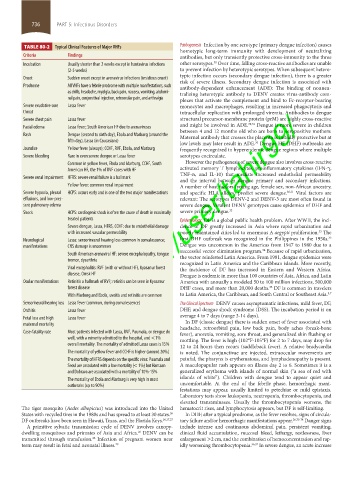
                   TABLE 80-2    Typical Clinical Features of Major VHFs  Pathogenesis  Infection by one serotype (primary dengue infection) causes
                                                                       homotypic long-term immunity with development of neutralizing
                  Criteria       Findings                              antibodies, but only transiently protective cross-immunity to the three
                                                                                   30
                  Incubation     Usually shorter than 2 weeks except in hantavirus infections    other serotypes.  Over time, falling cross-reactive antibodies are unable
                                 (2-5 weeks)                           to prevent infection by heterotypic serotypes. When subsequent hetero-
                  Onset          Sudden onset except in arenavirus infections (insidious onset)  typic infection occurs (secondary dengue infection), there is a greater
                                                                       risk of severe illness. Secondary dengue infection is associated with
                  Prodrome       All VHFs have a febrile prodrome with multiple manifestations, such   antibody-dependent enhancement (ADE): The binding of nonneu-
                                 as chills, headache, myalgia, back pain, nausea, vomiting, abdomi-  tralizing heterotypic antibody to DENV creates virus-antibody com-
                                 nal pain, conjunctival injection, retroocular pain, and arthralgia  plexes that activate the complement and bind to Fc-receptor-bearing
                  Severe exudative sore   Lassa fever                  monocytes and macrophages, resulting in increased phagocytosis and
                                https://kat.cr/user/tahir99/
                  throat                                               intracellular replication with prolonged viremia. Antibodies to dengue
                  Severe chest pain  Lassa fever                       structural precursor-membrane protein (prM) are highly cross-reactive
                  Facial edema   Lassa fever; South American HF due to arenaviruses  and might be involved in ADE. 30,31  Dengue is more severe in children
                  Rash           Dengue (second to sixth day), Ebola and Marburg (around the   between 4 and 12 months old who are born to seropositive mothers:
                                                                       Maternal antibody that crosses the placenta is initially protective but at
                                 fifth day), Lassa (in Caucasians)     low levels may later result in ADE.  Dengue HF (DHF) outbreaks are
                                                                                                 30
                  Jaundice       Yellow fever (always); CCHF, RVF, Ebola, and Marburg  frequently recognized in hyperendemic dengue regions where multiple
                  Severe bleeding  Rare in even severe dengue or Lassa fever  serotypes cocirculate.
                                 Common in yellow fever, Ebola and Marburg, CCHF, South   However the pathogenesis of severe dengue also involves cross-reactive
                                 American HF, the 1% of RVF cases with HF  activated memory T lymphocytes, proinflammatory cytokines (IFN-γ,
                  Severe renal impairment HFRS: severe renal failure is a hallmark  TNF-α, and IL-10) that mediate increased endothelial permeability
                                                                       and the interval between dengue primary and secondary infections.
                                 Yellow fever: common renal impairment  A number of host factors (young age, female sex, non-African ancestry,
                  Severe hypoxia, pleural   HCPS: occurs early and is one of the two major manifestations  and specific HLA alleles) predict severe dengue. 30,31  Viral factors are
                  effusions, and low-pres-                             relevant: The serotypes DENV-2 and DENV-3 are most often found in
                  sure pulmonary edema                                 severe dengue. Virulent DENV genotypes cause epidemics of DHF and
                  Shock          HCPS: cardiogenic shock is often the cause of death in maximally   severe primary dengue. 32
                                 treated patients                      Epidemiology  DF is a global public health problem. After WWII, the inci-
                                 Severe dengue, Lassa, HFRS, CCHF: due to endothelial damage   dence of DF greatly increased in Asia where rapid urbanization and
                                 with increased vascular permeability  poorly maintained cities led to enormous A aegypti proliferation.  The
                                                                                                                      33
                                                                                                                          33
                  Neurological   Lassa: sensorineural hearing loss common in convalescence;   first DHF outbreak was recognized in the Philippines in the 1950s.
                    manifestations  CNS damage is uncommon             Dengue was uncommon in the Americas from 1947 to 1980 due to a
                                                                                                   34
                                 South American arenaviral HF: severe encephalopathy, tongue   successful vector elimination program.  Because of rapid urbanization,
                                                                       the vector reinfested Latin America. From 1981, dengue epidemics were
                                 tremor, dysarthria                    recognized in Latin America and the Caribbean islands. More recently,
                                 Viral encephalitis: RVF (with or without HF), Kyasanur forest   the incidence of DF has increased in Eastern and Western Africa.
                                 disease, Omsk HF                      Dengue is endemic in more than 100 countries of Asia, Africa, and Latin
                  Ocular manifestations  Retinitis a hallmark of RVF; retinitis can be seen in Kyasanur   America with annually a modeled 50 to 100 million infections, 500,000
                                 forest disease                        DHF cases, and more than 20,000 deaths.  DF is common in travelers
                                                                                                      35
                                 With Marburg and Ebola, uveitis and retinitis are common  to Latin America, the Caribbean, and South Central or Southeast Asia. 5,7
                  Sensorineural hearing loss Lassa fever (common, during convalescence)  The Clinical Spectrum  DENV causes asymptomatic infections, mild fever, DF,
                  Orchitis       Lassa fever                           DHF, and dengue shock syndrome (DSS). The incubation period is on
                  Fetal loss and high   Lassa fever                    average 4 to 7 days (range 3-14 days).
                                                                         In DF (classic dengue) there is sudden onset of fever associated with
                    maternal mortality                                 headache, retroorbital pain, low back pain, body aches (break-bone
                  Case-fatality rate  Most patients infected with Lassa, RVF, Puumala, or dengue do   fever), anorexia, vomiting, sore throat, and generalized skin flushing or
                                 well, with a minority admitted to the hospital, and <1%    mottling. The fever is high (102°F-105°F) for 2 to 7 days, may drop for
                                 overall  mortality. The mortality of admitted Lassa cases is 15%  12 to 24 hours then recurs (saddleback fever). A relative bradycardia
                                 The mortality of yellow fever and CCHF is higher (around 20%)  is  noted.  The  conjunctivae  are  injected,  extraoccular  movements  are
                                 The mortality of HFRS depends on the specific virus: Puumala and   painful, the pharynx is erythematous, and lymphadenopathy is  present.
                                 Seoul are associated with a low mortality (< 1%) but Hantaan   A maculopapular rash appears on illness day 2 to 6. Sometimes it is a
                                 and Dobrava are associated with a mortality of 10%-15%  generalized erythema with islands of normal skin (“a sea of red with
                                 The mortality of Ebola and Marburg is very high in most    islands  of  white”).  Children  with  dengue  tend to  appear  quiet  and
                                 outbreaks (up to 90%)                   uncomfortable. At the end of the febrile phase, hemorrhagic mani-
                                                                       festations  may  appear,  usually  limited  to  petechiae  or  mild  epistaxis.
                                                                       Laboratory tests show  leukopenia, neutropenia, thrombocytopenia, and
                                                                       elevated transaminases. Usually the thrombocytopenia worsens, the
                 The tiger mosquito (Aedes albopictus) was introduced into the United   hematocrit rises, and lymphocytosis appears, but DF is self-limiting.
                 States with recycled tires in the 1980s and has spread to at least 30 states.    In DHF, after a typical prodrome, as the fever resolves, signs of circula-
                                                                    26
                 DF outbreaks have been seen in Hawaii, Texas, and the Florida Keys. 16,17,27  tory failure and/or hemorrhagic manifestations appear. 26,30-34  Danger signs
                   A  primitive  sylvatic  transmission  cycle  of  DENV  involves  canopy-  include intense and continuous abdominal pain, persistent vomiting,
                 dwelling mosquitoes and primates of Asia and Africa.  DENV can be   clinical fluid accumulation, mucosal bleed, lethargy, restlessness,  liver
                                                         26
                 transmitted through transfusion.  Infection of pregnant women near   enlargement >2 cm, and the combination of hemoconcentration and rap-
                                         28
                 term may result in fetal and neonatal illness. 29     idly worsening thrombocytopenia. 36,37  In severe dengue, an acute increase


            section05_c74-81.indd   736                                                                                1/23/2015   12:37:42 PM

