


Page 126 - Hall et al (2015) Principles of Critical Care-McGraw-Hill
P. 126
92      PART 1: An Overview of the Approach to and Organization of Critical Care


                 admission. The TS  and the RTS  are derived from the Triage Index.   low rates of serious bleeding (1.2% vs 1%). On October 25, 2011, Eli
                               42
                                          43
                 In the part of the RTS used for triage, the T-RTS, specific decision rules   Lilly and Company withdrew rhAPC from the market worldwide. In
                 are proposed to indicate appropriate transfer to a trauma center.  These   PROWESS SHOCK, the observed pooled mortality was much lower
                                                               43
                 rules are based on the score and the GCS score. There are at least two   than expected, lower than in PROWESS, which enrolled a broader
                 caveats regarding use of scoring systems to guide ICU triage decisions.   population of severe sepsis. The low mortality rates observed in
                 First, a patient who could be admitted to the ICU who has a very low   PROWESS SHOCK may be explained in part by recent advances
                 probability of mortality estimated by the MPM , might in fact have a   in the management of septic shock and in part by the selection of lower
                                                    0
                 higher actual probability of mortality if ICU admission were denied,    risk patients.
                                                                    20
                 because outcome could be adversely affected by ward admission and the   In support of this approach (ie, use of APACHE II to identify high-
                 associated lower intensity of monitoring and treatment. Second, physi-  risk patients), a cost-effectiveness analysis by Manns and coworkers
                                                                                                                          68
                 cians tend to underestimate mortality in low-risk patients. Thus scoring   found that rhAPC is relatively cost-effective when targeted to patients
                 systems can be more accurate than clinician judgment for risk estimate   with severe sepsis, greater severity of illness (an APACHE II score of 25
                 of low-risk patients. 31                              or more), and a reasonable life expectancy if they survive the episode
                   A novel use of severity of illness scoring systems is in patient selection   of sepsis. In a second cost-effectiveness analysis by Angus and cowork-
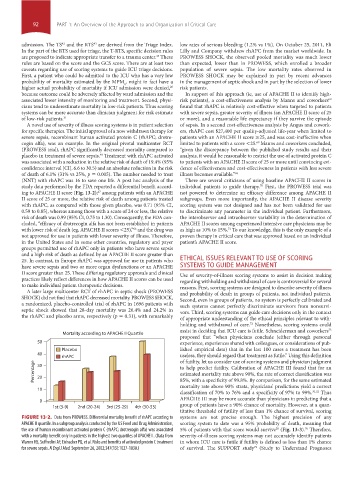
                 for specific therapies. The initial approval of a now withdrawn therapy for   ers, rhAPC cost $27,400 per quality-adjusted life-year when limited to
                 severe sepsis, recombinant human activated protein C (rhAPC; drotre-  patients with an APACHE II score ≥25, and was cost-ineffective when
                 cogin alfa), was an example. In the original pivotal multicenter RCT   limited to patients with a score <25.  Manns and coworkers concluded,
                                                                                                 69
                 (PROWESS trial), rhAPC significantly decreased mortality compared to   “given the discrepancy between the published study results and their
                 placebo in treatment of severe sepsis.  Treatment with rhAPC activated   analysis, it would be reasonable to restrict the use of activated protein C
                                            40
                 was associated with a reduction in the relative risk of death of 19.4% (95%   to patients with an APACHE II score of 25 or more until convincing evi-
                 confidence interval [CI], 6.6 to 30.5) and an absolute reduction in the risk   dence of effectiveness and cost-effectiveness in patients with less severe
                 of death of 6.1% (31% vs 25%, p = 0.005). The number needed to treat   illness becomes available.” 68
                 (NNT) with rhAPC was 16 to save one life. A post hoc analysis of the   There are several criticisms of using baseline APACHE II scores in
                 study data performed by the FDA reported a differential benefit accord-  individual patients  to guide therapy.  First, the PROWESS trial was
                                                                                                  70
                 ing to APACHE II score (Fig. 13-2);  among patients with an APACHE   not powered to determine an efficacy difference among APACHE II
                                           67
                 II score of 25 or more, the relative risk of death among patients treated   subgroups. Even more importantly, the APACHE II disease severity
                 with rhAPC, as compared with those given placebo, was 0.71 (95% CI,   scoring system was not designed and has not been validated for use
                 0.59 to 0.85), whereas among those with a score of 24 or less, the relative   to discriminate any parameter in the individual patient. Furthermore,
                 risk of death was 0.99 (95% CI, 0.75 to 1.30). Consequently, the FDA con-  the interobserver and intraobserver variability in the determination of
                 cluded, “efficacy of drotrecogin alfa has not been established in patients   APACHE II scores among experienced intensive care physicians may be
                 with lower risk of death (eg, APACHE II scores <25),”  and the drug was   as high as 10% to 15%.  To our knowledge, this is the only example of a
                                                                                        71
                                                       66
                 not approved for use in patients with lower severity of illness. Therefore,   proven therapy in critical care that was approved based on an individual
                 in the United States and in some other countries, regulatory and payer   patient’s APACHE II score.
                 groups permitted use of rhAPC only in patients who have severe sepsis
                 and a high risk of death as defined by an APACHE II score greater than
                 25. In contrast, in Europe rhAPC was approved for use in patients who   ETHICAL ISSUES RELEVANT TO USE OF SCORING
                 have severe sepsis and two or more organ dysfunctions or an APACHE   SYSTEMS TO GUIDE MANAGEMENT
                 II score greater than 25. These differing regulatory approvals and clinical   Use of severity-of-illness scoring systems to assist in decision making
                 practices likely reflect differences in how APACHE II scores can be used   regarding withholding and withdrawal of care is controversial for several
                 to make individual patient therapeutic decisions.     reasons. First, scoring systems are designed to describe severity of illness
                   A later large multicenter RCT of rhAPC in septic shock (PROWESS   and probability of death in groups of patients, not individual patients.
                 SHOCK) did not find that rhAPC decreased mortality. PROWESS SHOCK,   Second, even in groups of patients, no system is perfectly calibrated and
                 a randomized, placebo-controlled trial of rhAPC in 1696 patients with   such systems cannot perfectly  discriminate  survivors from nonsurvi-
                 septic  shock  showed  that  28-day  mortality  was  26.4%  and  24.2%  in   vors. Third, scoring systems can guide care decisions only in the context
                 the rhAPC and placebo arms, respectively (p = 0.31), with remarkably   of appropriate understanding of the ethical principles relevant to with-
                                                                       holding and withdrawal of care.  Nonetheless, scoring systems could
                                                                                               72
                                                                       assist in deciding that ICU care is futile. Schneiderman and coworkers
                                                                                                                          73
                               Mortality according to APACHE II Quartile
                                                                       proposed that “when physicians conclude (either through personal
                       50                                              experience, experiences shared with colleagues, or considerations of pub-
                               Placebo                                 lished empirical data) that in the last 100 cases a treatment has been
                       40                                              useless, they should regard that treatment as futile.” Using this definition
                               rhAPC                                   of futility, let us consider use of scoring systems and physician judgment
                     Percentage  30                                    to help predict futility. Calibration of APACHE III found that for an
                                                                       estimated mortality rate above 90%, the rate of correct classification was
                       20
                                                                       85%, with a specificity of 99.8%. By comparison, for the same estimated
                                                                       mortality rate above 90% strata, physicians’ predictions yield a correct
                       10
                                                                       classification of 70% to 76% and a specificity of 97% to 99%. 31,32  Thus
                                                                       APACHE III may be more accurate than physicians in predicting that a
                       0                                               group of patients have a 90% chance of mortality. However, at a quan-
                            1st (3-9)  2nd (20-24)  3rd (25-29)  4th (30-53)
                                                                       titative threshold of futility of less than 1% chance of survival, scoring
                 FIGURE 13-2.  Data from PROWESS. Differential mortality benefit of rhAPC according to   systems are not precise enough. The highest precision of any
                 APACHE II quartile. In a subgroup analysis conducted by the US Food and Drug Administration,   scoring  system to  date  was  a 95%  probability of  death,  meaning  that
                                                                                                        28
                                                                                                                  76
                 the use of human recombinant activated protein C (rhAPC; drotrecogin alfa) was associated   5% of patients with that score would survive  (Fig. 13-3).  Therefore,
                 with a mortality benefit only in patients in the highest two quartiles of APACHE II. (Data from   severity-of-illness scoring systems may not accurately identify patients
                 Warren HS, Suffredini AF, Eichacker PQ, et al. Risks and benefits of activated protein C treatment   in whom ICU care is futile if futility is defined as less than 1% chance
                 for severe sepsis. N Engl J Med. September 26, 2002;347(13):1027-1030.)  of survival. The SUPPORT study  (Study to Understand Prognoses
                                                                                                74


            Section01.indd   92                                                                                        1/22/2015   9:37:27 AM

