


Page 128 - Hall et al (2015) Principles of Critical Care-McGraw-Hill
P. 128
94      PART 1: An Overview of the Approach to and Organization of Critical Care


                 create a pernicious bias. For example, hospitals providing care to more   assignment of appropriate diagnosis is very important in making an accu-
                 severely ill patients will tend to have actual mortality rates above pre-  rate mortality prediction.  The principal diagnosis could differ between
                                                                                         15
                 dicted, and thus will appear to be giving poor care. On the other hand,   prospective identification versus retrospective chart review. 54
                 hospitals with less severely ill patients will tend to have actual mortality
                 rates lower than predicted, and will appear to be giving better than aver-    ■  SEVERITY-OF-ILLNESS SCORING SYSTEMS
                 age care. 80                                             FOR SPECIFIC DISEASE CATEGORIES
                     ■  LEAD-TIME BIAS                                 For patients with specific disease processes, it is debated whether
                                                                       specific severity scoring systems are better than general ones. Because
                 Lead-time bias refers to the different lengths of time that patients are   inaccuracy of diagnosis can cause error, we recommend that scoring sys-
                 ill prior to ICU care and scoring. Lead-time differences also influence   tems be tested for different diagnostic categories. Both disease-specific
                 treatment decisions, as well as predicted and  actual  mortality.  Acute   systems (APACHE II and APACHE III) and non–disease-specific sys-
                 physiology scores do not assess previous treatments. Thus, for the same   tems (SAPS II and MPM II) need to be compared in external validating
                 score, a patient hypoxemic in the emergency room can improve rapidly   patient samples. 15
                 and have a better outcome than a patient referred from another hospital   APACHE II, APACHE III, and SAPS II have performed well in several
                 for persistent hypoxemia. Because of lead-time bias, APACHE II under-  disease-specific categories,  including liver  failure, 81,82  malignancy, 83-85
                 estimates the mortality of patients referred from other ICUs,  other   cardiac bypass surgery, 86-88  sepsis,  peritonitis, 90-92  pancreatitis, 93-99  acute
                                                                                               89
                                                               25
                 hospitals, or even within other parts of the same hospital.  APACHE III   myocardial infarction, 100-103  HIV patients, 104,105  obstetric patients,  and
                                                          15
                                                                                                                      106
                 contains a variable to assess patient location and treatment prior to ICU   stroke.  APACHE III performed well in head-injured patients. 108,109  In
                                                                            107
                 admission in an attempt to minimize lead-time bias.   general, the performance of APACHE II, APACHE III, and SAPS II for
                   Therapies provided prior to and immediately after ICU admission   these disease processes was similar to that reported for heterogeneous
                 change physiologic variables and thus influence physiologic scores.   ICU patients.
                 Rapid and successful resuscitation in the emergency department prior   APACHE II and III have consistently performed poorly in
                 to ICU admission or early in the ICU will hide abnormally low values   trauma, 46,110,111  in postoperative patients, 112,113  and in women with
                 of variables that would have been recorded as the worst over 24 hours.   eclampsia. 114
                 Theoretically, poor care would increase physiologic scores and increase
                 predicted mortality rate, whereas good care would decrease scores and     ■  INACCURACY OF SCORING SYSTEMS FOR CERTAIN TYPES OF
                 reduce predicted mortality rate.  The effects of treatment can be mini-  INTENSIVE CARE UNITS OR DIFFERENT GEOGRAPHIC REGIONS
                                        80
                 mized and mortality prediction might be enhanced by using hospital
                 presentation data.                                    The patient cohorts used to derive and validate a scoring system can
                                                                       influence the mortality predictions. There are potentially important
                     ■  IMPRECISE PRINCIPAL DIAGNOSIS                  differences in outcomes of comparable patients in community versus
                                                                       teaching  hospitals,  in  different  regions  of  a  country,  and  in  different
                 Inaccurate diagnosis is another source of error in many scoring systems.   countries because of the influence of health care funding and policy. For
                 Some scoring systems (eg, APACHE III) predict different prognoses of   example, a comparison of New Zealand and US hospitals demonstrated
                 patients who have different diseases but similar physiologic abnormalities.   different patient selection and fewer ICU admissions in New Zealand,
                 Accurate diagnosis can be difficult in the critically ill for several reasons.   and yet found similar hospital mortality. 55
                 First, patients in the ICU often suffer from several conditions. APACHE   Some  investigators  have  used  scoring  systems  to  compare  critical
                 II and APACHE III require identification of one diagnosis or organ failure   care in different countries but came to sharply different conclusions.
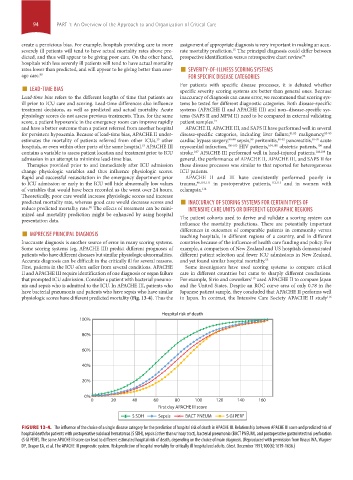
                 that prompted ICU admission. Consider a patient with bacterial pneumo-  For example, Sirio and coworkers  used APACHE II to compare Japan
                                                                                               115
                 nia and sepsis who is admitted to the ICU. In APACHE III, patients who   and the United States. Despite an ROC curve area of only 0.78 in the
                 have bacterial pneumonia and patients who have sepsis who have similar   Japanese patient sample, they concluded that APACHE II performs well
                 physiologic scores have different predicted mortality (Fig. 13-4). Thus the   in Japan. In contrast, the Intensive Care Society APACHE II study
                                                                                                                         116

                                                                 Hospital risk of death
                                     100%

                                      80%

                                      60%


                                      40%

                                      20%

                                       0%
                                         0      20     40     60     80     100    120     140    160
                                                                First day APACHE III score
                                                       S SDH    Sepsis   BACT PNEUM    S GI PERF

                 FIGURE 13-4.  The influence of the choice of a single disease category for the prediction of hospital risk of death in APACHE III. Relationship between APACHE III score and predicted risk of
                 hospital death for patients with postoperative subdural hematomas (S SDH), sepsis (other than urinary tract), bacterial pneumonia (BACT PNEUM), and postoperative gastrointestinal perforation
                 (S GI PERF). The same APACHE III score can lead to different estimated hospital risk of death, depending on the choice of main diagnosis. (Reproduced with permission from Knaus WA, Wagner
                 DP, Draper EA, et al. The APACHE III prognostic system. Risk prediction of hospital mortality for critically ill hospitalized adults. Chest. December 1991;100(6):1619-1636.)


            Section01.indd   94                                                                                        1/22/2015   9:37:29 AM

