


Page 131 - Hall et al (2015) Principles of Critical Care-McGraw-Hill
P. 131
CHAPTER 14: Chronic Critical Illness  97


                     CHAPTER    Chronic Critical Illness                    TABLE 14-1    Phenotype of Chronic Critical Illness
                      14        Shannon S. Carson                         Prolonged ventilatory failure and ventilator dependence
                                                                            Residual hypoxemia and decreased lung compliance from ARDS
                                                                            Respiratory muscle weakness
                                                                          Hemodynamic instability
                                                                            Residual or recurrent sepsis
                                                                            Orthostatic hypotension
                     KEY POINTS                                             Arrhythmias
                       •  Between 5% and 10% of patients admitted to adult ICUs become   Right and left ventricular dysfunction
                      chronically critically ill. The  burden  of chronic critical  illness is   Renal insufficiency or failure
                      anticipated to increase dramatically in the next decade as the popula-  Malnutrition
                      tion ages and more patients survive the acute phase of critical illness.  Hyperglycemia and insulin resistance
                                                                            Anasarca
                        •  Advanced age and multiple organ failure due to severe sepsis and   Muscle atrophy
                      multiple trauma are the most significant risk factors for chronic   Skin breakdown
                      critical illness, especially when complicated by comorbidities and   Delirium or coma
                      nosocomial complications.                           Anxiety and depression
                        •  Chronically critically  ill  patients have  distinct  physiology  com-
                      pared with more acutely ill patients, including suppressed levels
                      of anterior pituitary hormones, severe depletion of protein stores
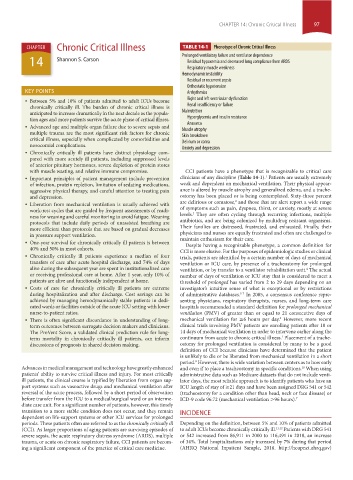
                      with muscle wasting, and relative immune compromise.  CCI patients have a phenotype that is recognizable to critical care
                                                                                                       1
                        •  Important principles of patient management include prevention   clinicians of any discipline (Table 14-1).  Patients are usually extremely
                      of infection, protein repletion, limitation of sedating medications,   weak and dependent on mechanical ventilation. Their physical appear-
                      aggressive physical therapy, and careful attention to treating pain   ance is altered by muscle atrophy and generalized edema, and a trache-
                      and depression.                                     ostomy has been placed or is being contemplated. Sixty-three percent
                                                                                            2
                        •  Liberation from mechanical ventilation is usually achieved with   are delirious or comatose,  and those that are alert report a wide range
                      work-rest cycles that are guided by frequent assessments of readi-  of symptoms such as pain, dyspnea, thirst, or anxiety, mostly at severe
                                                                              3
                      ness for weaning and careful monitoring to avoid fatigue. Weaning   levels.   They are  often  cycling  through recurring  infections, multiple
                      protocols that include daily periods of unassisted breathing are   antibiotics, and are being colonized by multidrug resistant organisms.
                      more efficient than protocols that are based on gradual decreases   Their families are distressed, frustrated, and exhausted. Finally, their
                      in pressure support ventilation.                    physicians and nurses are equally frustrated and often are challenged to
                        •  One-year survival for chronically critically ill patients is between   maintain enthusiasm for their care.
                                                                           Despite having a recognizable phenotype, a common definition for
                      40% and 50% in most cohorts.                        CCI is more elusive. For the purposes of epidemiologic studies or clinical
                        •  Chronically  critically  ill  patients  experience  a  median  of  four   trials, patients are identified by a certain number of days of mechanical
                      transfers of care after acute hospital discharge, and 74% of days   ventilation or ICU care, by presence of a tracheostomy for prolonged
                      alive during the subsequent year are spent in institutionalized care   ventilation, or by transfer to a ventilator rehabilitation unit.  The actual
                                                                                                                     4
                      or receiving professional care at home. After 1 year, only 10% of   number of days of ventilation or ICU stay that is considered to meet a
                      patients are alive and functionally independent at home.  threshold of prolonged has varied from 2 to 29 days depending on an
                        •  Costs of care for chronically critically ill patients are extreme   investigator’s  intuitive  sense  of  what  is  exceptional  or  by  restrictions
                      during  hospitalization and  after discharge. Cost savings  can be   of administrative databases.  In 2005, a consensus conference repre-
                                                                                              5-7
                      achieved by managing hemodynamically stable patients in dedi-  senting physicians, respiratory therapists, nurses, and long-term care
                      cated wards or facilities outside of the acute ICU setting with lower   hospitals recommended a standard definition for prolonged mechanical
                      nurse-to-patient ratios.                            ventilation  (PMV)  of greater than  or equal  to 21  consecutive days of
                        •  There is often significant discordance in understanding of long-  mechanical ventilation for  ≥6 hours per day.  However,  more recent
                                                                                                            8
                      term outcomes between surrogate decision makers and clinicians.   clinical trials involving PMV patients are enrolling patients after 10 or
                      The ProVent Score, a validated clinical prediction rule for long-  14 days of mechanical ventilation in order to intervene earlier along the
                                                                                                            1
                      term   mortality  in  chronically  critically  ill  patients,  can  inform   continuum from acute to chronic critical illness.  Placement of a trache-
                      discussions of prognosis in shared decision making.  ostomy for prolonged ventilation is considered by many to be a good
                                                                          definition of CCI because clinicians have determined that the patient
                                                                          is unlikely to die or be liberated from mechanical ventilation in a short
                                                                          period.  However, there is wide variation between centers as to how early
                                                                               9
                    Advances in medical management and technology have greatly enhanced   and even if to place a tracheostomy in specific conditions.  When using
                                                                                                                   10
                    patients’ ability to survive critical illness and injury. For most critically   administrative data such as Medicare datasets that do not include venti-
                    ill patients, the clinical course is typified by liberation from organ sup-  lator days, the most reliable approach is to identify patients who have an
                    port systems such as vasoactive drugs and mechanical ventilation after   ICU length of stay of ≥21 days and have been assigned DRG 541 or 542
                    reversal of the acute process, followed by a short period of observation   (tracheostomy for a condition other than head, neck or face disease) or
                    before transfer from the ICU to a medical/surgical ward or an interme-  ICD-9 code 96.72 (mechanical ventilation >96 hours). 7
                    diate care unit. For a significant number of patients, however, this timely
                    transition to a more stable condition does not occur, and they remain   INCIDENCE
                    dependent on life-support systems or other ICU services for prolonged
                    periods. These patients often are referred to as the chronically critically ill   Depending on the definition, between 5% and 10% of patients admitted
                    (CCI). As larger proportions of aging patients are surviving episodes of   to adult ICUs become chronically critically ill. 11,12  Patients with DRG 541
                    severe sepsis, the acute respiratory distress syndrome (ARDS), multiple   or 542 increased from 86,911 in 2000 to 116,491 in 2010, an increase
                    trauma, or acute on chronic respiratory failure, CCI patients are becom-  of 34%. Total hospitalizations only increased by 7% during that period
                    ing a significant component of the practice of critical care medicine.  (AHRQ National Inpatient Sample, 2010.  http://hcupnet.ahrq.gov)


            Section01.indd   97                                                                                        1/22/2015   9:37:30 AM

