


Page 127 - Hall et al (2015) Principles of Critical Care-McGraw-Hill
P. 127
CHAPTER 13: Assessment of Severity of Illness   93


                                                                                                              78
                         N of cases             Hospital death rate       die without CPR (cardiopulmonary resuscitation),  and many die after
                     400                                           100    withholding or withdrawal of care.
                                                                           A major portion of ICU resources is spent on patients who have mini-
                                                                          mal chances of survival. However, until a public consensus is reached
                                                                                                           79
                                                                   80     about dealing with these very difficult issues,  broad ethical principles
                     300                                                  of beneficence, nonmalfeasance, and autonomy are likely to be more
                                                                          important components of end-of-life decisions than quantitative data
                                                                          provided by scoring systems. Broader social and economic policy issues
                                                                   60
                                                                          should be separate concerns.
                     200
                                                                          SOURCES OF ERROR AND BIAS IN SCORING SYSTEMS
                                                                   40
                                                                          Severity-of-illness scoring systems are not perfect, partially because of
                                                                          error and bias. Error and bias limit the reproducibility of scoring systems
                     100
                                                                   20     outside the original sample of patients, and thus limit the applicability
                                                                          of scoring systems to different clinical situations. Specifically, bias of
                                                                          scoring systems can be related to the selection of included variables,
                                                                          to the collection of data, to the lead time before the onset of the acute
                       0                                        +  0
                          0  10  20  30  40  50  60  70  80  90 100       disease and admission of the patient to the ICU, to the imprecision in
                                 10-Point APACHE III ranges (first day)   choosing a principal admission diagnosis, to the inaccuracy of certain
                                                                          scoring systems for specific disease categories, and finally to the use
                                  N of cases  Predicted  Observed         of scoring systems for purposes they were not meant to accomplish.
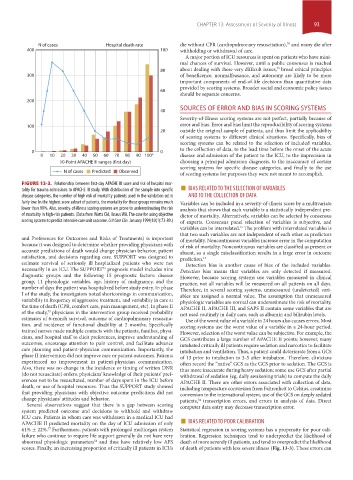
                    FIGURE 13-3.  Relationship between first-day APACHE III score and risk of hospital mor-    ■
                    tality for trauma admissions to APACHE III study. With distribution of the sample into specific   BIAS RELATED TO THE SELECTION OF VARIABLES
                    disease categories, the number of high risk of mortality patients used in the validation set is   AND TO THE COLLECTION OF DATA
                    fairly low. In the highest score subset of patients, the mortality for these groups remains much   Variables can be included in a severity-of-illness score by a multivariate
                    lower than 99%. Also, severity-of-illness scoring systems are prone to underestimating the risk   analysis that shows that each variable is a statistically independent pre-
                    of mortality in high-risk patients. (Data from Watts CM, Knaus WA. The case for using objective   dictor of mortality. Alternatively, variables can be selected by consensus
                    scoring systems to predict intensive care unit outcome. Crit Care Clin. January 1994;10(1):73-89.)  of experts.  Consensus panel selection of  variables  is subjective, and
                                                                          variables can be interrelated.  The problem with interrelated variables is
                                                                                              15
                                                                          that two such variables are not independent of each other as predictors
                    and Preferences for Outcomes and Risks of Treatments) is important   of mortality. Noncontinuous variables increase error in the computation
                    because it was designed to determine whether providing physicians with   of risk of mortality. Noncontinuous variables are classified as present or
                    accurate predictions of death would change physician behavior, patient   absent, so a single misclassification results in a large error in outcome
                    satisfaction, and decisions regarding care. SUPPORT was designed to   prediction. 15
                    estimate survival of seriously ill hospitalized patients who were not   Detection bias is another cause of bias of the included variables.
                                               74
                    necessarily in an ICU. The SUPPORT  prognosis model includes nine   Detection bias means that variables are only detected if measured.
                    diagnostic groups and the following 15 prognostic factors: disease   However, because scoring systems use variables measured in clinical
                    group, 11 physiologic variables, age, history of malignancy, and the   practice, not all variables will be measured on all patients on all days.
                    number of days the patient was hospitalized before study entry. In phase   Therefore, in several scoring systems, unmeasured (undetected) vari-
                    I of the study, the investigators noted shortcomings in communication,   ables are assigned a normal value. The assumption that unmeasured
                    variability in frequency of aggressive treatment, and variability in care at   physiologic variables are normal can underestimate the risk of mortality.
                    the time of death (CPR, comfort care, pain management, etc). In phase II   APACHE II, APACHE III, and SAPS II contain some variables that are
                    of the study,  physicians in the intervention group received probability   not used routinely in daily care, such as albumin and bilirubin levels.
                            75
                    estimates of 6-month survival, outcome of cardiopulmonary resuscita-  Use of the worst value of a variable in 24 hours also causes errors. Most
                    tion, and  incidence  of functional disability at 2  months. Specifically   scoring systems use the worst value of a variable in a 24-hour period.
                    trained nurses made multiple contacts with the patients, families, physi-  However, selection of the worst value can be subjective. For example, the
                    cians, and hospital staff to elicit preferences, improve understanding of   GCS contributes a large number of APACHE II points; however, many
                    outcomes, encourage attention to pain control, and facilitate advance   intubated critically ill patients require sedation and narcotics to facilitate
                    care planning and patient-physician communication. Importantly, the   intubation and ventilation. Thus, a patient could deteriorate from a GCS
                    phase II intervention did not improve care or patient outcomes. Patients   of 13 prior to intubation to 3-5 after intubation. Therefore, clinicians
                    experienced no improvement in patient-physician communication.   often record the “native” GCS as the GCS prior to sedation. The GCS is
                    Also, there was no change in the incidence or timing of written DNR   thus more inaccurate during heavy sedation; some use GCS after partial
                    (do not resuscitate) orders, physicians’ knowledge of their patients’ pref-  withdrawal of sedation (eg, daily awakening trials) to compute the daily
                    erences not to be resuscitated, number of days spent in the ICU before   APACHE II. There are other errors associated with collection of data,
                    death, or use of hospital resources. Thus the SUPPORT study showed   including temperature conversion from Fahrenheit to Celsius, creatinine
                    that providing physicians with objective outcome predictions did not   conversion to the international system, use of the GCS on deeply sedated
                    change physicians’ attitudes and behavior.            patients,  transcription errors, and errors in analysis of data. Direct
                                                                                54
                     Several observations suggest that there is a gap between scoring   computer data entry may decrease transcription error.
                    system predicted outcome and decisions to withhold and withdraw
                    APACHE II predicted mortality on the day of ICU admission of only   ■  BIAS RELATED TO POOR CALIBRATION
                    ICU care. Patients in whom care was withdrawn in a medical ICU had
                             77
                    61% ± 22%.  Furthermore, patients with prolonged multiorgan system   Statistical regression in scoring systems has a propensity for poor cali-
                    failure who continue to require life support generally do not have very   bration. Regression techniques tend to underpredict the likelihood of
                    abnormal  physiologic  parameters   and thus  have  relatively  low  APS   death of more severely ill patients, and tend to overpredict the likelihood
                                            54
                    scores. Finally, an increasing proportion of critically ill patients in ICUs   of death of patients with less severe illness (Fig. 13-3). These errors can


            Section01.indd   93                                                                                        1/22/2015   9:37:28 AM

