


Page 133 - Hall et al (2015) Principles of Critical Care-McGraw-Hill
P. 133
CHAPTER 14: Chronic Critical Illness  99


                                                                           Infectious complications were documented in a series of 100 patients
                      TABLE 14-3    Neuroendocrine Function in Acute and Chronic Phases of Critical Illness
                                                                          admitted to a hospital unit dedicated to the care of patients with chronic
                                     Acute Critical Illness  Chronic Critical Illness  critical illness.  All patients were receiving mechanical ventilation
                                                                                    28
                    ACTH             ↑                 ↓                  through a tracheostomy after at least 2 weeks of critical illness. During
                                                                          hospitalization on this unit, 61% of patients developed evidence of SIRS,
                    Cortisol         ↑↑                ↑
                                                                          and 11% developed septic shock. Line sepsis (11%), primary bacteremia
                    Prolactin        ↑                 ↓                  (6%), tracheostomy-associated pneumonia (10%), and Clostridium dif-
                    Thyrotropin      ↓                 ↓                  ficile colitis (10%) were the most common infections. Urosepsis was less
                    Gonadotropin     ↓                 ↓                  common in this series, but the authors were appropriately conservative
                                                                          in the diagnosis of urosepsis. This diagnosis required the presence of
                    Growth hormone   ↑, pulsatile      ↓, irregular       SIRS and pyuria or a positive urine culture without any other obvious
                                                                          source of infection.
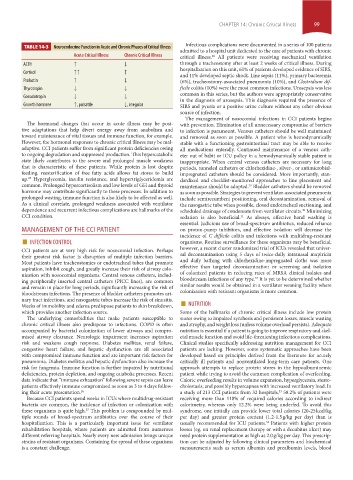
                                                                           The management of nosocomial infections in CCI patients begins
                     The hormonal  changes that occur in  acute illness may be posi-  with prevention. Elimination of all unnecessary compromise of barriers
                    tive  adaptations  that  help divert energy away  from  anabolism and   to infection is paramount. Venous catheters should be well maintained
                    toward maintenance of vital tissues and immune function, for example.   and removed as soon as possible. A patient who is hemodynamically
                    However, the hormonal responses to chronic critical illness may be mal-  stable with a functioning gastrointestinal tract may be able to receive
                    adaptive. CCI patients suffer from significant protein deficiencies owing   all medications enterally. Continued maintenance of a venous cath-
                    to ongoing degradation and suppressed production. This hypercatabolic   eter out of habit or ICU policy in a hemodynamically stable patient is
                    state likely contributes to the severe and prolonged muscle weakness   inappropriate. When central venous catheters are necessary for long
                    that is characteristic of these patients. While protein is lost despite   periods, tunneled catheters or chlorhexidine-, silver-, or antimicrobial-
                    feeding, reesterification of free fatty acids allows fat stores to build   impr egnated catheters should be considered. More importantly, stan-
                    up.  Hyperglycemia, insulin resistance, and hypertriglyceridemia are    dardized and checklist-monitored approaches to line placement and
                      23
                    common. Prolonged hypercortisolism and low levels of GH and thyroid   maintenance should be adopted.  Bladder catheters should be removed
                                                                                                 29
                    hormone may contribute significantly to these processes. In addition to   as soon as possible. Strategies to prevent ventilator-associated pneumonia
                    prolonged wasting, immune function is also likely to be affected as well.   include semirecumbent positioning, oral decontamination, removal of
                    As a clinical correlate, prolonged weakness associated with ventilator   the nasogastric tube when possible, closed endotracheal suctioning, and
                    dependence and recurrent infectious complications are hallmarks of the   scheduled drainage of condensate from ventilator circuits.  Minimizing
                                                                                                                   30
                    CCI condition.                                        sedation is also beneficial.  As  always, effective hand washing is
                                                                                              31
                                                                          essential. Judicious use of broad-spectrum antibiotics, reduced reliance
                    MANAGEMENT OF THE CCI PATIENT                         on proton-pump inhibitors, and effective isolation will decrease the
                        ■  INFECTION CONTROL                              incidence of  C difficile colitis and infections with multidrug-resistant
                                                                          organisms. Routine surveillance for these organisms may be beneficial;
                    CCI patients are at very high risk for nosocomial infection. Perhaps   however, a recent cluster randomized trial of ICUs revealed that univer-
                    their greatest risk factor is disruption of multiple infection barriers.   sal decontamination using 5 days of twice-daily intranasal mupiricin
                    Most patients have tracheostomies or endotracheal tubes that promote   and daily bathing with chlorhexidine-impregnated cloths was more
                    aspiration, inhibit cough, and greatly increase their risk of airway colo-  effective than targeted decontamination or screening and isolation
                    nization with nosocomial organisms. Central venous catheters, includ-  of colonized patients in reducing rates of MRSA clinical isolates and
                                                                                                   32
                    ing peri pherally inserted central catheters (PICC lines), are common   bloodstream infections of any type.  It is yet to be determined whether
                    and remain in place for long periods, significantly increasing the risk of   similar results would be obtained in a ventilator weaning facility where
                    bloodstream infections. The presence of bladder catheters promotes uri-  colonization with resistant organisms is more common.
                    Weeks of immobility and edema predispose patients to skin breakdown,   ■  NUTRITION
                    nary tract infections, and nasogastric tubes increase the risk of sinusitis.
                    which provides another infection source.              Some of the hallmarks of chronic critical illness include low protein
                     The underlying comorbidities that make patients susceptible to   stores owing to impaired synthesis and persistent losses, muscle wasting
                    chronic critical illness also predispose to infections. COPD is often   and atrophy, and weight loss (unless volume overload persists). Adequate
                    accompanied by bacterial colonization of lower airways and compro-  nutrition is essential if a patient is going to improve respiratory and skel-
                    mised  airway clearance.  Neurologic  impairment  increases  aspiration   etal muscle function and avoid life-threatening infectious complications.
                    risk and weakens cough response. Diabetes mellitus, renal failure,   Clinical studies specifically addressing nutrition management for CCI
                    congestive heart failure, and hepatic dysfunction are all associated   patients are lacking. However, some systematic approaches have been
                    with compromised immune function and are important risk factors for   developed based on principles derived from the literature for acutely
                    pneumonia. Diabetes mellitus and hepatic dysfunction also increase the   critically ill patients and nonventilated long-term care patients. One
                    risk for fungemia. Immune function is further impaired by nutritional   approach attempts to replace protein stores in the hypoalbuminemic
                    deficiencies, protein depletion, and ongoing catabolic processes. Recent   patient while trying to avoid the common complication of overfeeding.
                    data indicate that “immune exhaustion” following severe sepsis can leave   Caloric overfeeding results in volume expansion, hyperglycemia, steato-
                    patients effectively immune compromised as soon as 3 to 4 days follow-  cholestasis, and possibly hypercapnea with increased ventilatory load. In
                    ing their acute presentation. 26                      a study of 213 CCI patients from 32 hospitals,  58.2% of patients were
                                                                                                           33
                     Because CCI patients spend weeks in ICUs where multidrug-resistant   receiving more than 110% of required calories according to indirect
                    bacteria are common, the incidence of infection or colonization with   calorimetry, whereas only 12.2% were being underfed. To avoid this
                    these organisms is quite high.  This problem is compounded by mul-  syndrome, one initially can provide lower total calories (20-25 kcal/kg
                                         27
                    tiple rounds of broad-spectrum antibiotics over the course of their   per day) and greater protein content (1.2-1.5 g/kg per day) than is
                    hospitalization.  This  is  a  particularly  important  issue  for  ventilator   usually recommended for ICU patients.  Patients with higher protein
                                                                                                       34
                    rehabilitation hospitals, where patients are admitted from numerous   losses (eg, on renal replacement therapy or with a decubitus ulcer) may
                    different referring hospitals. Nearly every new admission brings unique   need protein supplementation as high as 2.0 g/kg per day. This prescrip-
                    strains of resistant organisms. Containing the spread of these organisms   tion can be adjusted by following clinical parameters and biochemical
                    is a constant challenge.                              measurements  such  as  serum  albumin  and  prealbumin  levels,  blood


            Section01.indd   99                                                                                        1/22/2015   9:37:31 AM

