


Page 132 - Hall et al (2015) Principles of Critical Care-McGraw-Hill
P. 132
98      PART 1: An Overview of the Approach to and Organization of Critical Care


                         12                                              TABLE 14-2    Risk Factors for Chronic Critical Illness
                                                                        Advanced age
                         10 8                                           Severe sepsis
                        Total annual days in millions  6 4              Multiple trauma
                                                                        Multilobar pneumonia or ARDS
                                                                        Severe cerebrovascular accident or traumatic brain injury
                                                                        Comorbidities
                                                                          COPD
                                                                          Renal insufficiency
                                                                          CHF
                                                                        Postoperative complications
                          2
                                                                          Preoperative instability
                                                                          Prolonged operation
                          0                                             Ventilator-associated pneumonia or central line–associated bloodstream infection
                                2000        2010       2020
                                            Year                        ICU-acquired weakness
                                     ICU Days   Hospital Days
                                                                       polyneuropathy (CIP), critical illness myopathy, and immobility. CIP
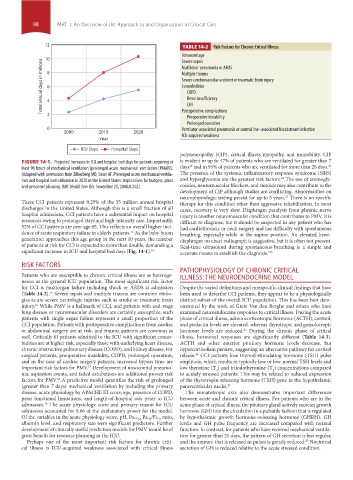
                 FIGURE 14-1.  Projected increases in ICU and hospital bed days for patients requiring at   is evident in up to 47% of patients who are ventilated for greater than 7
                                                                                                                          21
                                                                          20
                 least 96 hours of mechanical ventilation (prolonged acute mechanical ventilation [PAMV]).   days  and in 95% of patients who are ventilated for more than 28 days.
                 (Adapted with permission from Zilberberg MD, Shorr AF. Prolonged acute mechanical ventila-  The presence of the systemic inflammatory response syndrome (SIRS)
                                                                                                          22
                 tion and hospital bed utilization in 2020 in the United States: implications for budgets, plant   and hyperglycemia are the greatest risk factors.  The use of aminogly-
                 and personnel planning. BMC Health Serv Res. November 25, 2008;8:242.)  cosides, neuromuscular blockers, and steroids may also contribute to the
                                                                       development of CIP although studies are conflicting. Abnormalities on
                                                                                                           21
                                                                       neurophysiologic testing persist for up to 5 years.  There is no specific
                 These CCI patients represent 0.25% of the 35 million annual hospital   therapy for this condition other than aggressive rehabilitation. In most
                 discharges in the United States. Although this is a small fraction of all   cases, recovery is very slow. Diaphragm paralysis from phrenic nerve
                 hospital admissions, CCI patients have a substantial impact on hospital   injury is another neuromuscular condition that contributes to PMV. It is
                 resources owing to prolonged stays and high-intensity care. Importantly,   difficult to diagnose, but it should be suspected in any patient who has
                 52% of CCI patients are over age 65. This reflects an overall higher inci-  had cardiothoracic or neck surgery and has difficulty with spontaneous
                                                      13
                 dence of acute respiratory failure in elderly patients.  As the baby boom   breathing, especially while in the supine position. An elevated hemi-
                 generation approaches this age group in the next 10 years, the number   diaphragm on chest radiograph is suggestive, but it is often not present.
                 of patients at risk for CCI is expected to more than double, demanding a   Real-time ultrasound during spontaneous breathing is a simple and
                 significant increase in ICU and hospital bed days (Fig. 14-1). 14  accurate means to establish the diagnosis. 21b
                 RISK FACTORS
                                                                       PATHOPHYSIOLOGY OF CHRONIC CRITICAL
                 Patients who are susceptible to chronic critical illness are as heteroge-  ILLNESS: THE NEUROENDOCRINE MODEL
                 neous as the general ICU population. The most significant risk factor
                 for CCI is multiorgan failure including shock or ARDS at admission   Despite the varied definitions and nonspecific clinical findings that have
                 (Table 14-2).  Severe sepsis and multiple trauma are common etiolo-  been used to describe CCI patients, they appear to be a physiologically
                           15
                 gies as are severe neurologic injuries such as stroke or traumatic brain   distinct subset of the overall ICU population. This has been best dem-
                 injury.  While PMV is a hallmark of CCI, and patients with end-stage   onstrated by the work of Grete Van den Berghe and others who have
                      16
                 lung disease or neuromuscular disorders are certainly susceptible, such   examined neuroendocrine responses to critical illness. During the acute
                 patients with single organ failure represent a small proportion of the   phase of critical illness, adrenocorticotropic hormone (ACTH), cortisol,
                 CCI population. Patients with postoperative complications from cardiac   and prolactin levels are elevated, whereas thyrotropic and gonadotropic
                 or abdominal surgery are at risk, and trauma patients are common as   hormone  levels  are  reduced.   During  the  chronic  phase  of  critical
                                                                                             23
                 well. Critically ill patients admitted to the ICU with significant comor-  illness, hormonal responses are significantly different (Table  14-3).
                 bidities are at higher risk, especially those with underlying heart disease,   ACTH and other anterior pituitary hormone levels decrease, but
                 chronic obstructive pulmonary disease (COPD), and kidney disease. For   hypercortisolism persists, suggesting an alternative pathway for cortisol
                 surgical patients, preoperative instability, COPD, prolonged operation,   release.  CCI patients lose thyroid-stimulating hormone (TSH) pulse
                                                                            24
                 and in the case of cardiac surgery patients, increased bypass time are   amplitude, which results in typically low or low-normal TSH levels and
                 important risk factors for PMV.  Development of nosocomial pneumo-  low thyroxine (T ) and triiodothyronine (T ) concentrations compared
                                        17
                                                                                    4
                                                                                                       3
                 nia, aspiration events, and failed extubations are additional proven risk   to acutely stressed patients. This may be related to reduced expression
                 factors for PMV.  A predictive model quantifies the risk of prolonged   of the thyrotropin-releasing hormone (TRH) gene in the hypothalamic
                             18
                 (greater than 7 days) mechanical ventilation by including the primary   paraventricular nuclei. 25
                 disease, acute physiology by APACHE III score, age, presence of COPD,   The somatotropic axis also demonstrates important differences
                 prior  functional  limitations,  and  length-of-hospital  stay  prior  to  ICU   between acute and chronic critical illness. For patients who are in the
                 admission.  The acute physiology score and primary reason for ICU   acute phase of critical illness, the pituitary gland actively secretes growth
                         19
                 admission accounted for 0.66 of the explanatory power for the model.    hormone (GH) into the circulation in a pulsatile fashion that is regulated
                                                                  ratio,   by hypothalamic growth hormone–releasing hormone (GHRH). GH
                 Of the variables in the acute physiology score, pH, Pa CO 2 , Pa O 2 /Fi O 2
                 albumin level, and respiratory rate were significant predictors. Further   levels  and  GH  pulse  frequency  are  increased  compared  with  normal
                 development of clinically useful prediction models for PMV would be of   function. In contrast, for patients who have received mechanical ventila-
                 great benefit for resource planning in the ICU.       tion for greater than 21 days, the pattern of GH secretion is less regular,
                   Perhaps one of the most important risk factors for chronic criti-  and the amount that is released in pulses is greatly reduced.  Nocturnal
                                                                                                                  23
                 cal  illness is  ICU-acquired  weakness  associated  with critical  illness   secretion of GH is reduced relative to the acute stressed condition.


            Section01.indd   98                                                                                        1/22/2015   9:37:31 AM

