


Page 137 - Hall et al (2015) Principles of Critical Care-McGraw-Hill
P. 137
CHAPTER 15: Long-Term Outcomes After Critical Illness  103


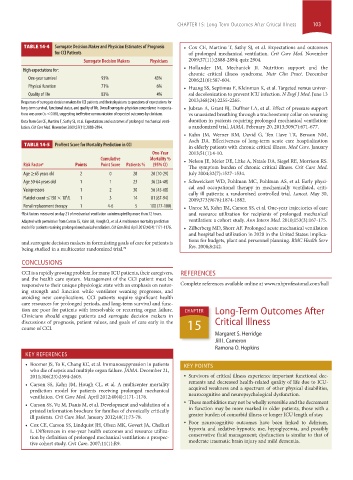
                     TABLE 14-4     Surrogate Decision Maker and Physician Estimates of Prognosis      • Cox CE, Martinu T, Sathy SJ, et al. Expectations and outcomes
                               for CCI Patients                              of  prolonged  mechanical ventilation.  Crit Care Med.  November
                                         Surrogate Decision Makers  Physicians  2009;37(11):2888-2894; quiz 2904.
                                                                              • Hollander JM, Mechanick JI. Nutrition support and the
                    High expectations for:
                                                                             chronic critical illness syndrome.  Nutr Clin Pract. December
                      One-year survival        93%               43%         2006;21(6):587-604.
                      Physical function        71%                6%          • Huang SS, Septimus E, Kleinman K, et al. Targeted versus univer-
                      Quality of life          83%                4%         sal decolonization to prevent ICU infection. N Engl J Med. June 13
                                                                             2013;368(24):2255-2265.
                   Responses of surrogate decision makers for CCI patients and their physicians to questions of expectations for
                   long-term survival, functional status, and quality of life. Overall surrogate-physician concordance in expecta-    • Jubran A, Grant BJ, Duffner LA, et al. Effect of pressure support
                   tions was poor (κ <0.08), suggesting ineffective communication of expected outcomes by clinicians.  vs unassisted breathing through a tracheostomy collar on weaning
                   Data from Cox CE, Martinu T, Sathy SJ, et al. Expectations and outcomes of prolonged mechanical venti-  duration in patients requiring prolonged mechanical ventilation:
                   lation. Crit Care Med. November 2009;37(11):2888-2894.    a randomized trial. JAMA. February 20, 2013;309(7):671-677.
                                                                              • Kahn JM, Werner RM, David G, Ten Have TR, Benson NM,
                                                                             Asch DA. Effectiveness of long-term acute care hospitalization
                      TABLE 14-5    ProVent Score for Mortality Prediction in CCI  in elderly patients with chronic critical illness. Med Care. January
                                                                One-Year     2013;51(1):4-10.
                                               Cumulative      Mortality %     • Nelson JE, Meier DE, Litke A, Natale DA, Siegel RE, Morrison RS.
                    Risk Factor a     Points   Point Score  Patients %  (95% CI)  The symptom burden of chronic critical illness.  Crit Care Med.
                    Age ≥65 years old   2         0       28    20 (10-29)   July 2004;32(7):1527-1534.
                    Age 50-64 years old  1        1       23    36 (24-48)    • Schweickert WD, Pohlman MC, Pohlman AS, et al. Early physi-
                                                                             cal and occupational therapy in mechanically ventilated, criti-
                    Vasopressors        1         2       30    56 (45-68)
                                                                             cally ill patients: a randomised controlled trial. Lancet. May 30,
                    Platelet count ≤150 × 10 /L  1  3     14    81 (67-94)   2009;373(9678):1874-1882.
                                   9
                    Renal replacement therapy  1  4-6     5    100 (77-100)    • Unroe M, Kahn JM, Carson SS, et al. One-year trajectories of care
                    a Risk factors measured on day 21 of mechanical ventilation uninterrupted by more than 72 hours.  and resource utilization for recipients of prolonged mechanical
                    Adapted with permission from Carson SS, Kahn JM, Hough CL, et al. A multicenter mortality prediction   ventilation: a cohort study. Ann Intern Med. 2010;153(3):167-175.
                    model for patients receiving prolonged mechanical ventilation. Crit Care Med. April 2012;40(4):1171-1176.    • Zilberberg MD, Shorr AF. Prolonged acute mechanical ventilation
                                                                             and hospital bed utilization in 2020 in the United States: implica-
                    and surrogate decision makers in formulating goals of care for patients is   tions for budgets, plant and personnel planning. BMC Health Serv
                    being studied in a multicenter randomized trial. 70      Res. 2008;8:242.

                    CONCLUSIONS

                    CCI is a rapidly growing problem for many ICU patients, their caregivers,  REFERENCES
                    and the health care system. Management of the CCI patient must be
                    responsive to their unique physiologic state with an emphasis on restor-  Complete references available online at www.mhprofessional.com/hall
                    ing strength and function while ventilator weaning progresses, and
                    avoiding new complications. CCI patients require significant health
                    care resources for prolonged periods, and long-term survival and func-
                    tion are poor for patients with irresolvable or recurring organ failure.   CHAPTER  Long-Term Outcomes After
                    Clinicians should engage patients and surrogate decision makers in
                    discussions of prognosis, patient values, and goals of care early in the   15  Critical Illness
                    course of CCI.
                                                                                     Margaret S. Herridge
                                                                                     Jill I. Cameron
                                                                                     Ramona O. Hopkins
                     KEY REFERENCES
                        • Boomer JS, To K, Chang KC, et al. Immunosuppression in patients   KEY POINTS
                       who die of sepsis and multiple organ failure. JAMA. December 21,
                       2011;306(23):2594-2605.                                • Survivors of critical illness experience important functional dec-
                        • Carson SS, Kahn JM, Hough CL, et al. A multicenter mortality   rements and decreased health-related quality of life due to ICU-
                       prediction model for patients receiving prolonged mechanical   acquired weakness and a spectrum of other physical disabilities,
                       ventilation. Crit Care Med. April 2012;40(4):1171-1176.  neurocognitive and neuropsychological dysfunction.
                        • Carson SS, Vu M, Danis M, et al. Development and validation of a     • These morbidities may not be wholly reversible and the decrement
                       printed information brochure for families of chronically critically   in function may be more marked in older patients, those with a
                       ill patients. Crit Care Med. January 2012;40(1):73-78.  greater burden of comorbid illness or longer ICU length of stay.
                        • Cox CE, Carson SS, Lindquist JH, Olsen MK, Govert JA, Chelluri     • Poor neurocognitive outcomes have been linked to delirium,
                       L. Differences in one-year health outcomes and resource utiliza-  hypoxia and sedative-hypnotic use, hypoglycemia, and possibly
                       tion by definition of prolonged mechanical ventilation: a prospec-  conservative fluid management; dysfunction is similar to that of
                       tive cohort study. Crit Care. 2007;11(1):R9.          moderate traumatic brain injury and mild dementia.


            Section01.indd   103                                                                                       1/22/2015   9:37:33 AM

