


Page 158 - Hall et al (2015) Principles of Critical Care-McGraw-Hill
P. 158
124     PART 1: An Overview of the Approach to and Organization of Critical Care


                 these disagreements and quantitative evidence suggests CPR among     TABLE 18-3     Suggested Components for a Withdrawal of Life-Sustaining
                 ICU patients, especially those receiving vasopressors, has little benefit   ICU Treatments Protocol
                 with survival to hospital discharge ranging from 9.3% to 21.2%, with
                 3.6% of patients on vasopressors who receive CPR being discharged to   Stages of the Withdrawal  Key Elements and Practical Details
                 home.  Historically, general ethical convention in the United States is   Preparation and general      1.  Document decision and rationale for withdrawal of life
                      104
                 that autonomy was the preimminent value and thus drives end-of-life   care issues  support
                 treatment decisions. However, many ethicists and professional medical      2.  Discuss the withdrawal plan with the interdisciplinary
                 societies have taken the position that physicians are not obligated to     ICU team including nursing and respiratory therapy
                 provide care that is futile.  The American Medical Association rec-       3.  Explain to family the process and expected duration of
                                     93
                 ommends that when a patient or surrogate decision maker insists on         the process based on the patient’s clinical context
                 a therapy that the physician believes is futile, a communication and      4.  Offer open visitation for family and endorse time for
                 negotiation process should be initiated to reconcile these differences     cultural or religious rituals
                 and the treatment should be provided until differences are reconciled.      5.  Offer appropriate spiritual and/or psychosocial support
                                                                   105
                 Another approach has been developed in the state of Texas and codified     for family (eg, chaplains, palliative care)
                 into state law:  The Texas Advance Directives Act outlines processes      6.  Discontinue treatments (eg, vasopressors) and monitor-
                            106
                 that allow physicians to override the requests of patients or families for   ing devices (eg, cardiac monitors) not intended to sup-
                 treatment deemed futile, while ensuring due process for patients and       port goal of comfort excluding mechanical ventilation
                 families. Debate on the pros and cons of this legislation will no doubt     7.  Continue administering analgesic and sedative medi-
                 continue as consensus is currently lacking on how to best address irre-    cations if patient already receiving
                 solvable conflict between surrogates and clinicians. 107,108  Even though
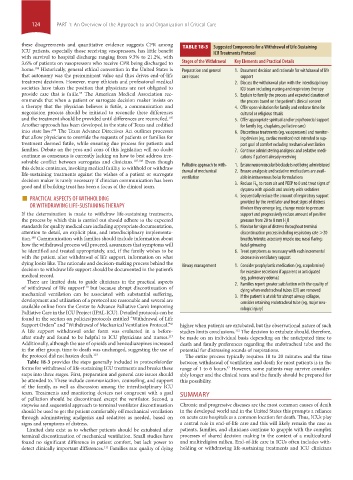
                 this debate continues, invoking medical futility to withhold or withdraw   Palliative approach to with-    1.  Ensure neuromuscular blockade is not being administered
                 life-sustaining treatments against the wishes of a patient or surrogate   drawal of mechanical      2.  Ensure analgesic and sedative medications are avail-
                 decision maker is rarely necessary if clinician communication has been   ventilation  able in intravenous bolus formulations
                 good and if building trust has been a focus of the clinical team.         3.  Reduce Fi o 2  to room air and PEEP to 0 and treat signs of
                                                                                            dyspnea with opioids and anxiety with sedatives
                     ■  PRACTICAL ASPECTS OF WITHHOLDING                                   4.  Sequentially reduce the amount of respiratory support
                    OR WITHDRAWING LIFE-SUSTAINING THERAPY                                  provided by the ventilator and treat signs of distress
                                                                                            if/when they emerge (eg, change mode to pressure
                 If  the  determination  is  made  to  withdraw  life-sustaining  treatments,   support and progressively reduce amount of positive
                 the process by which this is carried out should adhere to the expected     pressure from 20 to 0 mm H O
                                                                                                           2
                   standards for quality medical care including appropriate documentation,     5.  Monitor for signs of distress throughout terminal
                 attention to detail, an explicit plan, and interdisciplinary implementa-   discontinuation process including respiratory rate >20
                 tion.  Communication with families should include information about        breaths/minute; accessory muscle use; nasal flaring;
                     109
                 how the withdrawal process will proceed, assurances that symptoms will     facial grimacing
                 be identified and treated appropriately, and, if the family wishes to be     6.  Treat symptoms as necessary with each incremental
                 with the patient after withdrawal of life support, information on what     decrease in ventilatory support
                 dying looks like. The rationale and decision-making process behind the   Airway management    1.  Consider prophylactic medication (eg, scopolamine)
                 decision to withdraw life support should be documented in the patient’s    for excessive secretions if apparent or anticipated
                 medical record.                                                            (eg, pulmonary edema)
                   There are limited data to guide  clinicians  in the practical aspects
                 of withdrawal of life support  but because abrupt discontinuation of      2.  Families report greater satisfaction with the quality of
                                       110
                                                                                            dying when endotracheal tubes (ET) are removed
                 mechanical ventilation can be associated with substantial suffering,      3.  If the patient is at risk for abrupt airway collapse,
                 development and utilization of a protocol are reasonable and several are   consider retaining endotracheal tube (eg, major neu-
                 available online from the Center to Advance Palliative Care’s Improving    rologic injury)
                 Palliative Care in the ICU Project (IPAL-ICU). Detailed protocols can be
                 found in the section on policies/protocols entitled “Withdrawal of Life
                 Support Orders” and “Withdrawal of Mechanical Ventilation Protocol.”    higher when patients are extubated, but the observational nature of such
                                                                    68
                 A life support withdrawal order form was evaluated in a before-  studies limits conclusions.  The decision to extubate should, therefore,
                                                                                          112
                 after study and found to be helpful to ICU physicians and nurses.    be made on an individual basis depending on the anticipated time to
                                                                   113
                 Additionally, although the use of opioids and benzodiazepines increased   death and family preferences regarding the endotracheal tube and the
                 in the after group, time to death was unchanged, suggesting the use of   potential for distressing sounds of respirations.
                 the protocol did not hasten death. 113                  The entire process typically requires 10 to 20 minutes and the time
                   Table 18-3 provides the steps generally included in protocols/order   between withdrawal of ventilation and death for most patients is in the
                 forms for withdrawal of life-sustaining ICU treatments and breaks these   range of 1 to 6 hours.  However, some patients may survive consider-
                                                                                       47
                 steps into three stages. First, preparation and general care issues should   ably longer and the clinical team and the family should be prepared for
                 be attended to. These include communication, counseling, and support   this possibility.
                 of the family, as well as discussion among the interdisciplinary ICU
                 team.  Treatments  and monitoring  devices  not congruent with a goal   SUMMARY
                 of  palliation  should  be  discontinued  except  the  ventilator.  Second,  a
                 stepwise and sequential approach to terminal ventilator discontinuation   Chronic and progressive diseases are the most common causes of death
                 should be used to get the patient comfortably off mechanical ventilation   in the developed world and in the United States this prompts a reliance
                 through  administering  analgesics  and  sedatives  as  needed,  based  on   on acute care hospitals as a common location for death. Thus, ICUs play
                 signs and symptoms of distress.                       a central role in end-of-life care and this will likely remain the case as
                   Limited data exist as to whether patients should be extubated after   patients, families, and clinicians continue to grapple with the complex
                 terminal discontinuation of mechanical ventilation. Small studies have   processes of shared decision making in the context of a multicultural
                 found  no  significant  difference  in  patient  comfort,  but  lack  power  to   and multireligion milieu. End-of-life care in ICUs often includes with-
                 detect clinically important differences.  Families rate quality of dying   holding or withdrawing life-sustaining treatments and ICU clinicians
                                             111


            Section01.indd   124                                                                                       1/22/2015   9:37:50 AM

