


Page 250 - Hall et al (2015) Principles of Critical Care-McGraw-Hill
P. 250
154     PART 2: General Management of the Patient


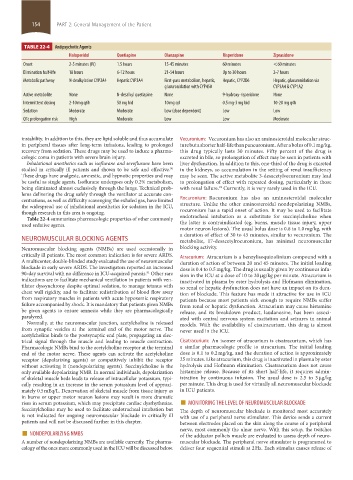
                   TABLE 22-4    Antipsychotic Agents
                                 Haloperidol      Quetiapine      Olanzapine          Risperidone      Ziprasidone
                  Onset          2-5 minutes (IV)  1.5 hours      15-45 minutes       60 minutes       <60 minutes
                  Elimination half-life  18 hours  6-12 hours     21-54 hours         Up to 30 hours   2-7 hours
                  Metabolic pathway  N-dealkylation CYP3A4  Hepatic CYP3A4  First-pass metabolism, hepatic,   Hepatic, CYP2D6  Hepatic, glucuronidation via
                                                                  glucuronidation with CYP450          CYP3A4 & CYP1A2
                  Active metabolite  None         N-desalkyl quetiapine  None         9-hydroxy-risperidone  None
                  Intermittent dosing  2-10 mg q6h  50 mg bid     10 mg qd            0.5 mg-3 mg bid  10-20 mg q4h
                  Sedation       Moderate         Moderate        Low (dose dependent)  Low            Low
                  QTc prolongation risk  High     Moderate        Low                 Low              Moderate


                 instability. In addition to this, they are lipid soluble and thus accumulate   Vecuronium:  Vecuronium has also an aminosteroidal molecular struc-
                 in peripheral tissues after long-term infusions, leading to prolonged   ture but a shorter half-life than pancuronium. After a bolus of 0.1 mg/kg,
                 recovery from sedation. These drugs may be used to induce a pharma-  this drug typically lasts 30 minutes. Fifty percent of the drug is
                 cologic coma in patients with severe brain injury.    excreted in bile, so prolongation of effect may be seen in patients with
                   Inhalational anesthetics such as isoflurane and sevoflurane have been   liver dysfunction. In addition to this, one-third of the drug is excreted
                 studied in critically ill patients and shown to be safe and effective.    in the kidneys, so accumulation in the setting of renal insufficiency
                                                                    90
                 These drugs have analgesic, amnestic, and hypnotic properties and may   may be seen. The active metabolite 3-desacetylvecuronium may lead
                 be useful as single agents. Isoflurane undergoes only 0.2% metabolism,   to prolongation of effect with repeated dosing, particularly in those
                 being eliminated almost exclusively through the lungs. Technical prob-  with renal failure.  Currently, it is very rarely used in the ICU.
                                                                                    92
                 lems delivering the drug safely through the ventilator at accurate con-
                 centrations, as well as difficulty scavenging the exhaled gas, have limited   Rocuronium:  Rocuronium has also an aminosteroidal molecular
                 the widespread use of inhalational anesthetics for sedation in the ICU,   structure. Unlike the other aminosteroidal nondepolarizing NMBs,
                 though research in this area is ongoing.              rocuronium has a rapid onset of action. It may be used to facilitate
                   Table 22-4 summarizes pharmacologic properties of other commonly   endotracheal intubation as a  substitute for  succinylcholine  when
                 used sedative agents.                                 the latter is contraindicated (eg, burns, muscle tissue injury, upper
                                                                       motor neuron lesions). The usual bolus dose is 0.6 to 1.0 mg/kg, with
                                                                       a duration of effect of 30 to 45 minutes, similar to vecuronium. The
                 NEUROMUSCULAR BLOCKING AGENTS                         metabolite,  17-desacetylrocuronium,  has  minimal  neuromuscular
                 Neuromuscular blocking agents (NMBs) are used occasionally in   blocking activity.
                 critically ill patients. The most common indication is for severe ARDS.     Atracurium:  Atracurium is a benzylisoquinolinium compound with a
                 A multicenter, double-blinded study evaluated the use of neuromuscular   duration of action of between 20 and 45 minutes. The initial loading
                 blockade in early severe ARDS. The investigators reported an increased   dose is 0.4 to 0.5 mg/kg. The drug is usually given by continuous infu-
                 90-day survival with no difference in ICU-acquired paresis.  Other rare   sion in the ICU at a dose of 10 to 20 μg/kg per minute. Atracurium is
                                                            91
                 indications are to facilitate mechanical ventilation in patients with ven-  inactivated in plasma by ester hydrolysis and Hofmann elimination,
                 tilator dyssynchrony despite optimal sedation, to manage tetanus with   so renal or hepatic dysfunction does not have an impact on its dura-
                 chest wall rigidity, and to facilitate redistribution of blood flow away   tion of blockade. This feature has made it attractive for use in ICU
                 from respiratory muscles in patients with acute hypoxemic respiratory   patients because most patients sick enough to require NMBs suffer
                 failure accompanied by shock. It is mandatory that patients given NMBs   from renal or hepatic dysfunction. Atracurium may cause histamine
                 be given agents to ensure amnesia while they are pharmacologically   release, and its breakdown product, laudanosine, has been associ-
                 paralyzed.                                            ated with central nervous system excitation and seizures in animal
                   Normally, at the neuromuscular junction, acetylcholine is released   models. With the availability of cisatracurium, this drug is almost
                 from synaptic vesicles at the terminal end of the motor nerve. The   never used in the ICU.
                 acetylcholine binds to the postsynaptic end plate, propagating an elec-
                 trical signal through the muscle and leading to muscle contraction.   Cisatracurium:  An isomer of atracurium is cisatracurium, which has
                 Pharmacologic NMBs bind to the acetylcholine receptor at the terminal   a similar pharmacologic profile to atracurium. The initial loading
                 end of the motor nerve. These agents can activate the acetylcholine   dose is 0.1 to 0.2 mg/kg, and the duration of action is approximately
                 receptor (depolarizing agents) or competitively inhibit the receptor   25 minutes. Like atracurium, this drug is inactivated in plasma by ester
                 without activating it (nondepolarizing agents).  Succinylcholine  is the   hydrolysis and Hofmann elimination. Cisatracurium does not cause
                 only available depolarizing NMB. In normal individuals, depolarization   histamine  release.  Because  of  its  short  half-life,  it  requires  admin-
                 of skeletal muscle beds leads to release of intracellular potassium, typi-  istration by continuous infusion. The usual dose is 2.5 to 3 μg/kg
                 cally resulting in an increase in the serum potassium level of approxi-  per minute. This drug is used for virtually all neuromuscular blockade
                 mately 0.5 mEq/L. Denervation of skeletal muscle from tissue injury as   in ICU patients.
                 in burns or upper motor neuron lesions may result in more dramatic     ■
                 rises in serum potassium, which may precipitate cardiac dysrhythmias.   MONITORING THE LEVEL OF NEUROMUSCULAR BLOCKADE
                 Succinylcholine may be used to facilitate endotracheal intubation but   The depth of neuromuscular blockade is monitored most accurately
                 is not indicated for ongoing neuromuscular blockade in critically ill   with use of a peripheral nerve stimulator. This device sends a current
                 patients and will not be discussed further in this chapter.  between electrodes placed on the skin along the course of a peripheral
                     ■  NONDEPOLARIZING NMBS                           nerve, most commonly the ulnar nerve. With this setup, the twitches
                                                                       of the adductor pollicis muscle are evaluated to assess depth of neuro-
                 A number of nondepolarizing NMBs are available currently. The pharma-  muscular blockade. The peripheral nerve stimulator is programmed to
                 cology of the ones more commonly used in the ICU will be discussed below.  deliver four sequential stimuli at 2 Hz. Each stimulus causes release of


            section02.indd   154                                                                                       1/13/2015   2:05:06 PM

