


Page 263 - Hall et al (2015) Principles of Critical Care-McGraw-Hill
P. 263
CHAPTER 25: Cardiopulmonary Resuscitation  167


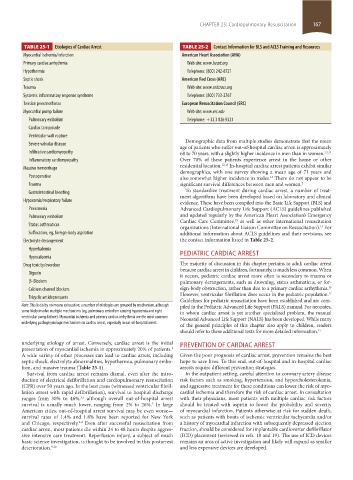
                      TABLE 25-1    Etiologies of Cardiac Arrest            TABLE 25-2    Contact Information for BLS and ACLS Training and Resources
                    Myocardial ischemia/infarction                        American Heart Association (AHA)
                    Primary cardiac arrhythmia                              Web site: www.heart.org
                    Hypothermia                                             Telephone: (800) 242-8721
                    Septic shock                                          American Red Cross (ARC)
                    Trauma                                                  Web site: www.redcross.org
                    Systemic inflammatory response syndrome                 Telephone: (800) 733-2767
                    Tension pneumothorax                                  European Resuscitation Council (ERC)
                    Myocardial pump failure                                 Web site: www.erc.edu
                      Pulmonary embolism                                    Telephone: +32 3 826 9321
                      Cardiac tamponade
                      Ventricular wall rupture
                                                                           Demographic data from multiple studies demonstrate that the mean
                      Severe valvular disease
                                                                          age of patients who suffer out-of-hospital cardiac arrest is approximately
                      Infiltrative cardiomyopathy                         68 to 70 years, with a slightly higher incidence in men than in women. 1,2,11
                      Inflammatory cardiomyopathy                         Over 70% of these patients experience arrest in the home or other
                    Massive hemorrhage                                    residential location. 12,13  In-hospital cardiac arrest patients exhibit similar
                                                                          demographics,  with one  survey showing  a  mean age  of  71 years  and
                      Postoperative                                       also somewhat higher incidence in males.  There do not appear to be
                                                                                                        14
                      Trauma                                              significant survival differences between men and women. 2
                                                                           To standardize treatment during cardiac arrest, a number of treat-
                      Gastrointestinal bleeding                           ment algorithms have been developed based on laboratory and clinical
                    Hypoxemia/respiratory failure
                                                                          evidence. These have been compiled into the Basic Life Support (BLS) and
                      Pneumonia                                           Advanced Cardiopulmonary Life Support (ACLS) guidelines published
                      Pulmonary embolism                                  and updated regularly by the American Heart Association’s Emergency
                                                                          Cardiac Care Committee,  as well as other international resusci tation
                                                                                            15
                      Status asthmaticus                                  organizations (International Liaison Committee on Resuscitation).  For
                                                                                                                         15
                      Suffocation, eg, foreign-body aspiration            additional information about ACLS guidelines and their revisions, see
                    Electrolyte derangement                               the contact information listed in Table 25-2.
                      Hyperkalemia
                      Hypocalcemia                                        PEDIATRIC CARDIAC ARREST
                    Drug toxicity/overdose                                The majority of discussion in this chapter pertains to adult cardiac arrest
                                                                          because cardiac arrest in children, fortunately, is much less common. When
                      Digoxin
                                                                          it occurs, pediatric cardiac arrest more often is secondary to trauma or
                      β-Blockers                                          pulmonary derangements, such as drowning, status asthmaticus, or for-
                                                                                                                            16
                      Calcium channel blockers                            eign-body obstruction, rather than due to a primary cardiac arrhythmia.
                                                                                                                            17
                      Tricyclic antidepressants                           However, ventricular fibrillation does occur in the pediatric population.
                                                                          Guidelines for pediatric resuscitation have been  established and are com-
                    Note: This list is by no means exhaustive; a number of etiologies are grouped by mechanism, although   piled in the Pediatric Advanced Life Support (PALS) manual. For neonates,
                    some likely involve multiple mechanisms (eg, pulmonary embolism causing hypoxemia and right   in  whom  cardiac arrest  is  yet  another  specialized  problem,  the  manual
                    ventricular pump failure). Myocardial ischemia and primary cardiac arrhythmia are the most common   Neonatal Advanced Life Support (NALS) has been developed. While many
                    underlying pathophysiologic mechanisms in cardiac arrest, especially in out-of-hospital arrest.
                                                                          of  the  general  principles  of  this  chapter  also  apply  to  children,  readers
                                                                          should refer to these additional texts for more detailed information. 15
                    underlying etiology of arrest. Conversely, cardiac arrest is the initial   PREVENTION OF CARDIAC ARREST
                    presentation of myocardial ischemia in approximately 20% of patients.
                                                                       2
                    A wide  variety of other processes can lead to cardiac arrest, including   Given the poor prognosis of cardiac arrest, prevention remains the best
                    septic shock, electrolyte abnormalities, hypothermia, pulmonary embo-  hope to save lives. To this end, out-of-hospital and in-hospital cardiac
                    lism, and  massive trauma (Table 25-1).               arrests require different prevention strategies.
                     Survival from cardiac arrest remains dismal, even after the intro-  In the outpatient setting, careful attention to coronary artery disease
                    duction of electrical defibrillation and cardiopulmonary resuscitation   risk factors such as smoking, hypertension, and hypercholesterolemia,
                    (CPR) over 50 years ago. In the best cases (witnessed ventricular fibril-  and aggressive treatment for these conditions can lower the risk of myo-
                    lation arrest with rapid defibrillation), survival to hospital discharge   cardial ischemia and therefore the risk of cardiac arrest. In consultation
                    ranges from 30% to 46%,  although overall out-of-hospital arrest   with their physicians, most patients with multiple cardiac risk factors
                                        3,4
                    survival is usually much lower, ranging from 2% to 26%.  In large   should be treated with aspirin to lower the probability and severity
                                                                5
                    American cities, out-of-hospital arrest survival may be even worse—  of myocardial infarction. Patients otherwise at risk for sudden death,
                    survival rates of 1.4% and 1.8% have been reported for New York   such as patients with bouts of ischemic ventricular tachycardia and/or
                    and Chicago, respectively.  Even after successful resuscitation from   a history of myocardial infarction with subsequently depressed ejection
                                       6-8
                    cardiac arrest, most patients die within 24 to 48 hours despite aggres-  fraction, should be considered for implantable cardioverter defibrillator
                    sive intensive care treatment. Reperfusion injury, a subject of much   (ICD) placement (reviewed in refs. 18 and 19). The use of ICD devices
                    basic science investigation, is thought to be involved in this postarrest   remains an area of active investigation and likely will expand as smaller
                    deterioration. 9,10                                   and less expensive devices are developed.


            section02.indd   167                                                                                       1/13/2015   2:05:09 PM

