


Page 266 - Hall et al (2015) Principles of Critical Care-McGraw-Hill
P. 266
170     PART 2: General Management of the Patient


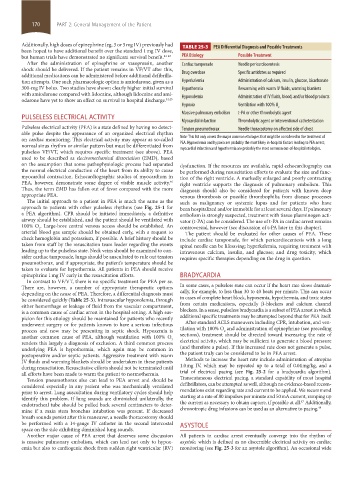
                 Additionally, high doses of epinephrine (eg, 3 or 5 mg IV) previously had     TABLE 25-3    PEA Differential Diagnosis and Possible Treatments
                 been hoped to have additional benefit over the standard 1 mg IV dose,
                 but human trials have demonstrated no significant survival benefit. 41-43  PEA Etiology  Possible Treatment
                   After the administration of epinephrine or vasopressin, another   Cardiac tamponade  Needle pericardiocentesis
                 shock should be delivered. If the patient remains in VF/VT after this,
                 additional medications can be administered before additional defibrilla-  Drug overdose  Specific antidotes as required
                 tion attempts. One such pharmacologic option is amiodarone, given as a   Hyperkalemia  Administration of calcium, insulin, glucose, bicarbonate
                 300-mg IV bolus. Two studies have shown clearly higher initial survival   Hypothermia  Rewarming with warm IV fluids, warming blankets
                 with amiodarone compared with lidocaine, although lidocaine and ami-
                 odarone have yet to show an effect on survival to hospital discharge. 44,45  Hypovolemia  Administration of IV fluids, blood, and/or blood products
                                                                        Hypoxia            Ventilation with 100% O
                                                                                                         2
                                                                        Massive pulmonary embolism  t-PA or other thrombolytic agent
                 PULSELESS ELECTRICAL ACTIVITY
                                                                        Myocardial infarction  Thrombolytic agent or interventional catheterization
                 Pulseless electrical activity (PEA) is a state defined by having no detect-  Tension pneumothorax  Needle thoracostomy on affected side of chest
                 able pulse despite the appearance of an organized electrical rhythm
                 on cardiac monitoring. This electrical activity may appear as so-called   Note: This list only covers the major common etiologies that might be considered in the treatment of
                 normal sinus rhythm or similar pattern but must be differentiated from   PEA. Hypovolemia and hypoxia are probably the most likely in-hospital factors leading to PEA arrest;
                 pulseless VF/VT, which requires specific treatment (see above). PEA   myocardial infarction and hypothermia are probably the most common out-of-hospital etiologies.
                 used to be described as  electromechanical dissociation (EMD), based
                 on the assumption that some pathophysiologic process had separated   dysfunction. If the resources are available, rapid echocardiography can
                 the normal electrical conduction of the heart from its ability to cause   be performed during resuscitation efforts to evaluate the size and func-
                 myocardial  contraction.  Echocardiographic  studies  of  myocardium  in   tion of the right ventricle. A markedly enlarged and poorly contracting
                 PEA, however, demonstrate some degree of visible muscle activity.    right ventricle supports the diagnosis of pulmonary embolism. This
                                                                    46
                 Thus, the term EMD has fallen out of favor compared with the more   diagnosis should also be considered for patients with known deep
                 appropriate PEA.                                      venous thrombosis or possible thrombophilia from disease processes
                   The initial approach to a patient in PEA is much the same as the   such as malignancy or systemic lupus and for patients who have
                 approach to patients with other pulseless rhythms (see  Fig. 25-1 for   been hospitalized and/or immobile for at least several days. If pulmonary
                 a PEA algorithm). CPR should be initiated immediately, a definitive   embolism is strongly suspected, treatment with tissue plasminogen acti-
                 airway should be established, and the patient should be ventilated with   vator (t-PA) can be considered. The use of t-PA in cardiac arrest remains
                 100% O . Large-bore central venous access should be established. An   controversial, however (see discussion of t-PA later in this chapter).
                       2
                 arterial blood gas sample should be obtained early, with a request to   The patient should be evaluated for other causes of PEA. These
                 check hemoglobin and potassium, if possible. A brief history should be   include cardiac tamponade, for which pericardiocentesis with a long
                 taken from staff by the resuscitation team leader regarding the events   spinal needle can be lifesaving; hyperkalemia, requiring treatment with
                 leading up to the pulseless state. Neck veins should be examined to con-  intravenous calcium, insulin, and glucose; and drug toxicity, which
                 sider cardiac tamponade, lungs should be auscultated to rule out tension   requires specific therapies depending on the drug in question.
                 pneumothorax, and if appropriate, the patient’s temperature should be
                 taken to evaluate for hypothermia. All patients in PEA should receive
                 epinephrine 1 mg IV early in the resuscitation efforts.  BRADYCARDIA
                   In contrast to VF/VT, there is no specific treatment for PEA per se.
                 There are, however, a number of appropriate therapeutic options   In some cases, a pulseless state can occur if the heart rate slows dramati-
                 depending on the cause of PEA. Therefore, a differential diagnosis must   cally, for example, to less than 30 to 40 beats per minute. This can occur
                 be considered quickly (Table 25-3). Intravascular hypovolemia, through   in cases of complete heart block, hypoxemia, hypothermia, and toxic states
                 either hemorrhage or leakage of fluid from the vascular compartment,   from  certain  medications,  especially  β-blockers  and  calcium  channel
                 is a common cause of cardiac arrest in the hospital setting. A high sus-  blockers. In a sense, pulseless bradycardia is a subset of PEA arrest in which
                 picion for this etiology should be maintained for patients who recently   additional specific treatments may be attempted beyond that for PEA itself.
                 underwent surgery or for patients known to have a serious infectious   After standard ACLS maneuvers including CPR, intubation, and ven-
                 process and now may be presenting in septic shock. Hypoxemia is   tilation with 100% O  and administration of epinephrine (see preceding
                                                                                      2
                 another common cause of PEA, although ventilation with 100% O    sections), treatment should be directed toward increasing the rate of
                                                                    2
                 renders this largely a diagnosis of exclusion. A third common process   electrical activity, which may be sufficient to generate a blood pressure
                 underlying PEA is hypothermia, which again may be common in     (and therefore a pulse). If this increased rate does not generate a pulse,
                 postoperative and/or septic patients. Aggressive treatment with warm   the patient truly can be considered to be in PEA arrest.
                 IV fluids and warming blankets should be undertaken in these patients   Methods to increase the heart rate include administration of atropine
                 during resuscitation. Resuscitative efforts should not be terminated until   1.0 mg IV, which may be repeated up to a total of 0.04 mg/kg, and a
                 all efforts have been made to warm the patient to normothermia.  trial of electrical pacing (see  Fig. 25-2 for a bradycardia algorithm).
                   Tension pneumothorax also can lead to PEA arrest and should be   Transcutaneous electrical pacing, a standard capability of most hospital
                 considered especially in any patient who was mechanically ventilated   defibrillators, can be attempted as well, although no evidence-based recom-
                 prior to arrest. Lung auscultation during ventilatory cycles should help   mendations exist regarding rate and current to be applied. We recommend
                 identify  this  problem.  If  lung  sounds  are  diminished  unilaterally,  the   starting at a rate of 80 impulses per minute and 50 mA current, ramping up
                                                                                                                47
                 endotracheal tube should be pulled back several centimeters to deter-  the current as necessary to obtain capture, if possible at all.  Additionally,
                 mine if a main stem bronchus intubation was present. If decreased   chronotropic drug infusions can be used as an alternative to pacing. 48
                 breath sounds persist after this maneuver, a needle thoracostomy should
                 be performed with a 14-gauge IV catheter in the second intercostal   ASYSTOLE
                 space on the side exhibiting diminished lung sounds.
                   Another major cause of PEA arrest that deserves some discussion   All patients in cardiac arrest eventually converge into the rhythm of
                 is massive pulmonary embolism, which can lead not only to hypox-  asystole, which is defined as no discernible electrical activity on cardiac
                 emia but also to cardiogenic shock from sudden right ventricular (RV)   monitoring (see Fig. 25-3 for an asystole algorithm). An occasional wide


            section02.indd   170                                                                                       1/13/2015   2:05:11 PM

