


Page 268 - Hall et al (2015) Principles of Critical Care-McGraw-Hill
P. 268
172     PART 2: General Management of the Patient


                   The exact mechanism of defibrillation remains uncertain. Whether   THE THREE-PHASE TIME-SENSITIVE MODEL
                 a critical number of myocardial cells require membrane depolariza-  OF CARDIAC ARREST THERAPY
                 tion to overcome ventricular fibrillation or whether certain regions of
                 the heart must achieve a critical current density remains a subject of   There is hope that in the coming years resuscitation science will offer
                 active study. Several mechanistic aspects are clear, however. The energy   substantially  improved  survival  for  victims  of  cardiac  arrest.  With
                 discharged (measured in joules, or watt-seconds) appears to have both   the success of early defibrillation programs in airports, casinos, and
                 dose-response and therapeutic window characteristics. That is, the   other public places, survival rates in these special locales have soared
                                                                                      56
                 chance of successful defibrillation rises with increasing energies deli-  to greater than 50%.  However, a new paradigm has emerged in our
                 vered; however, as energy is increased further, functional myocardial   understanding of sudden death. The three-phase time-sensitive model
                 injury predominates over useful resuscitative properties. With standard   of cardiac arrest, based on data from the past several years, offers
                 biphasic defibrillators, 150 to 200 J is generally the recommended energy   the  hope  of  better  survival  with  therapy  tailored  to  the  time  after
                 for all shocks, though it is suggested to follow manufacture guidelines;   initial arrest. 33
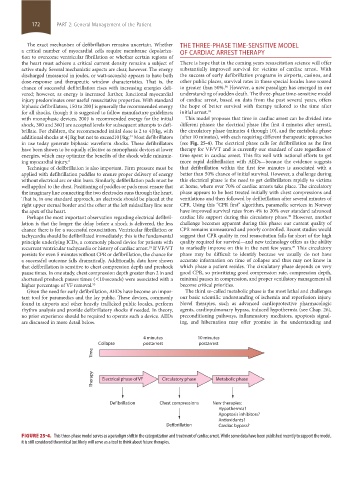
                 with monophasic devices, 200 J is recommended energy for the initial   This model proposes that time in cardiac arrest can be divided into
                 shock, 300 and 360 J are accepted levels for subsequent attempts to defi-  different phases: the electrical phase (the first 4 minutes after arrest),
                 brillate. For children, the recommended initial dose is 2 to 4 J/kg, with   the circulatory phase (minutes 4 through 10), and the metabolic phase
                 additional shocks at 4 J/kg but not to exceed10 J/kg.  Most defibrillators   (after 10 minutes), with each requiring different therapeutic approaches
                                                      54
                 in use today generate biphasic waveform shocks. These defibrillators   (see Fig. 25-4). The electrical phase calls for defibrillation as the first
                 have been shown to be equally effective as monophasic devices at lower   therapy for VF/VT and is currently our standard of care regardless of
                 energies, which may optimize the benefits of the shock while minimiz-  time spent in cardiac arrest. This fits well with national efforts to get
                 ing myocardial injury. 4                              more rapid defibrillation with AEDs—because the evidence suggests
                   Technique of defibrillation is also important. Firm pressure must be   that  defibrillation  within  the first  few  minutes  is  associated  with  a
                 applied with defibrillation paddles to ensure proper delivery of energy   better than 50% chance of initial survival. However, a challenge during
                 without electrical arc or skin burn. Similarly, defibrillation pads must be   this electrical phase is the need to get defibrillators rapidly to victims
                 well applied to the chest. Positioning of paddles or pads must ensure that   at home, where over 70% of cardiac arrests take place. The circulatory
                 the imaginary line connecting the two electrodes runs through the heart.   phase appears to be best treated initially with chest compressions and
                 That is, in one standard approach, an electrode should be placed at the   ventilations and then followed by defibrillation after several minutes of
                 right upper sternal border and the other at the left midaxillary line near   CPR. Using this “CPR first” algorithm, paramedic services in Norway
                 the apex of the heart.                                have improved survival rates from 4% to 20% over standard advanced
                   Perhaps the most important observation regarding electrical defibril-  cardiac life support during this circulatory phase.  However, another
                                                                                                            30
                 lation is that the longer the delay before a shock is delivered, the less   challenge becomes apparent during this phase: our current quality of
                 chance there is for a successful resuscitation. Ventricular fibrillation or   CPR remains unmeasured and poorly controlled. Recent studies would
                 tachycardia should be defibrillated immediately; this is the fundamental   suggest that CPR quality in real resuscitation falls far short of the high
                 principle underlying ICDs, a commonly placed device for patients with   quality required for survival—and new technology offers us the ability
                                                                                                             29
                 recurrent ventricular tachycardia or history of cardiac arrest.  If VF/VT   to markedly improve on this in the next few years.  This circulatory
                                                             18
                 persists for even 5 minutes without CPR or defibrillation, the chance for   phase may be difficult to identify because we usually do not have
                 a successful outcome falls dramatically. Additionally, data have shown   accurate  information  on  time  of  collapse  and  thus  may  not  know  in
                 that defibrillation is sensitive to chest compression depth and preshock   which phase a patient resides. The circulatory phase depends on very
                 pause times. In one study, chest compression depth greater than 2 in and   good CPR, so prioritizing good compression rate, compression depth,
                 shortened preshock pauses times (<10 seconds) were associated with a   minimal pauses in compression, and proper ventilatory management all
                 higher percentage of VF removal. 55                   become critical priorities.
                   Given the need for early defibrillation, AEDs have become an impor-  The third so-called metabolic phase is the most lethal and challenges
                 tant tool for paramedics and the lay public. These devices, commonly   our basic scientific understanding of ischemia and reperfusion injury.
                 found in airports and other heavily trafficked public locales, perform   Novel  therapies,  such  as  advanced  cardioprotective  pharmacologic
                 rhythm analysis and provide defibrillatory shocks if needed. In theory,   agents, cardiopulmonary bypass, induced hypothermia (see Chap. 26),
                 no prior experience should be required to operate such a device. AEDs   preconditioning pathways, inflammatory mediators, apoptosis signal-
                 are discussed in more detail below.                   ing, and hibernation may offer promise in the understanding and


                                                           4 minutes         10 minutes
                                           Collapse        postarrest         postarrest
                                         Time


                                         Therapy  Electrical phase of VF  Circulatory phase  Metabolic phase


                                               Defibrillation   Chest compressions  New therapies:
                                                                                        Hypothermia?
                                                                                        Apoptosis inhibitors?
                                                                                        Antioxidants?
                                                                   Defibrillation        Cardiac bypass?

                 FIGURE 25-4.  This three-phase model serves as a paradigm shift in the categorization and treatment of cardiac arrest. While some data have been published recently to support the model,
                 it is still considered theoretical but likely will serve as a tool to think about future therapies.


            section02.indd   172                                                                                       1/13/2015   2:05:13 PM

