


Page 265 - Hall et al (2015) Principles of Critical Care-McGraw-Hill
P. 265
CHAPTER 25: Cardiopulmonary Resuscitation  169


                    AIRWAY                                                 1)   Primary ABCD assessment
                                                                                Check responsiveness
                    To attempt optimal airway opening, the chin should be lifted, and the jaw
                    should be thrust forward. A quick evaluation of the oropharynx should   Activate emergency response system
                                                                                Call for defibrillator
                    be performed to look for a foreign body, blood, or other occluding
                    material. Any visualized foreign body should be removed by suction or   A Airway—open airway
                                                                              B Breathing—positive pressure ventilations
                    by careful use of fingers or forceps. After this evaluation, several “rescue   C Circulation—chest compressions
                    breaths” should be delivered via mouth-to-mouth or mask-to-mouth   D Defibrillation—assess for and shock VF/pulseless VT
                    technique. If the chest wall does not rise with these breaths, it is possible
                    that a complete airway obstruction exists, and abdominal thrusts should
                    be performed to attempt airway clearance. If these fail, trained personnel   2)   Reassess patient
                    may need to establish a surgical airway via cricothyrotomy.  A Airway—airway device
                                                                              B Breathing—confirm airway device placement
                    BREATHING                                                 B Breathing—secure airway device
                                                                              B Breathing—confirm e ective oxygenation and ventilation
                    While holding the chin and jaw in the correct position, breaths should   C Circulation—establish IV access
                    be delivered during initial efforts until a more definitive airway can be   C Circulation—identify rhythm
                    obtained. In cardiac arrest, this is performed via endotracheal intu-  C Circulation—administer appropriate drugs based on rhythm and
                    bation, which is performed routinely by anesthesiologists, emergency          condition
                    physicians, respiratory therapists, and paramedics. If possible, venti-  C Circulation—assess for occult blood flow (“pseudo-EMD”)
                                                      via bag-valve mask until   D Di erential Diagnosis—search for and treat reversible causes
                    lation should be performed with maximal Fi O 2
                    intubation is performed. Pulse oximetry can be used to monitor patient
                    oxygen saturation during this process.
                                                                           Review most frequent causes
                    VENTRICULAR TACHYCARDIA WITH A PULSE                      -Hypovolemia         -“Tablets” (drug overdose, accidents)
                                                                              -Hypoxia             -Tamponade
                    Ventricular tachycardia (VT) may or may not generate a pulse. Therefore,   -Hydrogen ion-acidosis  -Tension pneumothorax
                    it is crucial to assess the hemodynamic status before ACLS resuscitative   -Hyper-/Hypokalemia  -Thrombosis, coronary
                    measures are begun. If the patient has a pulse, is conscious, and has   -Hypothermia  -Thrombosis, pulmonary
                    only mild complaints of palpitations, mild chest discomfort, weakness,
                    and/or anxiety, electrical cardioversion can be considered with initial
                    synchronized shocks at 100 J or higher. If the patient exhibits signs of   Epinephrine at appropriate dose
                    instability, including syncope, severe chest pain, or marked hypoten-
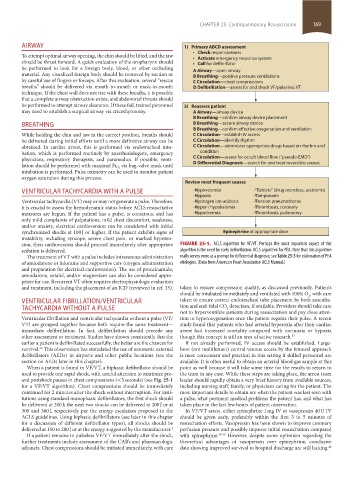
                    sion, then cardioversion should proceed immediately after appropriate   FIGURE 25-1.  ACLS algorithm for VF/VT. Perhaps the most important aspect of this
                    sedation is delivered.                                algorithm is the need for early defibrillation. ACLS algorithm for PEA. Note that this algorithm
                     The treatment of VT with a pulse includes intravenous administration   really serves more as a prompt for differential diagnosis; see Table 25-3 for elaboration of PEA
                    of amiodarone or lidocaine and supportive care (oxygen administration   etiologies. (Data from American Heart Association ACLS Manual.)
                    and preparation for electrical cardioversion). The use of procainamide,
                    amiodarone, sotalol, and/or magnesium can also be considered appro-
                    priate for use. Recurrent VT often requires electrophysiologic evaluation
                    and treatment, including the placement of an ICD (reviewed in ref. 35).  taken to ensure compression quality, as discussed previously. Patients
                                                                          should be intubated immediately and ventilated with 100% O , with care
                                                                                                                     2
                    VENTRICULAR FIBRILLATION/VENTRICULAR                  taken to ensure correct endotracheal tube placement by both ausculta-
                    TACHYCARDIA WITHOUT A PULSE                           tion and end-tidal CO  detection, if available. Providers should take care
                                                                                          2
                                                                          not to hyperventilate patients during resuscitation and pay close atten-
                    Ventricular fibrillation and ventricular tachycardia without a pulse (VF/  tion to hyperoxygenation once the patient regains their pulse. A recent
                    VT) are grouped together because both require the same treatment—  study found that patients who had arterial hyperoxia after their cardiac
                    immediate defibrillation. In fact, defibrillation should precede any   arrest had increased mortality compared with normoxia or hypoxia
                    other assessment or treatment. Studies have shown consistently that the     though this concept is still an area of active research. 37
                    earlier a patient is defibrillated successfully, the better are the chances for   If not already performed, IV access should be established. Large-
                    survival.  This observation has stimulated the use of automatic external   bore (not multilumen) central venous access by the femoral approach
                          36
                    defibrillators  (AEDs)  in  airports  and  other  public  locations  (see  the    is most convenient and practical in this setting if skilled personnel are
                    section on AEDs later in this chapter).               available. It is often useful to obtain an arterial blood gas sample at this
                     When a patient is found in VF/VT, a biphasic defibrillator should be   point as well because it will take some time for the results to return to
                    used to provide one rapid shock, with careful attention to minimize pre-   the team in any case. While these steps are taking place, the arrest team
                    and postshock pauses in chest compressions (<5 seconds) (see Fig. 25-1   leader should rapidly obtain a very brief history from available sources,
                    for a VF/VT algorithm). Chest compressions should be immediately   including nursing staff, family, or physicians caring for the patient. The
                    continued for 2 minutes after the shock without interruption. For insti-  most important details to obtain are when the patient was last seen with
                    tutions using standard monophasic defibrillators, the first shock should   a pulse, what pertinent medical problems the patient has, and what has
                    be delivered at 200 J; the next two shocks can be delivered at 200 J or at   taken place in the last few hours of patient observation.
                    300 and 360 J, respectively per the energy escalation proposed in the   In VF/VT arrest, either epinephrine 1 mg IV or vasopressin 40 U IV
                    ACLS guidelines. Using biphasic defibrillators (see later in this chapter   should be given early, preferably within the first 3 to 5 minutes of
                    for  a  discussion  of  different defibrillator  types),  all  shocks  should  be   resuscitation efforts. Vasopressin has been shown to improve coronary
                    delivered at 150 to 200 J or at the energy suggested by the manufacturer. 4  perfusion pressure and possibly improve initial resuscitation compared
                     If a patient remains in pulseless VF/VT immediately after the shock,   with epinephrine. 38-39  However, despite some optimism regarding the
                    further treatments include assessment of the CAB’s and pharmacologic   theoretical advantages of  vasopressin  over  epinephrine, conclusive
                    adjuncts. Chest compressions should be initiated immediately, with care   data showing improved survival to hospital discharge are still lacking.
                                                                                                                            40


            section02.indd   169                                                                                       1/13/2015   2:05:10 PM

