


Page 34 - Hall et al (2015) Principles of Critical Care-McGraw-Hill
P. 34
CHAPTER 1: An Approach to Critical Care  3


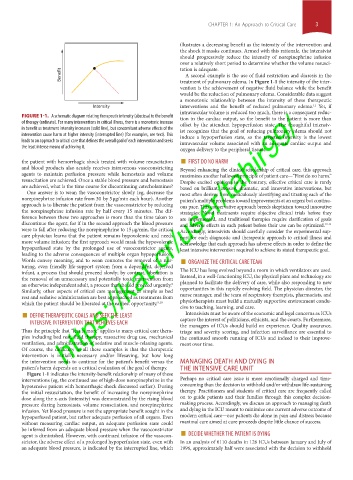
                                                                          illustrates a decreasing benefit as the intensity of the intervention and
                                                                          the shock it masks continues. Armed with this rationale, the intensivist
                                                                          should progressively reduce the intensity of norepinephrine infusion
                                                                          over a relatively short period to determine whether the volume resusci-
                                                                          tation is adequate.
                                 Benefit                                  treatment of pulmonary edema. In Figure 1-1 the intensity of the inter-
                                                                           A second example is the use of fluid restriction and diuresis in the
                                                                          vention is the achievement of negative fluid balance while the benefit
                                                                          would be the reduction of pulmonary edema. Considerable data suggest
                                                                          a  monotonic  relationship  between  the  intensity  of  these  therapeutic
                                                                                                                       11
                                            Intensity                     interventions and the benefit of reduced pulmonary edema.  Yet, if
                                  https://kat.cr/user/tahir99/
                                                                          intravascular volume is reduced too much, there is a consequent reduc-
                    FIGURE 1-1.  A schematic diagram relating therapeutic intensity (abscissa) to the benefit   tion in the cardiac output, so the benefit to the patient is more than
                    of therapy (ordinate). For many interventions in critical illness, there is a monotonic increase   offset by the attendant hypoperfusion state. The thoughtful intensiv-
                    in benefit as treatment intensity increases (solid line), but concomitant adverse effects of the   ist recognizes that the goal of reducing pulmonary edema should not
                    intervention cause harm at higher intensity (interrupted line) (for examples, see text). This   induce a hypoperfusion state, so  the targeted intensity is the lowest
                    leads to an approach to critical care that defines the overall goal of each intervention and seeks   intravascular volume associated with an adequate cardiac output and
                    the least intense means of achieving it.
                                                                          oxygen delivery to the peripheral tissues.
                    the patient with hemorrhagic shock treated with volume resuscitation     ■  FIRST DO NO HARM
                    and blood products also acutely receives intravenous vasoconstricting   Beyond enhancing the clinical scholarship of critical care, this approach
                    agents to maintain perfusion pressure while hemostasis and volume   maximizes another hallowed principle of patient care—“First do no harm.”
                    resuscitation are achieved. Once a stable blood pressure and hemostasis   Despite excited opinions to the contrary, effective critical care is rarely
                    are achieved, what is the time course for discontinuing catecholamines?  based on brilliant, incisive, dramatic, and innovative interventions, but
                     One answer is to wean the vasoconstrictor slowly (eg, decrease the   most often derives from meticulously identifying and titrating each of the
                    norepinephrine infusion rate from 30  by 5 µg/min each hour). Another   patient’s multiple problems toward improvements at an urgent but continu-
                    approach is to liberate the patient from the vasoconstrictor by reducing   ous pace. This conservative approach breeds skepticism toward innovative
                    the  norepinephrine  infusion  rate  by half  every  15  minutes.  The  dif-  strategies: Novel treatments require objective clinical trials before they
                    ference between these two approaches is more than the time taken to   are implemented, and traditional therapies require clarification of goals
                      discontinue the agent, for if in the second approach the blood pressure   and adverse effects in each patient before their use can be optimized. 12-14
                    were to fall after reducing the norepinephrine to 15 µg/min, the critical   Accordingly, intensivists should carefully consider the experimental sup-
                    care physician learns that the patient remains hypovolemic and needs   port for each diagnostic and therapeutic approach to critical illness and
                    more volume infusion; the first approach would mask the hypovolemic   acknowledge that each approach has adverse effects in order to define the
                    hypoperfused state by the prolonged use of vasoconstrictor agents,   least intensive intervention required to achieve its stated therapeutic goal.
                    leading to the adverse consequences of multiple organ hypoperfusion.
                    Words convey meaning, and to wean connotes the removal of a nur-    ■  ORGANIZE THE CRITICAL CARE TEAM
                    turing, even friendly life-support system from a dependent, deprived
                    infant, a process that should proceed slowly; by contrast, liberation is   The ICU has long evolved beyond a room in which ventilators are used.
                    the removal of an unnecessary and potentially toxic intervention from   Instead, in a well-functioning ICU, the physical plant and technology are
                                                                       8
                    an otherwise independent adult, a process that should proceed urgently.    planned to facilitate the delivery of care, while also responding to new
                    Similarly, other aspects of critical care management as simple as bed   opportunities in this rapidly evolving field. The physician director, the
                    rest and sedative administration are best approached as treatments from   nurse manager, and the team of respiratory therapists, pharmacists, and
                    which the patient should be liberated at the earliest opportunity. 9,10  physiotherapists must build a mutually supportive environment condu-
                        ■  DEFINE THERAPEUTIC GOALS AND SEEK THE LEAST     Intensivists must be aware of the economic and legal concerns as ICUs
                                                                          cive to teaching, learning, and care.
                      INTENSIVE INTERVENTION THAT ACHIEVES EACH           capture the interest of politicians, ethicists, and the courts. Furthermore,
                                                                          the managers of ICUs should build on experience. Quality assurance,
                    Thus the principle that “less is more” applies to many critical care thera-  triage and severity scoring, and infection surveillance are essential to
                    pies including bed rest, fluid therapy, vasoactive drug use, mechanical   the continued smooth running of ICUs and indeed to their improve-
                    ventilation, and administration of sedative and muscle-relaxing agents.   ment over time.
                    Of course, the difficulty in all these examples is that the therapeutic
                    intervention is initially necessary and/or lifesaving, but how long
                    the intervention needs to continue for the patient’s benefit versus the  MANAGING DEATH AND DYING IN
                    patient’s harm depends on a critical evaluation of the goal of therapy.  THE INTENSIVE CARE UNIT
                     Figure 1-1 indicates the intensity-benefit relationship of many of these
                    interventions (eg, the continued use of high-dose norepinephrine in the   Perhaps no critical care issue is more emotionally charged and time-
                    hypotensive patient with hemorrhagic shock discussed earlier). During   consuming than the decision to withhold and/or withdraw life-sustaining
                    the initial resuscitation, the benefit of increasing the norepinephrine   therapy. Practitioners and students of critical care are frequently called
                    dose along the x-axis (intensity) was demonstrated by the rising blood   on to guide patients and their families through this complex decision-
                    pressure during hemostasis, volume resuscitation, and norepinephrine   making process. Accordingly, we discuss an approach to managing death
                    infusion. Yet blood pressure is not the appropriate benefit sought in the   and dying in the ICU meant to minimize one current adverse outcome of
                    hypoperfused patient, but rather adequate perfusion of all organs. Even   modern critical care—our patients die alone in pain and distress because
                    without measuring cardiac output, an adequate perfusion state could   maximal care aimed at cure proceeds despite little chance of success.
                    agent is diminished. However, with continued infusion of the vasocon-  ■  DECIDE WHETHER THE PATIENT IS DYING
                    be inferred from an adequate blood pressure when the vasoconstrictor
                    strictor, the adverse effect of a prolonged hypoperfusion state, even with   In an analysis of 6110 deaths in 126 ICUs between January and July of
                    an adequate blood pressure, is indicated by the interrupted line, which   1996, approximately half were associated with the decision to withhold


            Section01.indd   3                                                                                         1/22/2015   9:36:41 AM

