


Page 35 - Hall et al (2015) Principles of Critical Care-McGraw-Hill
P. 35
4      PART 1: An Overview of the Approach to and Organization of Critical Care


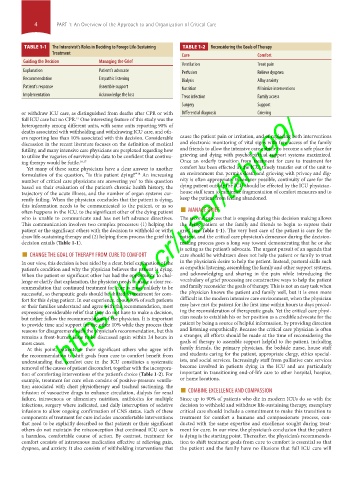
                   TABLE 1-1     The Intensivist’s Roles in Deciding to Forego Life-Sustaining     TABLE 1-2    Reconsidering the Goals of Therapy
                            Treatment                                   Cure                      Comfort
                  Guiding the Decision      Managing the Grief
                                                                        Ventilation               Treat pain
                  Explanation               Patient’s advocate          Perfusion                 Relieve dyspnea
                  Recommendation            Empathic listening          Dialysis                  Allay anxiety
                  Patient’s response        Assemble support            Nutrition                 Minimize interventions
                  Implementation            Acknowledge the loss        Treat infection           Family access
                                                                        Surgery                   Support
                                https://kat.cr/user/tahir99/
                 or withdraw ICU care, as distinguished from deaths after CPR or with   Differential diagnosis  Grieving
                                    15
                 full ICU care but no CPR.  One interesting feature of this study was the
                 heterogeneity among different units, with some units reporting 90% of
                 deaths associated with withholding and withdrawing ICU care, and oth-
                 ers reporting less than 10% associated with this decision. Considerable   cause the patient pain or irritation, and of replacing both interventions
                 discussion in the recent literature focuses on the definition of medical   and electronic monitoring of vital signs with free access of the family
                 futility, and many intensive care physicians are perplexed regarding how   and friends to allow the intensive care cubicle to become a safe place for
                 to utilize the vagaries of survivorship data to be confident that continu-  grieving and dying with psychospiritual support systems maximized.
                 ing therapy would be futile. 16,17                    Once  an  orderly transition  from  treatment  for  cure  to  treatment  for
                   Yet many of these same physicians have a clear answer to another   comfort has been effected in the ICU, timely transfer out of the unit to
                 formulation of the question, “Is this patient dying?”  An increasing   an environment that permits death and grieving with privacy and dig-
                                                         18
                 number of critical care physicians are answering yes’ to this question   nity is often appropriate. Whenever possible, continuity of care for the
                 based on their evaluation of the patient’s chronic health history, the   dying patient outside the ICU should be effected by the ICU physician-
                 trajectory of the acute illness, and the number of organ systems cur-  house staff team to minimize fragmentation of comfort measures and to
                 rently failing. When the physician concludes that the patient is dying,   keep the patient from feeling abandoned.
                 often happens in the ICU, to the significant other of the dying patient   ■  MANAGE GRIEF
                 this information needs to be communicated to the patient, or as so
                 who is unable to communicate and has not left advance directives.   The second process that is ongoing during this decision making allows
                 This communication involves two complex processes: (1) helping the   the dying patient or the family and friends to begin to express their
                 patient or the significant others with the decision to withhold or with-  grief (see Table 1-1). The very best care of the patient is care for the
                 draw life-sustaining therapy and (2) helping them process the grief this   patient, and the critical care physician’s demeanor during the decision-
                 decision entails (Table 1-1).                         making process goes a long way toward demonstrating that he or she
                     ■  CHANGE THE GOAL OF THERAPY FROM CURE TO COMFORT  is acting as the patient’s advocate. The urgent pursuit of an agenda that
                                                                       care should be withdrawn does not help the patient or family to trust
                 In our view, this decision is best aided by a clear, brief explanation of the   in the physician’s desire to help the patient. Instead, pastoral skills such
                 patient’s condition and why the physician believes the patient is dying.   as empathic listening, assembling the family and other support systems,
                 When the patient or significant other has had the opportunity to chal-  and acknowledging and sharing in the pain while introducing the
                 lenge or clarify that explanation, the physician needs to make a clear rec-  vocabulary of grief processing are constructive ways to help the patient
                 ommendation that continued treatment for cure is most unlikely to be   and family reconsider the goals of therapy. This is not an easy task when
                 successful, so therapeutic goals should be shifted to treatment for com-  the physician knows the patient and family well, but it is even more
                 fort for this dying patient. In our experience, about 90% of such patients   difficult in the modern intensive care environment, when the physician
                 or their families understand and agree with the recommendation, most   may have met the patient for the first time within hours to days preced-
                 expressing considerable relief that they do not have to make a decision,   ing the reconsideration of therapeutic goals. Yet the critical care physi-
                 but rather follow the recommendation of the physician. It is important   cian needs to establish his or her position as a credible advocate for the
                 to provide time and support for the other 10% while they process their   patient by being a source of helpful information, by providing direction
                 reasons for disagreement with the physician’s recommendation, but this   and listening empathically. Because the critical care physician is often
                 remains a front-burner issue to be discussed again within 24 hours in   a stranger, all efforts should be made at the time of reconsidering the
                 most cases.                                           goals of therapy to assemble support helpful to the patient, including
                   At  this  point,  patients  or  their  significant  others  who  agree  with   family friends, the primary physician, the bedside nurse, house staff
                 the recommendation to shift goals from cure to comfort benefit from   and students caring for the patient, appropriate clergy, ethics special-
                 understanding that comfort care in the ICU constitutes a systematic   ists, and social services. Increasingly staff from palliative care services
                 removal of the causes of patient discomfort, together with the incorpora-  become involved in patients dying in the ICU and are particularly
                 tion of comforting interventions of the patient’s choice (Table 1-2). For   important in transitioning end-of-life care to other hospital, hospice,
                 example, treatment for cure often consists of positive-pressure ventila-  or home locations.
                 infusion of vasoactive drugs to enhance circulation, dialysis for renal   ■  COMBINE EXCELLENCE AND COMPASSION
                 tion associated with chest physiotherapy and tracheal suctioning, the
                 failure,  intravenous or  alimentary  nutrition,  antibiotics  for multiple   Since up to 90% of patients who die in modern ICUs do so with the
                 infections, surgery where indicated, and daily interruption of sedative   decision to withhold and withdraw life-sustaining therapy, exemplary
                 infusions to allow ongoing confirmation of CNS status. Each of these   critical care should include a commitment to make this transition to
                 components of treatment for cure includes uncomfortable interventions   treatment  for  comfort  a  humane  and  compassionate  process,  con-
                 that need to be explicitly described so that patients or their significant   ducted with the same expertise and excellence sought during treat-
                 others do not maintain the misconception that continued ICU care is   ment for cure. In our view, the physician’s conclusion that the patient
                 a harmless, comfortable course of action. By contrast, treatment for   is dying is the starting point. Thereafter, the physician’s recommenda-
                 comfort consists of intravenous medication effective at relieving pain,   tion to shift treatment goals from cure to comfort is essential so that
                 dyspnea, and anxiety. It also consists of withholding interventions that   the patient and the family have no illusions that full ICU care will


            Section01.indd   4                                                                                         1/22/2015   9:36:42 AM

