


Page 36 - Hall et al (2015) Principles of Critical Care-McGraw-Hill
P. 36
CHAPTER 1: An Approach to Critical Care  5


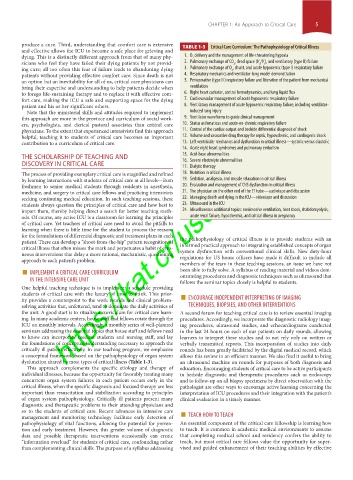
                    produce a cure. Third, understanding that comfort care is extensive     TABLE 1-3    Critical Care Curriculum: The Pathophysiology of Critical Illness
                    and effective allows the ICU to become a safe place for grieving and
                    dying. This is a distinctly different approach from that of many phy-    1.  O  delivery and the management of life-threatening hypoxia
                                                                              2
                    sicians who feel they have failed their dying patients by not provid-    2.  Pulmonary exchange of CO , dead space (V /V), and ventilatory (type II) failure
                                                                                            2
                                                                                                     d
                                                                                                      t
                    ing cure; all too often this fear of failure leads to abandoning dying     3.  Pulmonary exchange of O , shunt, and acute hypoxemic (type I) respiratory failure
                                                                                           2
                    patients without providing effective comfort care. Since death is not     4.  Respiratory mechanics and ventilator-lung model demonstration
                    an option but an inevitability for all of us, critical care physicians can     5.  Perioperative (type III) respiratory failure and liberation of the patient from mechanical
                    bring their expertise and understanding to help patients decide when   ventilation
                    to forego life-sustaining therapy and to replace it with effective com-    6.  Right heart catheter, central hemodynamics, and lung liquid flux
                    fort care, making the ICU a safe and supporting space for the dying     7.  Cardiovascular management of acute hypoxemic respiratory failure
                    patient and his or her significant others.              8.  Ventilatory management of acute hypoxemic respiratory failure, including ventilator-
                                  https://kat.cr/user/tahir99/
                     Note that the ministerial skills and attitudes required to implement   induced lung injury
                    this approach are more in the province and curriculum of social work-    9.  Ventilator waveforms to guide clinical management
                    ers, psychologists, and clerical pastoral associates than critical care     10.  Status asthmaticus and acute-on-chronic respiratory failure
                    physicians. To the extent that experienced intensivists find this approach     11.  Control of the cardiac output and bedside differential diagnosis of shock
                    helpful, teaching it to students of critical care becomes an important     12.  Volume and vasoactive drug therapy for septic, hypovolemic, and cardiogenic shock
                    contribution to a curriculum of critical care.          13.  Left ventricular mechanics and dysfunction in critical illness—systolic versus diastolic
                                                                            14.  Acute right heart syndromes and pulmonary embolism
                    THE SCHOLARSHIP OF TEACHING AND                         15.  Acid-base abnormalities
                                                                            16.  Severe electrolyte abnormalities
                    DISCOVERY IN CRITICAL CARE                              17.  Dialytic therapy
                    The process of providing exemplary critical care is magnified and refined     18.  Nutrition in critical illness
                    by learning interactions with students of critical care at all levels—from     19.  Sedation, analgesia, and muscle relaxation in critical illness
                    freshmen to senior medical students through residents in anesthesia,     20.  Evaluation and management of CNS dysfunction in critical illness
                    medicine, and surgery to critical care fellows and practicing intensivists     21.  The physician on the other end of the ET tube—audiotape and discussion
                    seeking continuing medical education. In such teaching sessions, these     22.  Managing death and dying in the ICU—videotape and discussion
                    students always question the principles of critical care and how best to     23.  Ultrasound in the ICU
                    impart them, thereby helping direct a search for better teaching meth-    24.  Miscellaneous additional topics: noninvasive ventilation, heat shock, rhabdomyolysis,
                    ods. Of course, any active ICU is a classroom for learning the principles   acute renal failure, hypothermia, and critical illness in pregnancy
                    of critical care. Yet teachers of critical care need to avoid the pitfalls to
                    learning when there is little time for the student to process the reasons
                    for the formulations of differential diagnostic and treatment plans in each   the pathophysiology of critical illness is to provide students with an
                    patient. There can develop a “shoot-from-the-hip” pattern recognition of
                    critical illness that often misses the mark and perpetuates a habit of erro-  informed practical approach to integrating established concepts of organ
                                                                          system  dysfunction  with conventional clinical skills. New duty-hour
                    neous interventions that delay a more rational, mechanistic, questioning
                    approach to each patient’s problem.                   regulations for US house officers have made it difficult to include all
                                                                          members of the team in these teaching sessions, an issue we have not
                        ■  IMPLEMENT A CRITICAL CARE CURRICULUM           been able to fully solve. A syllabus of reading material and videos dem-
                      IN THE INTENSIVE CARE UNIT                          onstrating procedures and diagnostic techniques such as ultrasound that
                                                                          follows the seminar topics closely is helpful to students.
                    One helpful teaching technique is to implement a schedule providing
                    ity provides a counterpoint to the work rounds and clinical problem-   ■  ENCOURAGE INDEPENDENT INTERPRETING OF IMAGING
                    students of critical care with the luxury of time to think. This prior-
                    solving activities that, unfettered, tend to dominate the daily activities of   TECHNIQUES, BIOPSIES, AND OTHER INTERVENTIONS
                    the unit. A good start is to ritualize a curriculum for critical care learn-  A second forum for teaching critical care is to review essential imaging
                    ing. In many academic centers, house staff and fellows rotate through the   procedures. Accordingly, we incorporate the diagnostic radiology imag-
                    ICU on monthly intervals. Accordingly, a monthly series of well-planned   ing procedures, ultrasound studies, and echocardiograms conducted
                    seminars addressing the essential topics that house staff and fellows need   in the last 24 hours on each of our patients on daily rounds, allowing
                    to know can incorporate medical students and nursing staff, and lay   learners to interpret  these  studies and to  not rely  only on written  or
                    the foundations of conceptual understanding necessary to approach the   verbally transmitted reports. This incorporation of studies into daily
                    critically ill patient effectively. In our teaching program, we emphasize   rounds has been greatly facilitated by the digital medical record, which
                    a conceptual framework based on the pathophysiology of organ system   allows this review in an efficient manner. We also find it useful to bring
                    dysfunction shared by most types of critical illness (Table 1-3).  an ultrasound machine on rounds for purposes of both diagnosis and
                     This approach complements the specific etiology and therapy of   education. Encouraging students of critical care to be active participants
                    individual illnesses, because the opportunity for favorably treating many   in bedside diagnostic and therapeutic procedures such as endoscopy
                    concurrent organ system failures in each patient occurs early in the   and to follow-up on all biopsy specimens by direct observation with the
                    critical illness, when the specific diagnosis and focused therapy are less   pathologist are other ways to encourage active learning concerning the
                    important than resuscitation and stabilization according to principles   interpretation of ICU procedures and their integration with the patient’s
                    of organ system pathophysiology. Critically ill patients present many   clinical evaluation in a timely manner.
                    diagnostic and therapeutic problems to their attending physicians and
                    management and monitoring technology facilitate early detection of   ■  TEACH HOW TO TEACH
                    so to the students of critical care. Recent advances in intensive care
                    pathophysiology of vital functions, allowing the potential for preven-  An essential component of the critical care fellowship is learning how
                    tion and early treatment. However, this greater volume of diagnostic   to teach. It is common in academic medical environments to assume
                    data and possible therapeutic interventions occasionally can create   that completing medical school and residency confers the ability to
                    “information overload” for students of critical care, confounding rather   teach, but most critical care fellows value the opportunity for super-
                    than complementing clinical skills. The purpose of a syllabus addressing   vised and guided enhancement of their teaching abilities by effective


            Section01.indd   5                                                                                         1/22/2015   9:36:42 AM

