


Page 39 - Hall et al (2015) Principles of Critical Care-McGraw-Hill
P. 39
8      PART 1: An Overview of the Approach to and Organization of Critical Care


                 quality metrics, once stated that “running a company on visible figures   should not be used to address quality. An example of a measurement
                 alone”  is  one  of  the  seven  deadly  sins  of  management.   However,  to   that is reliable is the measurement of time to reaching target cooling
                                                           3
                 demonstrate improvement or to detect deviations from the expectations,   temperature after cardiac arrest. The time zero (hospital arrival) and
                 metrics are needed.                                   the time of goal temperature can be clearly defined and abstracted from
                   Governments,  regulators,  clinicians,  insurance  companies,  and   charts. On the other hand, VAP rates are less reliable. A study compar-
                 patients may need different quality measures or the same measures   ing the identification of VAPs by two experienced providers, using the
                 presented in different ways. Unfortunately, quality indicators are often   CDC VAP definition, observed a twofold variation in the total numbers
                 selected based on convenience, feasibility, or politics rather than valid-  of VAP. Based on these data, twofold increases or decreases in VAP rates
                 ity. In this chapter, we will try to define what the ideal characteristics   could  be  simply due  to variation in  interpretations  of  the  CDC  VAP
                 of quality metrics should be and apply these principles to the current   definition. 5
                 metrics proposed for intensive care medicine.
                                https://kat.cr/user/tahir99/
                                                                       Actionable:  An indicator is only helpful if the users and managers
                                                                       of the outcomes and processes are able to take actions based on the
                 INDICATORS                                            information gained. For example, although long-term health-related
                     ■  CHARACTERISTICS                                quality of life in ICU survivors is an important outcome, it is a poorly
                                                                       actionable quality measure as the determinants of this outcome are
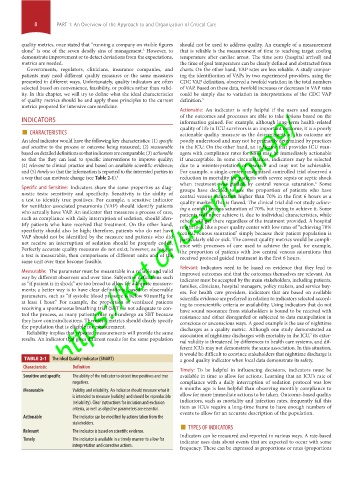
                 An ideal indicator would have the following key characteristics: (1) specific   poorly understood and may not be primarily determined by practices
                 and sensitive to the process or outcome being measured; (2) measurable   in the ICU. On the other hand, an indicator that provides ICU man-
                 based on detailed definitions so that indicators are comparable; (3) actionable    agers with compliance rates for SBTs may be immediately actionable
                 so that the they can lead to specific interventions to improve quality;    if unacceptable. In some circumstances, indicators may be selected
                 (4) relevant to clinical practice and based on available scientific evidence;   due to a misinterpretation of research and may not be achievable.
                 and (5) timely so that the information is reported to the interested parties in   For example, a single-center randomized controlled trial observed a
                 a way that can motivate change (see Table 2-1). 4     reduction in mortality for patients with severe sepsis or septic shock
                                                                       when treatment was guided by central venous saturation.  Some
                                                                                                                     6
                 Specific and Sensitive:  Indicators share  the  same  properties  as  diag-  groups have decided to use the proportion of patients who have
                 nostic tests: sensitivity and specificity. Sensitivity is the ability of   central venous saturation higher than 70% in the first 6 hours as a
                 a test to identify true positives. For example, a sensitive indicator   quality marker. This is flawed. The clinical trial did not study achiev-
                 for ventilator-associated pneumonia (VAP) should identify patients   ing a central venous saturation of 70%, but trying to achieve it. Some
                 who actually have VAP. An indicator that measures a process of care,   patients will never achieve it, due to individual characteristics, while
                 such as compliance with daily interruption of sedation, should iden-  others will get there regardless of the treatment provided. A hospital
                 tify patients who have received that treatment. On the other hand,   might look like a poor quality center with low rates of “achieving 70%
                 specificity should also be high; therefore, patients who do not have   central venous saturation” simply because their patient population is
                 VAP should not be identified by the measure and patients who did   particularly old or sick. The correct quality metrics would be compli-
                 not receive an interruption of sedation should be properly coded.   ance with processes of care used to achieve the goal, for example,
                 Perfectly accurate quality measures do not exist; however, as long as   the proportion of patients with low central venous saturations that
                 a test is measurable, then comparisons of different units and of the   received protocol guided treatment in the first 6 hours.
                 same unit over time become feasible.
                                                                       Relevant:  Indicators need to be based on evidence that they lead to
                 Measurable:  The parameter must be measurable in a reliable and valid   improved outcomes and that the outcomes themselves are relevant. An
                 way by different observers and over time. Subjective definitions such   indicator must be accepted by the main stakeholders, including patients,
                 as “if patient is in shock” are too broad to allow for adequate measure-  families, clinicians, hospital managers, policy makers, and service buy-
                 ments; a better way is to have clear definitions, based on observable   ers. For health care providers, indicators that are based on available
                 parameters, such as “if systolic blood pressure is below 90 mmHg for   scientific evidence are preferred in relation to indicators selected accord-
                 at least 1 hour.” For example, the proportion of ventilated patients   ing to nonscientific criteria or availability. Using indicators that do not
                 receiving a spontaneous breathing trial (SBT) is not adequate to con-  have sound resonance from stakeholders is bound to be received with
                 trol the process, as many patients may not undergo an SBT because   resistance and either disregarded or subjected to data manipulation in
                 they have contraindications. Therefore, metrics should clearly specify   conscious or unconscious ways. A good example is the use of nighttime
                 the population that is eligible for measurement.      discharges  as  a  quality  metric.  Although  one  study  demonstrated  an
                   Reliability implies that repeated measurements will provide the same   association of nighttime discharges with mortality in the ICU,  its exter-
                                                                                                                    7
                 results. An indicator that gives different results for the same population
                                                                       nal validity is threatened by differences in health care systems, and dif-
                                                                       ferent ICUs may not demonstrate the same association. In this situation,
                                                                       it would be difficult to convince stakeholders that nighttime discharge is
                   TABLE 2-1    The Ideal Quality Indicator (SMART)    a good quality indicator when local data demonstrate its safety.
                  Characteristic   Definition
                                                                       Timely:  To  be  helpful in  influencing  decisions,  indicators  must  be
                  Sensitive and specific  The ability of the indicator to detect true positives and true   available in time to allow for actions. Learning that an ICU’s rate of
                                   negatives.                          compliance with a daily interruption of sedation protocol was low
                  Measurable       Validity and reliability. An indicator should measure what it   6 months ago is less helpful than observing monthly compliance to
                                   is intended to measure (validity) and should be reproducible   allow for more immediate actions to be taken. Outcome-based quality
                                   (reliability). Clear instructions for inclusion and exclusion   indicators, such as mortality and infection rates, frequently fail this
                                   criteria, as well as objective parameters are essential.  item as ICUs require a long-time frame to have enough numbers of
                                                                       events to allow for an accurate description of the population.
                  Actionable       The indicator can be modified by actions taken from the
                                   stakeholders.                           ■
                  Relevant         The indicator is based on scientific evidence.  TYPES OF INDICATORS
                                                                       Indicators can be measured and reported in various ways. A rate-based
                  Timely           The indicator is available in a timely manner to allow for   indicator uses data about events that are expected to occur with some
                                   interpretation and corrective actions.
                                                                       frequency. These can be expressed as proportions or rates (proportions


            Section01.indd   8                                                                                         1/22/2015   9:36:43 AM

