


Page 359 - Hall et al (2015) Principles of Critical Care-McGraw-Hill
P. 359
CHAPTER 31: The Pathophysiology of the Circulation in Critical Illness  229


                                         Central  Circulation                   Left atrium


                                               PA
                                     Pra                Pla                                                         Peripheral
                                         CO 2        O 2                          Left ventricle                    resistance
                                              Ppl

                                                                 Arterial                          Systole
                     Venous


                                            CO 2  O 2                           Left atrium

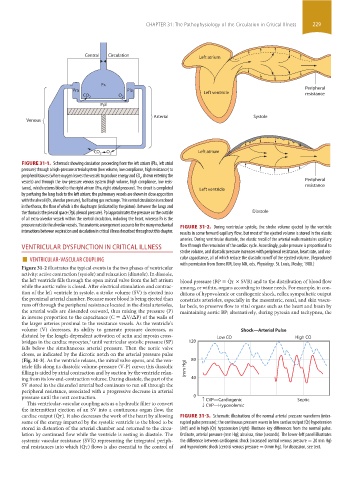
                    FIGURE 31-1.  Schematic showing circulation proceeding from the left atrium (Pla, left atrial
                    pressure) through a high-pressure arterial system (low volume, low compliance, high resistance) to
                    peripheral tissues (where oxygen leaves the vessels to produce energy and CO , shown entering the
                                                            2
                    vessels) and through the low-pressure venous system (high volume, high compliance, low resis-   Peripheral
                    tance), which returns blood to the right atrium (Pra, right atrial pressure). The circuit is completed   Left ventricle  resistance
                    by perfusing the lung back to the left atrium; the pulmonary vessels are shown in close apposition
                    with the alveoli (Pa, alveolar pressure), facilitating gas exchange. This central circulation is enclosed
                    in the thorax, the floor of which is the diaphragm (indicated by the piston). Between the lungs and
                    the thorax is the pleural space (Ppl, pleural pressure). Ppl approximates the pressure on the outside   Diastole
                    of all extra-alveolar vessels within the central circulation, including the heart, whereas Pa is the
                    pressure outside the alveolar vessels. The anatomic arrangement accounts for the many mechanical   FIGURE 31-2.  During ventricular systole, the stroke volume ejected by the ventricle
                    interactions between respiration and circulation in critical illness described throughout this chapter.  results in some forward capillary flow, but most of the ejected volume is stored in the elastic
                                                                          arteries. During ventricular diastole, the elastic recoil of the arterial walls maintains capillary
                    VENTRICULAR DYSFUNCTION IN CRITICAL ILLNESS           flow through the remainder of the cardiac cycle. Accordingly, pulse pressure is proportional to
                        ■  VENTRICULAR-VASCULAR COUPLING                  cular capacitance, all of which reduce the diastolic runoff of the ejected volume. (Reproduced
                                                                          stroke volume, and diastolic pressure increases with peripheral resistance, heart rate, and vas-

                    Figure 31-2 illustrates the typical events in the two phases of ventricular   with permission from Berne RM, Levy MN, eds. Physiology. St. Louis, Mosby; 1988.)
                    activity: active contraction (systole) and relaxation (diastole). In diastole,
                    the left ventricle fills through the open mitral valve from the left atrium   blood pressure (BP = Q ˙ t × SVR) and to the distribution of blood flow
                    while the aortic valve is closed. After electrical stimulation and contrac-  among, or within, organs according to tissue needs. For example, in con-
                    tion of the left ventricle in systole, a stroke volume (SV) is ejected into   ditions of hypovolemic or cardiogenic shock, reflex sympathetic output
                    the proximal arterial chamber. Because more blood is being ejected than   constricts arterioles, especially in the mesenteric, renal, and skin vascu-
                    runs off through the peripheral resistance located in the distal arterioles,   lar beds, to preserve flow to vital organs such as the heart and brain by
                    the arterial walls are distended outward, thus raising the pressure (P)     maintaining aortic BP; alternatively, during pyrexia and tachypnea, the
                    in inverse proportion to the capacitance (C = ΔV/ΔP) of the walls of
                    the larger arteries proximal to the resistance vessels. As the ventricle’s
                      volume (V) decreases, its ability to generate pressure decreases, as    Shock—Arterial Pulse
                    dictated by the length-dependent activation of actin and myosin cross-  Low CO               High CO
                    bridges in the cardiac myocytes,  until ventricular systolic pressure (SP)   120
                                           3
                    falls below the simultaneous arterial pressure. Then the aortic valve
                    closes, as indicated by the dicrotic notch on the arterial pressure pulse
                    (Fig. 31-3). As the ventricle relaxes, the mitral valve opens, and the ven-  80
                    tricle fills along its diastolic volume-pressure (V-P) curve; this diastolic   (mm Hg)
                    filling is aided by atrial contraction and by suction by the ventricle relax-
                    ing from its low end-contraction volume. During diastole, the part of the   40
                    SV stored in the distended arterial bed continues to run off through the
                    peripheral resistance, associated with a progressive decrease in arterial
                    pressure until the next contraction.                      0
                     This ventricular-vascular coupling acts as a hydraulic filter to convert     CVP—Cardiogenic  Septic
                                                                                   CVP—Hypovolemic
                    the intermittent ejection of an SV into a continuous organ flow, the
                    cardiac output (Q ˙ t). It also decreases the work of the heart by allowing   FIGURE 31-3.  Schematic illustrations of the normal arterial pressure waveform (inter-
                    some of the energy imparted by the systolic ventricle to the blood to be   rupted pulse pressure); the continuous pressure waves in low cardiac output (Qt) hypotension
                                                                                                                     ˙
                    stored in distention of the arterial chamber and returned to the circu-  (left) and in high (Qt) hypotension (right) illustrate key differences from the normal pulse.
                                                                                    ˙
                    lation by continued flow while the ventricle is resting in diastole. The     Ordinate, arterial pressure (mm Hg); abscissa, time (seconds). The lower-left panel illustrates
                    systemic vascular resistance (SVR) representing the integrated periph-  the difference between cardiogenic shock (increased central venous pressure = 20 mm Hg)
                    eral resistances into which (Q ˙ t) flows is also essential to the control of   and hypovolemic shock (central venous pressure = 0 mm Hg). For discussion, see text.


            section03.indd   229                                                                                       1/23/2015   2:06:39 PM

