


Page 361 - Hall et al (2015) Principles of Critical Care-McGraw-Hill
P. 361
CHAPTER 31: The Pathophysiology of the Circulation in Critical Illness  231


                    such as Pla are measured with respect to atmospheric pressure, so they   decreased VR by increasing Pra, thus keeping end-diastolic volume and
                    do not represent true transmural, or filling, pressures of the heart cham-  Q ˙ t abnormally low. Tension pneumothorax, massive pleural effusions,
                    ber when the pressure on the outside of the heart is not atmospheric.    high levels of PEEP, and greatly increased abdominal pressures can
                                                                      5,6
                    Pericardial pressure is most often equal to Ppl, which is subatmospheric   increase pressure outside the heart (Ppl) and thus reduce LVEDV and
                    during spontaneous breathing (−3 to  −10 mm Hg) and can become   SV despite high values of LVEDP (Table 31-1). Intercurrent LV hyper-
                    very negative in airflow obstruction or very positive with mechanical   trophy or infiltrative diseases (amyloidosis) occasionally stiffen the
                    ventilation and positive end-expiratory pressure (PEEP). For conve-  relaxed ventricle such that high filling pressures are needed to maintain
                    nience, the following discussion refers to the intravascular pressures as   an adequate SV, and inadequate filling time or poorly coordinated atrial
                    transmural, or filling, pressures, and any cause for altered pericardial or   contraction also impairs ventricular filling. 7
                    pleural pressure is noted.                             A right-to-left shift of the interventricular septum can also restrict
                        ■  THE DIASTOLIC V-P CURVE AND VENTRICULAR        diastolic filling. Presumably, the distention of the right ventricle causes
                                                                          the interventricular septum to bulge from right to left, thereby reduc-
                      FILLING DISORDERS (SEE TABLE 31-1)                  ing the unstressed volume and compliance of the left ventricle.  This
                                                                                                                        2,8
                    Figure 31-4B  plots LVEDV against LVEDP.  As ventricular volume   effect  of ventricular  interdependence is  much less  marked  when  the
                    increases from zero, the transmural pressure of the ventricle does not     pericardium is removed, perhaps because the limiting membrane of
                    exceed zero until about 50 mL (the unstressed volume) is added. Then   the pericardium restricts freedom of motion of the left ventricle, mak-
                    LVEDP increases in a curvilinear manner with ventricular volume (the   ing it more vulnerable to displacements of the septum. Accordingly,
                    stressed volume) first as a large change in volume for a small change   conditions in which the right ventricle is abnormally loaded (eg, acute
                    in pressure and then as a small change in volume for a large change in   pulmonary  embolism  or  acute-on-chronic  respiratory  failure  due  to
                    pressure. If the pericardium is removed, these V-P characteristics are   obstructive or restrictive lung disease) may impede the emptying of the
                    more linear such that the large change in LVEDP at higher values of   right ventricle, causing it to work at a higher end-diastolic volume. Then
                    LVEDV is no longer evident. Thus the pericardium acts like a mem-  LV filling pressures will be higher than expected for the end-diastolic
                    brane with a large unstressed volume loosely surrounding the heart up   volume. This provides one possible explanation for why PEEP is often
                    to a given ventricular volume, but at greater LVEDV the pericardium   associated with increased filling pressure to maintain a normal SV even
                    becomes very stiff. At higher heart volumes, most of the pressure   when LVEDP is corrected to the true filling pressure by subtracting
                                                                                                                     5,6,9,10
                    across the heart is across the pericardium, accounting for the very   the increase in Ppl (ΔPpl) measured when PEEP is applied.   Acute
                    steep rise in the diastolic V-P relation. In the presence of pericardial      myocardial ischemia also displaces the diastolic V-P curve of the left
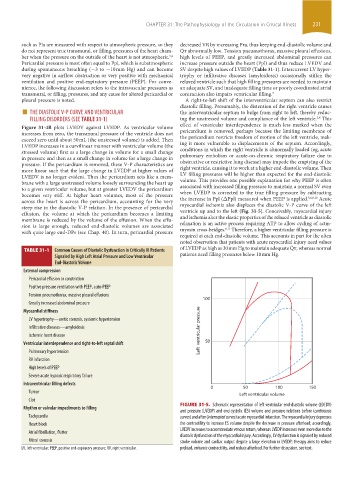
                    effusion, the volume at which the pericardium becomes a limiting   ventricle up and to the left (Fig. 31-5). Conceivably, myocardial injury
                    membrane is reduced by the volume of the effusion. When the effu-  and ischemia alter the elastic properties of the relaxed ventricle as diastolic
                    sion is large enough, reduced end-diastolic volumes are associated   relaxation is an active process requiring ATP to allow cycling of actin-
                                                                                         6,11
                    with quite large end-DPs (see Chap. 40). In turn, pericardial pressure   myosin cross-bridges.  Therefore, a higher ventricular filling pressure is
                                                                          required at each end-diastolic volume. This accounts in part for the often
                                                                          noted observation that patients with acute myocardial injury need values
                      TABLE 31-1     Common Causes of Diastolic Dysfunction in Critically Ill Patients   of LVEDP as high as 30 mm Hg to maintain adequate Q ˙ t, whereas normal
                               Signaled by High Left Atrial Pressure and Low Ventricular    patients need filling pressures below 10 mm Hg.
                               End-Diastolic Volume
                    External compression
                      Pericardial effusion or constriction
                      Positive pressure ventilation with PEEP, auto-PEEP
                      Tension pneumothorax, massive pleural effusions
                                                                                 100
                      Greatly increased abdominal pressure
                    Myocardial stiffness
                      LV hypertrophy—aortic stenosis, systemic hypertension
                      Infiltrative diseases—amyloidosis                         Left  ventricular pressure
                      Ischemic heart disease
                    Ventricular interdependence and right-to-left septal shift    50
                      Pulmonary hypertension
                      RV infarction
                      High levels of PEEP
                      Severe acute hypoxic respiratory failure
                    Intraventricular filling defects
                                                                                    0          50         100        150
                      Tumor
                                                                                              Left ventricular volume
                      Clot
                                                                          FIGURE 31-5.  Schematic representation of left ventricular end-diastolic volume (LDEDV)
                    Rhythm or valvular impediments to filling
                                                                          and pressure (LVEDP) and end-systolic (ES) volume and pressure relations before (continuous
                      Tachycardia                                         curves) and after (interrupted curves) acute myocardial infarction. The myocardial injury depresses
                      Heart block                                         the contractility to increase ES volume despite the decrease in pressure afterload; accordingly,
                                                                          LVEDV increases to accommodate venous return, whereas LVEDP increases even more due to the
                      Atrial fibrillation, flutter
                                                                          diastolic dysfunction of the myocardial injury. Accordingly, LV dysfunction is signaled by reduced
                      Mitral stenosis                                     stroke volume and cardiac output despite a large elevation in LVEDP; therapy aims to reduce
                    LV, left ventricular; PEEP, positive end-expiratory pressure; RV, right ventricular.  preload, enhance contractility, and reduce afterload. For further discussion, see text.


            section03.indd   231                                                                                       1/23/2015   2:06:40 PM

