


Page 364 - Hall et al (2015) Principles of Critical Care-McGraw-Hill
P. 364
234     PART 3: Cardiovascular Disorders


                   When Q ˙ t is insufficient, VR can be increased in several ways. A new   regional resistances is offset by redistribution of blood flow to peripheral
                 steady state of increased VR is achieved by increasing Pms with no   beds having low resistance and/or compliance.
                 change in RVR, indicated by the interrupted VR curve in the left panel   One illustration of this effect is the opening of an abdominal arte-
                 of Figure 31-6. This new VR curve intersects the same cardiac function   riovenous fistula  between the aorta and the inferior vena cava, which
                                                                                   23
                 curve at a higher value of Q ˙ t at point B. This method of increasing   doubles VR at the same values of Pms and Pra (Fig. 31-8). Consider
                 VR is associated with an increase in Pra. Due to the steep slope of the   aliquots of blood leaving the left heart simultaneously; the aliquot tra-
                 cardiac function curve in normal hearts, large increases in VR occur   versing the fistula returns to the right heart before the aliquot perfusing
                 with only small increases in Pra. Alternatively, VR can be increased   the lower body returns. When a greater fraction of the Q ˙ t traverses the
                 by enhanced cardiac function by increasing contractility or decreasing   open fistula having a very low compliance and resistance, more blood
                 afterload of the heart. This is depicted as an upward shift of the cardiac   returns to the heart because RVR decreases. This manifestation of
                 function curve, as in the right panel of Figure 31-6, such that greater   reduced RVR may account for poorly explained hemodynamic changes
                 Q ˙ t occurs at each Pra. The increase on each VR curve by this mecha-  in septic shock, when high Q ˙ t is associated with increased blood flow
                 nism is associated with a reduction in Pra. Further, in the normal heart,   to skeletal muscle, as if some metabolic stimulus increases the fraction
                 only a small change in VR is possible (from point A to point B in the   of Q ˙ t perfusing the low resistance and low compliance skeletal muscle
                 right panel), and greater reductions in Pra do not increase Q ˙ t further   bed, thereby reducing RVR and increasing VR. For another example,
                 because VR becomes flow limited as Pra decreases to below zero. This   systemic hypoxemia triples VR. It does so by increasing Pms through
                 explains why inotropic agents that enhance contractility are ineffective   venoconstriction to cause 70% of this increase, while redistribution of
                 in hypovolemic shock.                                 Q ˙ t  toward  vascular  beds  having  reduced  capacitance  and  resistance
                   When cardiac pumping function is depressed, as depicted by the inter-  account for 30% of the change.  These vascular mechanisms are less
                                                                                               24
                 rupted line in Figure 31-7, VR is decreased from point A to point B for the   predictable than observable, so future work may help understand effects
                 same value of Pms as Pra increases. The patient must then retain fluid or   of acidemia, hypercapnia, and vasoactive drugs in critical illness.
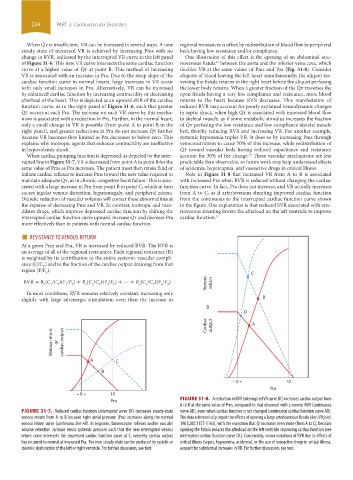
                 initiate cardiac reflexes to increase Pms toward the new value required to   Note in  Figure 31-8 that increased VR from A to B is associated
                 maintain adequate Q ˙ t, as in chronic congestive heart failure. This is asso-  with increased Pra when RVR is reduced without changing the cardiac
                 ciated with a large increase in Pra from point B to point C, which in turn     function curve. In fact, Pra does not increase, and VR actually increases
                 causes jugular venous distention, hepatomegaly, and peripheral edema.   from A to C, as if arteriovenous shunting improved cardiac function
                 Diuretic reduction of vascular volumes will correct these abnormalities at   from the continuous to the interrupted cardiac function curve shown
                 the expense of decreasing Pms and VR. In contrast, inotropic and vaso-  in the figure. One explanation is that reduced SVR associated with arte-
                 dilator drugs, which improve depressed cardiac function by shifting the   riovenous shunting lowers the afterload on the left ventricle to improve
                 interrupted cardiac function curve upward, increase Q ˙ t and decrease Pra   cardiac function. 17
                 more effectively than in patients with normal cardiac function.
                     ■  RESISTANCE TO VENOUS RETURN


                 At a given Pms and Pra, VR is increased by reduced RVR. The RVR is
                 an average of all of the regional resistances. Each regional resistance (R)
                 is weighted by its contribution to the entire systemic vascular compli-
                 ance (C/C ) and to the fraction of the cardiac output draining from that
                         T
                 region (F/F ):
                         T                                                                     C
                  RVR = R (C /C )(F /F ) + R (C /C )(F /F ) +  …  + R (C /C )(F /F )
                         1  1  T  1  T  2  2  T  2  T    n  n  T  n  T          Venous  return
                   In most conditions, RVR remains relatively constant, increasing only
                 slightly with large adrenergic stimulation; even then the increase in             B
                                                                                 or
                                                                                             D
                                                                                Cardiac  output  A
                            Venous return  or  cardiac output


                                         A       C
                                            B
                                                                                         – 0 +             10
                                                                                                      Pra
                                    – 0 +      10
                                                Pra                    FIGURE 31-8.  A reduction in RVR (interrupted VR curve BC) increases cardiac output from
                                                                       A to B at the same value of Pms, compared to that observed with a normal RVR (continuous
                 FIGURE 31-7.  Reduced cardiac function (interrupted curve BC) decreases steady-state   curve AD), even when cardiac function is not changed (continuous cardiac function curve AB).
                 venous return from A to B because right atrial pressure (Pra) increases along the normal   The data schematically depict the effects of opening a large arteriovenous fistula (Am J Physiol.
                 venous return curve (continuous line AB). In response, baroreceptor reflexes and/or vascular   1961;200:1157-1163), with the exception that Qt increases even more (from A to C), because
                                                                                                 ˙
                 volume retention increase mean systemic pressure such that the new interrupted venous   opening the fistula reduces the afterload on the left ventricle improving cardiac function (see
                 return curve intersects the depressed cardiac function curve at C, whereby cardiac output   interrupted cardiac function curve DC). Conceivably, minor variations of RVR due to effects of
                 has returned to normal at increased Pra. The new steady state can be produced by systolic or   critical illness (sepsis, hypoxemia, acidemia), or the use of vasoactive drugs in critical illness,
                 diastolic dysfunction of the left or right ventricle. For further discussion, see text.  account for substantial increases in VR. For further discussion, see text.


            section03.indd   234                                                                                       1/23/2015   2:06:42 PM

