


Page 40 - Hall et al (2015) Principles of Critical Care-McGraw-Hill
P. 40
CHAPTER 2: Measuring Quality  9


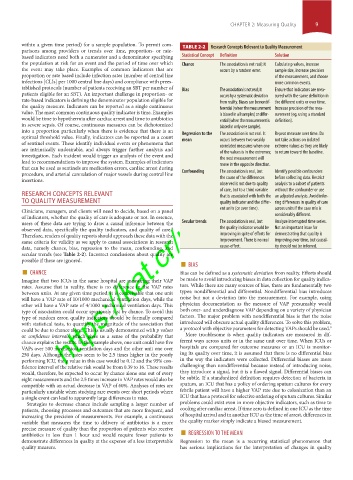
                    within a given time period) for a sample population. To permit com-    TABLE 2-2    Research Concepts Relevant to Quality Measurement
                    parisons  among  providers  or  trends  over  time,  proportion-  or  rate-
                    based indicators need both a numerator and a denominator specifying   Statistical Concept  Definition  Solution
                    the population at risk for an event and the period of time over which   Chance  The association is not real; it   Calculate p values, increase
                    the event may take place. Examples of common indicators that are   occurs by a random error.  sample size, increase precision
                    proportion or rate based include infection rates (number of central line              of the measurement, and choose
                    infections [CLIs] per 1000 central line days) and compliance with prees-              more common events.
                    tablished protocols (number of patients receiving an SBT per number of   Bias  The association is not real; it   Ensure that indicators are mea-
                    patients eligible for an SBT). An important challenge in proportion- or   occurs by a systematic deviation   sured with the same definition in
                    rate-based indicators is defining the denominator population eligible for   from reality. Biases can be nondif- the different units or over time.
                    the quality measure. Indicators can be reported as a single continuous   ferential (when the measurement  Increase precision of the mea-
                                  https://kat.cr/user/tahir99/
                    value. The most common continuous quality indicator is time. Examples   is biased in all samples) or differ-  surement (eg, using a standard
                    would be time to hypothermia after cardiac arrest and time to antibiotics   ential (when the measurement is  definition).
                    in severe sepsis. Of course, continuous measures can be dichotomized   biased in only one sample).
                    into a proportion particularly when there is evidence that there is an
                    optimal threshold value. Finally, indicators can be reported as a count   Regression to the   The association is not real. It   Repeat measure over time. Do
                                                                                                          not take actions on isolated
                                                                                       occurs between two weakly
                                                                          mean
                    of sentinel events. These identify individual events or phenomena that
                    are intrinsically undesirable, and always trigger further analysis and   correlated measures when one  extreme values as they are likely
                                                                                       of the values is in the extremes;  to return toward the baseline.
                    investigation. Each incident would trigger an analysis of the event and
                    lead to recommendations to improve the system. Examples of indicators   the next measurement will
                                                                                       move in the opposite direction.
                    that can be used as sentinels are medication errors, cardiac arrest during
                    procedure, and arterial cannulation of major vessels during central line   Confounding  The association is real, but   Identify possible confounders
                    insertions.                                                        the cause of the differences   before collecting data. Restrict
                                                                                       observed is not due to quality   analysis to a subset of patients
                                                                                       of care, but to a third variable   without the confounder or use
                    RESEARCH CONCEPTS RELEVANT                                         that is associated with both the  an adjusted analysis. Avoid infer-
                    TO QUALITY MEASUREMENT                                             quality indicator and the differ- ring differences in quality of care
                    Clinicians, managers, and clients will need to decide, based on a panel   ent units (or over time).  across units if the case mix is
                    of indicators, whether the quality of care is adequate or not. In essence,            considerably different.
                    users of these data are trying to draw a causal inference between the   Secular trends  The association is real, but   Analyze interrupted time series.
                    observed data, specifically the quality indicators, and quality of care.    the quality indicator would be  Not an important issue for
                                                                       8
                    Therefore, readers of quality reports should approach these data with the   improving in spite of efforts for  demonstrating that quality is
                    same criteria for validity as we apply to causal associations in research   improvement. There is no real   improving over time, but causal-
                    data, namely chance, bias, regression to the mean, confounding, and   cause-effect.   ity should not be inferred.
                    secular trends (see Table 2-2). Incorrect conclusions about quality are
                    possible if these are ignored.                            ■  BIAS
                        ■  CHANCE                                         Bias can be defined as a systematic deviation from reality. Efforts should


                    Imagine that two ICUs in the same hospital are measuring their VAP   be made to avoid introducing biases in data collection for quality indica-
                    rates. Assume that in reality, there is no difference in the VAP rates   tors. While there are many sources of bias, there are fundamentally two
                    between units. At any given time period, it is conceivable that one unit   types: nondifferential and differential. Nondifferential bias introduces
                    will have a VAP rate of 10/1000 mechanical ventilation days, while the   noise but not a deviation into the measurement. For example, using
                    other will have a VAP rate of 4/1000 mechanical ventilation days. This   physician documentation as the measure of VAP presumably would
                    type of association could occur spuriously just by chance. To avoid this   both over- and underdiagnose VAP depending on a variety of physician
                    type of random error, quality indicators should be formally compared   factors. The major problem with nondifferential bias is that the noise
                    with statistical tests, to quantify the magnitude of the association that   introduced will obscure actual quality differences. To solve this problem,
                    could be due to chance alone. This is usually demonstrated with p values    a protocol with objective parameters for detecting VAPs should be used. 9
                    or  confidence intervals, which gives us a sense of the probability that   More  troublesome is  when  quality  indicators  are measured in  dif-
                    chance explains the results. In the example above, one unit could have five   ferent ways across units or in the same unit over time. When ICUs or
                    VAPs over 500 mechanical ventilation days and the other unit one over   hospitals are compared for outcome measures or an ICU is monitor-
                    250 days. Although the rates seem to be 2.5 times higher in the poorly   ing its quality over time, it is assumed that there is no differential bias
                    performing ICU, the p value in this case would be 0.12 and the 95% con-  in the way the indicators were collected. Differential biases are more
                    fidence interval of the relative risk would be from 0.39 to 16. These results   challenging than nondifferential because instead of introducing noise,
                    would, therefore, be expected to occur by chance alone one out of every   they introduce a signal, but it is a flawed signal. Differential biases can
                    eight measurements and the 2.5 times increase in VAP rates would also be   be subtle. If a standardized definition requires detection of bacteria in
                    compatible with an actual decrease in VAP of 60%. Analyses of rates are   sputum, an ICU that has a policy of ordering sputum cultures for every
                    particularly unstable when studying rare events over short periods where   febrile patient will have a higher VAP rate due to colonization than an
                    a single event can lead to apparently large differences in rates.  ICU that has a protocol for selective ordering of sputum cultures. Similar
                     Strategies to decrease chance include sampling a larger number of   problems could exist even in more objective indicators, such as time to
                    patients, choosing processes and outcomes that are more frequent, and   cooling after cardiac arrest. If time zero is defined in one ICU as the time
                    increasing the precision of measurements. For example, a continuous   of hospital arrival and in another ICU as the time of arrest, differences in
                    variable that measures the time to delivery of antibiotics is a more   the quality marker simply indicate a biased measurement.
                    antibiotics  in  less  than 1  hour  and would  require  fewer  patients  to   ■  REGRESSION TO THE MEAN
                    precise measure of quality than the proportion of patients who receive
                    demonstrate differences in quality at the expense of a less interpretable   Regression to the mean is a recurring statistical phenomenon that
                    quality measure.                                      has serious implications  for the  interpretation of changes  in quality


            Section01.indd   9                                                                                         1/22/2015   9:36:43 AM

