


Page 399 - Hall et al (2015) Principles of Critical Care-McGraw-Hill
P. 399
CHAPTER 35: Ventricular Dysfunction in Critical Illness   269


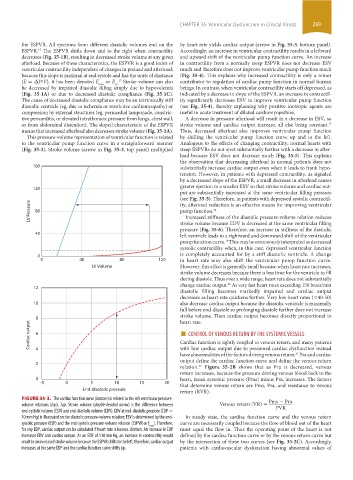
                    the ESPVR. All ejections from different diastolic volumes end on the   by heart rate yields cardiac output (arrow in Fig. 35-3, bottom panel).
                    ESPVR.  The ESPVR shifts down and to the right when contractility   Accordingly, an increase in ventricular contractility results in a leftward
                         17
                    decreases (Fig. 35-1B), resulting in decreased stroke volume at any given   and upward shift of the ventricular pump function curve. An increase
                    afterload. Because of these characteristics, the ESPVR is a good index of   in contractility from a normally steep ESPVR does not decrease ESV
                    ventricular contractility independent of changes in preload and afterload;   much and therefore does not improve ventricular pump function much
                    because this slope is maximal at end systole and has the units of elastance   (Fig. 35-4). This explains why increased contractility is only a minor
                    (E = ΔP/V), it has been denoted E  or E .  Stroke volume can also   contributor to regulation of cardiac pump function in normal human
                                                     17
                                                   es
                                              max
                    be decreased by impaired diastolic filling simply due to hypovolemia   beings. In contrast, when ventricular contractility starts off depressed, as
                    (Fig.  35-1A) or due to decreased diastolic compliance (Fig. 35-1C).   indicated by a decrease in slope of the ESPVR, an increase in contractil-
                    The cause of decreased diastolic compliance may be an intrinsically stiff   ity significantly decreases ESV to improve ventricular pump function
                    diastolic ventricle (eg, due to ischemia or restrictive cardiomyopathy) or   (see  Fig. 35-4), thereby explaining why positive inotropic agents are
                    compression by external structures (eg, pericardial tamponade, constric-  useful in acute treatment of dilated cardiomyopathies.
                    tive pericarditis, or elevated intrathoracic pressure from lungs, chest wall,   A decrease in pressure afterload will result in a decrease in ESV, so
                                                                                                                            17
                    or from abdominal distention). The sloped characteristic of the ESPVR   stroke volume and cardiac output increase, all else being constant.
                    means that increased afterload also decreases stroke volume (Fig. 35-1A).  Thus,  decreased  afterload  also  improves  ventricular  pump  function
                     This pressure-volume representation of ventricular function is related   by shifting the ventricular pump function curve up and to the left.
                    to the ventricular pump function curve in a straightforward manner   Analogous to the effects of changing contractility, normal hearts with
                    (Fig. 35-3). Stroke volume (arrow in Fig. 35-3, top panel) multiplied   steep ESPVRs do not eject substantially further with a decrease in after-
                                                                          load because ESV does not decrease much (Fig. 35-5). This explains
                                                                          the observation that decreasing afterload in normal patients does not
                       160                                                substantially increase cardiac output even when it leads to frank hypo-
                                                                          tension. However, in patients with depressed contractility, as signaled
                                                                          by a decreased slope of the ESPVR, a small decrease in afterload causes
                       120                                                greater ejection to a smaller ESV so that stroke volume and cardiac out-
                                                                          put are substantially increased at the same ventricular filling pressure
                                                                          (see Fig. 35-5). Therefore, in patients with depressed systolic contractil-
                      LV Pressure  80                                     pump function. 18
                                                                          ity, afterload reduction is an effective means for improving ventricular
                                                                           Increased stiffness of the diastolic pressure-volume relation reduces
                                                                          stroke volume because EDV is decreased at the same ventricular filling
                                                                          pressure (Fig. 35-6). Therefore, an increase in stiffness of the diastolic
                        40
                                                                          left ventricle leads to a rightward and downward shift of the ventricular
                                                                          pump function curve.  This may be erroneously interpreted as decreased
                                                                                         19
                                                                          systolic contractility when, in this case, depressed ventricular function
                         0                                                is completely accounted for by a stiff diastolic ventricle. A change
                          0            40            80           120     in heart rate may also shift the ventricular pump function curve.
                                            LV Volume                     However, this effect is generally small because when heart rate increases,
                                                                          stroke volume decreases because there is less time for the ventricle to fill
                                                                          during diastole. Thus over a wide range, heart rate does not substantially
                                                                          change cardiac output.  At very fast heart rates exceeding 150 beats/min
                                                                                          20
                        12
                                                                          diastolic filling becomes markedly impaired and cardiac output
                                                                          decreases as heart rate quickens further. Very low heart rates (<40-50)
                        10                                                also decrease cardiac output because the diastolic ventricle is maximally
                                                                          full before end-diastole so prolonging diastole further does not increase
                                                                          stroke volume. Then cardiac output becomes directly proportional to
                        8                                                 heart rate.
                      Cardiac output  6                                   Cardiac function is tightly coupled to venous return, and many patients
                                                                              ■
                                                                            CONTROL OF VENOUS RETURN BY THE SYSTEMIC VESSELS

                                                                          with low cardiac output due to presumed cardiac dysfunction instead
                        4
                                                                          have abnormalities of the factors driving venous return.  Pra and cardiac
                                                                                                                 21
                                                                          output define the cardiac function curve and define the venous return
                        2
                                                                          relation.   Figure 35-2B shows that as Pra is decreased, venous
                                                                                22
                                                                          return increases, because the pressure driving venous blood back to the
                        0                                                 heart, mean systemic pressure (Pms) minus Pra, increases. The factors
                          –5       0       5       10       15      20    that determine venous return are Pms, Pra, and resistance to venous
                                        End-diastolic pressure            return (RVR).
                    FIGURE 35-3.  The cardiac function curve (bottom) is related to the left ventricular pressure-   Pms − Pra
                    volume relations (top). Top. Stroke volume (double-headed arrow) is the difference between   Venous return (VR) =  PVR
                    end-systolic volume (ESV) and end-diastolic volume (EDV). EDV at end-diastolic pressure (EDP =
                    10 mm Hg) is illustrated on the diastolic pressure-volume relation; ESV is determined by the end-  In steady state, the cardiac function curve and the venous return
                    systolic pressure (ESP) and the end-systolic pressure-volume relation (ESPVR or E ). Therefore,   curve are necessarily coupled because the flow of blood out of the heart
                                                               max
                    for any EDP, cardiac output can be calculated if heart rate is known. Bottom. An increase in EDP   must equal the flow in. Thus the operating point of the heart is not
                    increases EDV and cardiac output. At an EDP of 510 mm Hg, an increase in contractility would   defined by the cardiac function curve or by the venous return curve but
                    result in an increased stroke volume because the ESPVR shifts to the left; therefore, cardiac output   by the intersection of these two curves (see Fig. 35-2C). Accordingly,
                    increases at the same EDP and the cardiac function curve shifts up.  patients with cardiovascular dysfunction having abnormal values of


            section03.indd   269                                                                                       1/23/2015   2:07:02 PM

