


Page 429 - Hall et al (2015) Principles of Critical Care-McGraw-Hill
P. 429
CHAPTER 37: Myocardial Ischemia  299


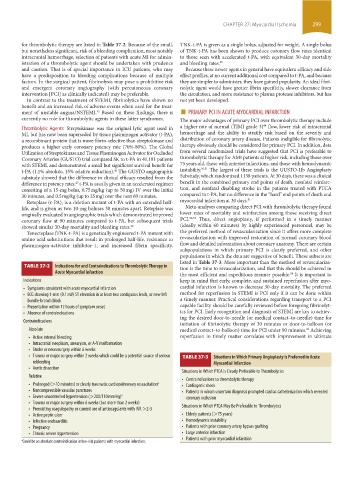
                    for thrombolytic therapy are listed in Table 37-2. Because of the small,   TNK-t-PA is given as a single bolus, adjusted for weight. A single bolus
                    but nonetheless significant, risk of a bleeding complication, most notably   of TNK-t-PA has been shown to produce coronary flow rates identical
                    intracranial hemorrhage, selection of patients with acute MI for admin-  to those seen with accelerated t-PA, with equivalent 30-day mortality
                    istration of a thrombolytic agent should be undertaken with prudence   and bleeding rates. 49
                    and caution. That is of special importance in ICU patients, who may   Because these newer agents in general have equivalent efficacy and side
                    have a  predisposition  to  bleeding complications because of  multiple     effect profiles, at no current additional cost compared to t-PA, and because
                    factors. In the surgical patient, fibrinolysis may pose a prohibitive risk   they are simpler to administer, they have gained popularity. An ideal fibri-
                    and emergent coronary angiography (with percutaneous coronary    nolytic agent would have greater fibrin specificity, slower clearance from
                    intervention [PCI] as clinically indicated) may be preferable.  the circulation, and more resistance to plasma protease inhibitors, but has
                     In contrast to the treatment of STEMI, fibrinolytics have shown no   not yet been developed.
                    benefit and an increased risk of adverse events when used for the treat-
                    ment of unstable angina/NSTEMI.  Based on these findings, there is     ■  PRIMARY PCI IN ACUTE MYOCARDIAL INFARCTION
                                             45
                    currently no role for thrombolytic agents in these latter syndromes.  The major advantages of primary PCI over thrombolytic therapy include
                                                                                                      44
                    Thrombolytic  Agents:  Streptokinase was the original lytic agent used in   a higher rate of normal (TIMI grade 3)  flow, lower risk of intracranial
                    MI, but has now been superseded by tissue plasminogen activator (t-PA),   hemorrhage and the ability to stratify risk based on the severity and
                    a recombinant protein that is more fibrin-selective than streptokinase and   distribution of coronary artery disease. Patients ineligible for fibrinolytic
                    produces a higher early coronary patency rate (70%-80%). The Global   therapy obviously should be considered for primary PCI. In addition, data
                    Utilization of Streptokinase and Tissue Plasminogen Activator for Occluded   from several randomized trials have suggested that PCI is preferable to
                    Coronary Arteries (GUSTO) trial compared SK to t-PA in 41,101 patients   thrombolytic therapy for AMI patients at higher risk, including those over
                    with STEMI, and demonstrated a small but significant survival benefit for   75 years old, those with anterior infarctions, and those with hemodynamic
                    t-PA (1.1% absolute, 15% relative reduction).  The GUSTO angiographic   instability. 50,51  The largest of these trials is the GUSTO-IIb Angioplasty
                                                   46
                    substudy showed that the difference in clinical efficacy resulted from the   Substudy, which randomized 1138 patients. At 30 days, there was a clinical
                    difference in patency rates.  t-PA is usually given in an accelerated regimen   benefit in the combined primary end points of death, nonfatal reinfarc-
                                      47
                    consisting of a 15-mg bolus, 0.75 mg/kg (up to 50 mg) IV over the initial    tion, and nonfatal disabling stroke in the patients treated with PTCA
                    30 minutes, and 0.5 mg/kg (up to 35 mg) over the next 60 minutes.  compared to t-PA, but no difference in the “hard” end points of death and
                     Reteplase (r-PA), is a deletion mutant of t-PA with an extended half-  myocardial infarction at 30 days. 51
                    life, and is given as two 10-mg boluses 30 minutes apart. Reteplase was   Meta-analyses comparing direct PCI with thrombolytic therapy found
                    originally evaluated in angiographic trials which demonstrated improved   lower rates of mortality and reinfarction among those receiving direct
                    coronary flow at 90 minutes compared to t-PA, but subsequent trials   PCI. 52,53  Thus, direct angioplasty, if performed in a timely manner
                    showed similar 30-day mortality and bleeding rates. 48  ( ideally within 60 minutes) by highly experienced personnel, may be
                     Tenecteplase (TNK-t-PA) is a genetically engineered t-PA mutant with   the preferred method of revascularization since it offers more complete
                    amino acid substitutions that result in prolonged half-life, resistance to   revascularization with improved restoration of normal coronary blood
                      plasminogen-activator inhibitor-1, and increased fibrin   specificity.   flow and detailed information about coronary anatomy. There are  certain
                                                                          subpopulations in which primary PCI is clearly preferred, and other
                                                                          populations in which the data are suggestive of benefit. These subsets are
                                                                          listed in Table 37-3. More important than the method of revasculariza-
                      TABLE 37-2     Indications for and Contraindications to Thrombolytic Therapy in   tion is the time to revascularization, and that this should be achieved in
                               Acute Myocardial Infarction
                                                                          the most efficient and expeditious manner possible.  It is important to
                                                                                                               54
                    Indications                                           keep in mind that early, complete, and sustained reperfusion after myo-
                    •  Symptoms consistent with acute myocardial infarction  cardial infarction is known to decrease 30-day mortality. The preferred
                    •  ECG showing 1-mm (0.1 mV) ST elevation in at least two contiguous leads, or new left    method for reperfusion in STEMI is PCI only if it can be done within
                      bundle-branch block                                 a timely manner. Practical considerations regarding transport to a PCI
                    •  Presentation within 12 hours of symptom onset      capable facility should be carefully reviewed before foregoing fibrinolyt-
                    •  Absence of contraindications                       ics for PCI. Early recognition and diagnosis of STEMI are key to achiev-
                                                                          ing the desired door-to-needle (or medical contact–to-needle) time for
                    Contraindications
                                                                          initiation  of fibrinolytic therapy of 30 minutes or door-to-balloon (or
                      Absolute                                            medical contact–to-balloon) time for PCI under 90 minutes.  Achieving
                                                                                                                     41
                      •  Active internal bleeding                         reperfusion in timely matter correlates with improvement in ultimate
                      •  Intracranial neoplasm, aneurysm, or A-V malformation
                      •  Stroke or neurosurgery within 6 weeks
                      •  Trauma or major surgery within 2 weeks which could be a potential source of serious     TABLE 37-3     Situations in Which Primary Angioplasty Is Preferred in Acute
                       rebleeding                                                    Myocardial Infarction
                      •  Aortic dissection
                                                                          Situations in Which PTCA Is Clearly Preferable to Thrombolytics
                      Relative                                            •  Contraindications to thrombolytic therapy
                      •  Prolonged (>10 minutes) or clearly traumatic cardiopulmonary resuscitation a  •  Cardiogenic shock
                      •  Noncompressible vascular punctures               •  Patients in whom uncertain diagnosis prompted cardiac catheterization which revealed
                      •  Severe uncontrolled hypertension (>200/110 mm Hg) a  coronary occlusion
                      •  Trauma or major surgery within 6 weeks (but more than 2 weeks)  Situations in Which PTCA May Be Preferable to Thrombolytics
                      •  Preexisting coagulopathy or current use of anticoagulants with INR >2-3
                      •  Active peptic ulcer                              •  Elderly patients (>75 years)
                      •  Infective endocarditis                           •  Hemodynamic instability
                      •  Pregnancy                                        •  Patients with prior coronary artery bypass grafting
                      •  Chronic severe hypertension                      •  Large anterior infarction
                                                                          •  Patients with prior myocardial infarction
                    a Could be an absolute contraindication in low-risk patients with myocardial infarction.


            section03.indd   299                                                                                       1/23/2015   2:07:19 PM

