


Page 426 - Hall et al (2015) Principles of Critical Care-McGraw-Hill
P. 426
296     PART 3: Cardiovascular Disorders


                 event, and so critical therapeutic interventions should not be delayed   muscle rupture and acute mitral regurgitation, acute ventricular septal
                 pending assay results. Once elevated, troponin levels can remain high   defect, and free wall rupture and tamponade.  In some cases, echo-
                                                                                                         14
                 for days to weeks, limiting their utility to detect late reinfarction.  cardiography may reveal findings compatible with right ventricular
                   One challenge with use of troponins in the intensive care unit is that   infarction. Echocardiography can also reveal alternative diagnoses,
                 their elevation may not be confined to acute coronary syndromes. A   such as valvular abnormalities, pericardial tamponade, or hypertrophic
                 number of other conditions prevalent in the critical care setting, includ-  cardiomyopathy. Acute right heart failure, manifested by a dilated and
                 ing sepsis, burns, pulmonary embolism, myocarditis, and renal failure,   hypokinetic right ventricle without hypertrophy suggestive of chronic
                 have been associated with increases in troponin, albeit at levels lower   pulmonary hypertension, can suggest pulmonary embolism. 15
                 than those usually seen with large myocardial infarctions.  Detectable   Transthoracic echocardiographic images may be suboptimal due to
                                                            9
                 troponin levels in critically ill patients, although they usually emanate   a poor acoustic window in critically ill patients, particularly those who
                 from myocardial cells, may not always represent either irreversible   are obese, have chronic lung disease, or are on positive pressure ventila-
                 cell death or myocardial ischemia. Endotoxin, cytokines, and other   tion. Contrast echocardiography may be used to improve image quality.
                                                                                                                          16
                 inflammatory mediators, along with catecholamines and conditions   Transesophageal echocardiography (TEE) can also provide better visual-
                 such as hypotension, inotropes or hypoxia may cause the breakdown   ization, particularly of valvular structures, and can be performed safely
                 of cytoplasmic troponin into smaller fragments that can pass through   at the bedside.
                 endothelial monolayers and subsequently be detected by sensitive assays     ■
                 for troponin.  In any event, isolated troponin elevation in the absence of   HEMODYNAMIC MONITORING
                          10
                 ECG changes or other clinical signs of ischemia should be evaluated in   In patients with hemodynamic instability that does not improve relatively
                 the clinical context. In some settings, echocardiography to evaluate for   quickly with simple therapeutic maneuvers, invasive hemodynamic
                 new wall motion abnormalities may be useful.          monitoring should be considered. Pulmonary artery catheterization
                     ■  ECHOCARDIOGRAPHY                               (PAC) provides simultaneous assessment of filling pressures and cardiac
                                                                       output, and can be quite useful for differential diagnosis in critically ill
                 To the physician confronted with a critically ill patient, echocar-  patients. In patients with hypoxemia and pulmonary infiltrates on chest
                 diography can be a key element in successful differential diagnosis.    x-ray, a frequent dilemma in ICU patients, PAC may be used to differen-
                                                                    11
                 Echocardiography is simple, safe, and  permits systemic interrogation   tiate cardiac from pulmonary causes. Right heart catheterization is also
                 of cardiac chamber size, left and right ventricular function, valvular   quite useful in the differential diagnosis of shock. Hemodynamic profiles
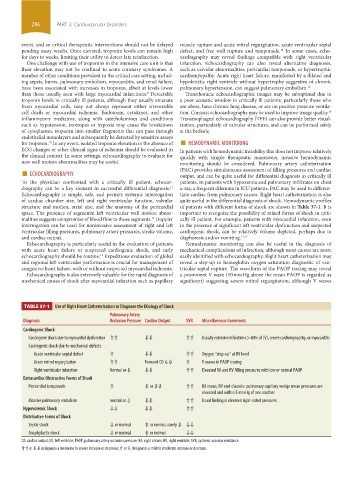
                 structure and motion, atrial size, and the anatomy of the pericardial   of patients with different forms of shock are shown in Table 37-1. It is
                 space. The presence of segmental left ventricular wall motion abnor-  important to recognize the possibility of mixed forms of shock in criti-
                 malities suggests compromise of blood flow to those segments.  Doppler   cally ill patient. For example, patients with myocardial infarction, even
                                                             12
                 interrogation can be used for noninvasive assessment of right and left   in the presence of significant left ventricular dysfunction and suspected
                 ventricular filling pressures, pulmonary artery pressures, stroke volume,   cardiogenic shock, can be relatively volume depleted, perhaps due to
                 and cardiac output.                                   diaphoresis and/or vomiting. 13,17
                   Echocardiography is particularly useful in the evaluation of patients   Hemodynamic  monitoring  can  also  be  useful  in  the  diagnosis  of
                 with  acute  heart  failure  or  suspected  cardiogenic  shock,  and  early   mechanical complications of infarction, although most causes are more
                 echocardiography should be routine.  Expeditious evaluation of global   easily identified with echocardiography. Right heart catheterization may
                                            13
                 and regional left ventricular performance is crucial for management of   reveal a step-up in hemoglobin oxygen saturation diagnostic of ven-
                 congestive heart failure, with or without suspected myocardial ischemia.  tricular septal rupture. The waveform of the PAOP tracing may reveal
                   Echocardiography is also extremely valuable for the rapid diagnosis of   a prominent V wave (10 mm Hg above the mean PAOP is regarded as
                 mechanical causes of shock after myocardial infarction such as  papillary   significant) suggesting severe mitral regurgitation, although V waves


                   TABLE 37-1    Use of Right Heart Catheterization to Diagnose the Etiology of Shock
                                               Pulmonary Artery
                  Diagnosis                    Occlusion Pressure Cardiac Output  SVR  Miscellaneous Comments
                  Cardiogenic Shock
                    Cardiogenic shock due to myocardial dysfunction  ⇑⇑  ⇓⇓  ⇑⇑  Usually extensive infarction (>40% of LV), severe cardiomyopathy, or myocarditis
                    Cardiogenic shock due to mechanical defects
                      Acute ventricular septal defect  ⇑   ⇓⇓            ⇑⇑    Oxygen “step-up” at RV level
                      Acute mitral regurgitation  ⇑⇑       Forward CO ⇓⇓  ⇑    V waves in PAOP tracing
                      Right ventricular infarction  Normal or ⇓  ⇓⇓      ⇑⇑    Elevated RA and RV filling pressures with low or normal PAOP
                  Extracardiac Obstructive Forms of Shock
                    Pericardial tamponade      ⇑           ⇓ or ⇓⇓       ⇑⇑    RA mean, RV end-diastolic pulmonary capillary wedge mean pressures are
                                                                               elevated and within 5 mm Hg of one another
                    Massive pulmonary embolism  normal or ⇓  ⇓⇓          ⇑⇑    Usual finding is elevated right-sided pressures
                  Hypovolemic Shock            ⇓⇓          ⇓⇓            ⇑⇑
                  Distributive Forms of Shock
                    Septic shock               ⇓ or normal  ⇑ or normal, rarely ⇓ ⇓⇓
                    Anaphylactic shock         ⇓ or normal  ⇑ or normal  ⇓⇓
                 CO, cardiac output; LV, left ventricle; PAOP, pulmonary artery occlusion pressure; RA, right atrium; RV, right ventricle; SVR, systemic vascular resistance.
                 ⇑⇑ or ⇓⇓ designates a moderate to severe increase or decrease; ⇑ or ⇓ designates a mild to moderate increase or decrease.


            section03.indd   296                                                                                       1/23/2015   2:07:19 PM

